Ever since I took out the leylandii hedge along the edge of the garden – at least twenty years ago – we have had problems with honey fungus. So called because of its honey coloured toadstools, which we have rarely seen, it has taken a steady toll of mainly woody plants, the latest of which was a Camellia, and one I was particularly sorry to lose.
Camellia ‘Ariel’s Song’ is a hybrid between C. fraterna and C. tsaii, neither of which is especially cold hardy, so my initial thought when the plant started to flag mid-winter was that it had been hit by the cold week before Christmas. Even then I was hoping that it was cold and fearing something worse, it might well have recovered from cold damage.
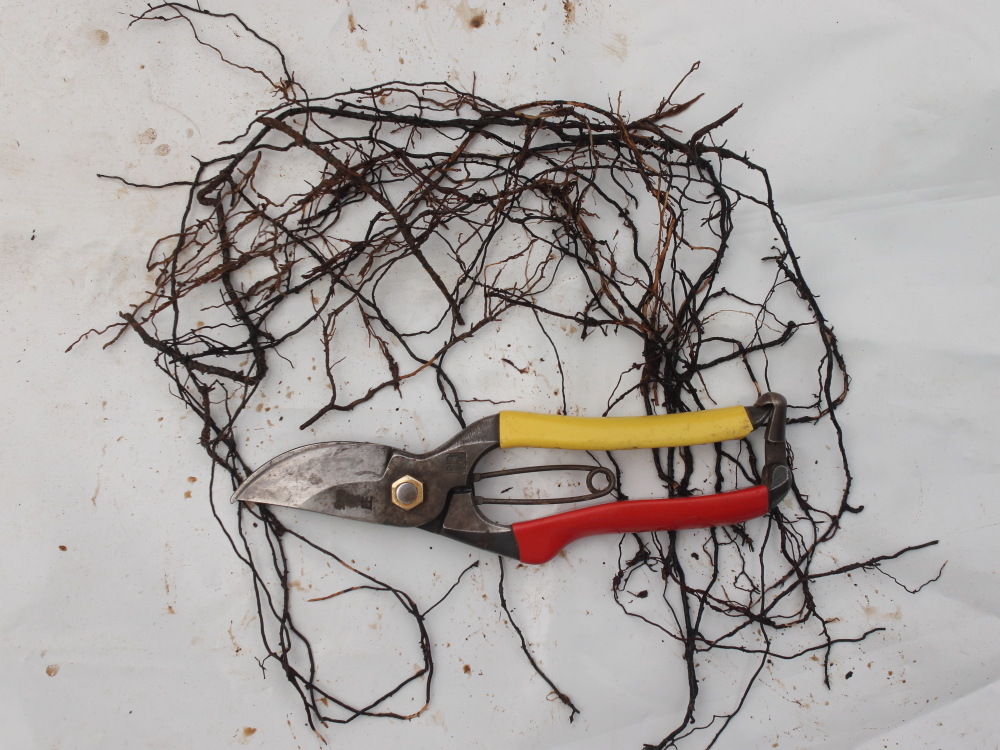
Today I dug it up and the presence of numerous black rhizomorphs threading through the brown root system left no doubt as to the culprit; honey fungus.
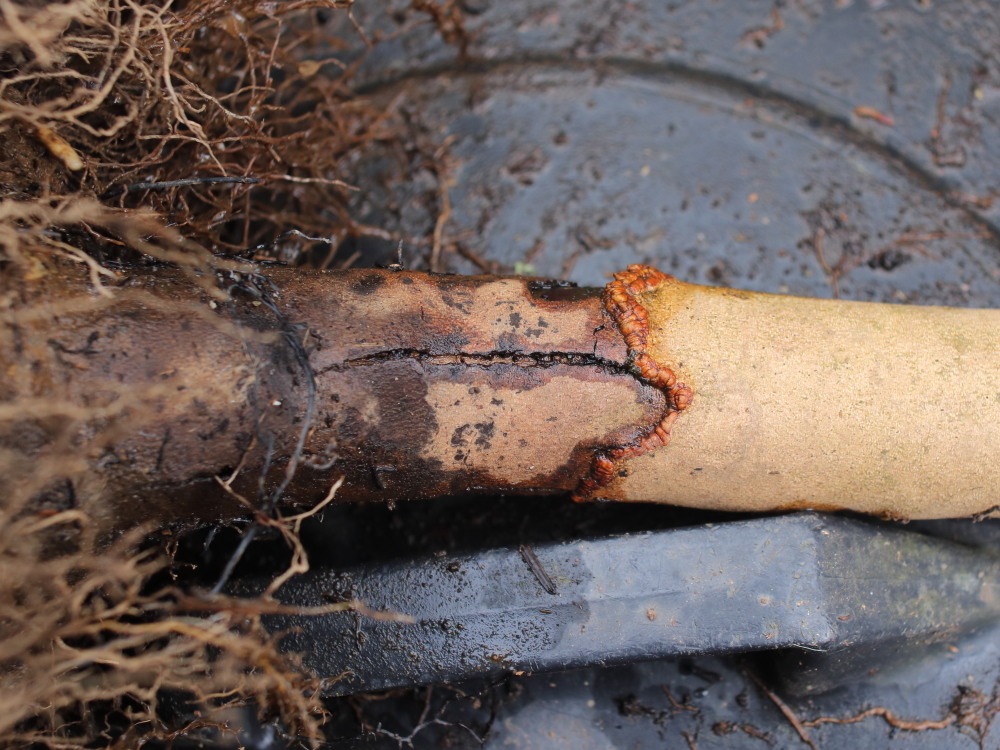
What I expected to find was for the stem to be dead near ground level with fans of white fungal mycelium under the bark. What I actually found suggested that the honey fungus had done its damage quite a long time ago and moved on. The bark was dead for the bottom three inches of the stem but when I peeled it away, there was no mycelium beneath. Along the bottom edge of live bark the camellia had been producing callus in a vain effort to heal the damage. You have to hand it to Camellias, they are remarkably tough. I have seen one survive complete ring barking with a strimmer, callusing over the inch or more gap in its bark from both sides over a period of three seasons.
No such survival for this one sadly, Ariel will sing no more. I have others I could replace it with but that would be folly. A nearby Skimmia looks like it might be the next victim. I find rhizomorphs wherever I dig in the garden, honey fungus is part of my garden’s “wood wide web”, breaking down dead woody remains in the soil but making sure it doesn’t run out by attacking and killing seemingly random live plants as well.
The standard narrative would be that healthy plants are able to resist the fungal attack and that it only parasitizes plants that are not in good health. The classic predator paradigm, weeding out the weak and ensuring the survival of the fittest. If that is the case, climate change with its sharp increase in more extreme weather, makes it very hard to keep woody plants in good shape over long periods, with prolonged wet, drought and strong winds all putting great strain on plant root systems. I have a Japanese maple which I suspect is fighting for its life and I have for the last couple of seasons tried to make sure it is never stressed by drought, throwing any and all spare dirty water its way and even giving it some from my stored supply in last summer’s heatwave. I fancy it has arrested its decline and perhaps even allowed a measure of recovery.

 garden ruminations
It might not have been the honey fungus.
If you are finding bootlaces everywhere it’s likely armillaria gallica which is not a particularly aggressive variety – mostly a sapotroph and only a weak pathogen of living plants. I have it in my garden and it hasn’t killed my shrubs yet, although I don’t trust it! And yes it will attack already weakened plants so I’m told. My biggest problem with it is it’s amazing ability to find and infest any compost or mulch in the garden, taking away all the nutrients, as well as making my compost unsuitable for use in parts of the garden that do not (yet!) have the fungus present. As a result I’m always struggling to mulch my borders, resulting in, you guessed it, weaker plants!
Anyway, just because you found rhizomorphs amongst the roots of your camellia doesn’t mean they were the culprit – I hate to say it but you will find the fungus amongst the roots of every plant – those are it’s favourite spots as they tend to be well fed and watered, perhaps amended with nutrients. Also it eats dead roots, even microscopic fragments present in the soil – there are plenty of these underneath healthy plants and this is totally normal – this is the same reason you will always find earthworms underneath plants – they actually eat the microorganisms that are responsible for breaking down organic matter, in this case dead/surplus root material.
The definitive test of honey fungus attack is not the presence of the rhizomorphs in the soil but the telltale white mycelium underneath the bark and/or roots. You can also look carefully for rhizomorphs that are actually growing into (firmly attached to) the roots.
I note that camellias are generally considered resistant to honey fungus attack but other problems could include crown rot – caused by stems being too damp at the bottom, or canker girdling the stem – this could be caused by camellia blight. I don’t doubt that the honey fungus would be waiting and ready to finish the job however.
In contrast to armillaria gallica, there are other types of honey fungus which are hugely aggressive but these don’t produce many rhizomorphs – a garden I work in has dead shrubs left right and centre and I have occasionally found the mycelium underneath the bark of dying shrubs but have never seen a single bootlace anywhere!
I hope that’s helpful. Sorry it’s 3 years too late but I wanted to address what I feel is a misconception, otherwise we have people needlessly pouring Jeyes Fluid all over their garden which is hugely detrimental to beneficial microorganisms and soil health! Personally I think the most reliable method to combat honey fungus is probably by suitable (re)planting decisions, but if one desperately wants to fight honey fungus to protect important or irreplaceable plants surely it would be much better to use trichoderma or bacillus subtilis. Note that even these have the ability to drastically change the ecosystem however, especially trichoderma which strongly represses all types of fungi both good and bad.
LikeLike
Well, that was a surprise. I’ve never had as long and detailed a response to a post before, on any subject and I appreciate it. It’s also very much a surprise that anyone would, even tangentially, come to the defence of any form of Armillaria. Our house was built some 45 years ago on farmland and our plot was a field corner bounded by a Cornish hedge, ie a soil bank faced with dry stone wall and planted with a mix of native hardwoods. When we arrived the only remaining section which had that planting was about a 10m stretch with oak, ash, sycamore, hawthorn, blackthorn, hazel and brambles; none in good condition but possibly indicative of considerable age to have so many species. In front of it, for reasons unfathomable, the previous occupants had planted a Leylandii hedge. It is long gone, along with all the original planting of the bank, though hazel still tries to make a comeback. I have lost plants in all corners of the garden but the greatest toll has been along the line of the Leylandii hedge. Overall I have lost several camellias, a large Skimmia, a Schefflera, Berberis thunbergii, Victoria Plum, Acer hersii and even a couple of Dahlias. I put losses behind me and move on, there are probably other long forgotten things. I have seen white mycelium on some of them, including the Dahlias, but by no means all. A number of trees have been felled over the years and the roots left to decay, it being impractical to remove them or to get a grinder in. A couple of these have produced large numbers of typical honey fungus toadstools from around the stumps.
It being Cornwall, we have wet conditions occasionally, but the garden drains well and waterlogging is not an issue. Drought, especially in early spring when everything comes into leaf needing and expecting plenty of moisture to be available, has likely been a factor occasionally, damaging roots that are then more vulnerable to attack.
Some instances then when I am pretty certain that honey fungus was involved, if not the sole or even the main culprit. Most when to be honest, I haven’t had a lot to go on. I did try Trichoderma once, to try and save the Skimmia that was just beginning to go off colour, but it didn’t work and the plant died anyway. I’ve never used Jeyes fluid or Armillatox. I’ve long been an RHS member so could send samples off to be diagnosed but suspect that I would be told that this and that was present but there was no way of knowing if it was the primary pathogen. They do occasionally make reference to the prevalence of problems they get asked about and honey fungus has always been high on the list.
What I do know is that I have a pretty aggressive pathogen of some sort at large and such limited evidence as I have points toward honey fungus. In terms of dealing with it I would be no further forward for knowing precisely what it is, as far as I know none of the likely culprits is effectively treatable, so I try to be philosophical, tell myself it keeps a turnover of woody plants going, refreshes the garden, creates planting opportunities. Incidentally, you refer to canker girdling the stems of camellias, perhaps caused by camellia blight. That is not something I’ve come across and I’m wondering what it might be.
LikeLike
Bot rot is what killed the Leylands here.
LikeLike
Sorry to hear you have that, nothing stops the advance of this. I knew whole areas of Kenilworth that had it with slowly dying shrubs and trees all down one road. My friend’s gardener found the culprit was indeed honey fungus.
LikeLike
Hi Jim,
I sympathise, I have honey fungus caused by cutting down an old cockspur thorn tree some years ago, or it may have been there before. Most years I get a large group of honey fungi in my lawn which I have to dispose of followed by scraping back the area administering a dose of nearly neat Jeyes Fluid. It stops any more fungi that year and the lawn survives. Question – I noticed that when tree felling on Dartmoor they often treat the stump with a staining chemical. Is this to rot the stump or to stop infection ? A garden professional treated my Oolin’s Golden Gage with strong stump killer when he cut mine down, I guess for the same reason ? Like vine weevil I guess it’s something we have to live with when plantings are close to each other.
Thought you would like to see a magnolia seedling of mine grown from seed from the RHS group seed list before the protocol regs came in. It’s a Yellow Lantern seedling and has taken about 12 years to get to this size (about 13′), first flowering about 5 years ago. Normally up here the frost gets it because it flowers early but this year it has missed it or it is flowering later.
Kind regards,
Mike Timberlake
LikeLiked by 1 person
I don’t know what they would have been treating stumps with on Dartmoor but my efforts to find out led me to Mycosolutions and a product called Avengelus, based on Trichoderma atrobrunneum, which they claim parasitises the parasite, it is a fungus that attacks Armillaria, another fungus. Sorbus International are doing it, and I have bought from them in the past, so I must check out what they are offering and how much it costs. Who the hell came up with “Avengelus”?
I did want to see your Magnolia, where should I be looking?
LikeLike
Gads! Perhaps ‘liking’ was inappropriate.
LikeLiked by 1 person
That is wicked!
LikeLiked by 1 person