Ever since I took out the leylandii hedge along the edge of the garden – at least twenty years ago – we have had problems with honey fungus. So called because of its honey coloured toadstools, which we have rarely seen, it has taken a steady toll of mainly woody plants, the latest of which was a Camellia, and one I was particularly sorry to lose.
Camellia ‘Ariel’s Song’ is a hybrid between C. fraterna and C. tsaii, neither of which is especially cold hardy, so my initial thought when the plant started to flag mid-winter was that it had been hit by the cold week before Christmas. Even then I was hoping that it was cold and fearing something worse, it might well have recovered from cold damage.
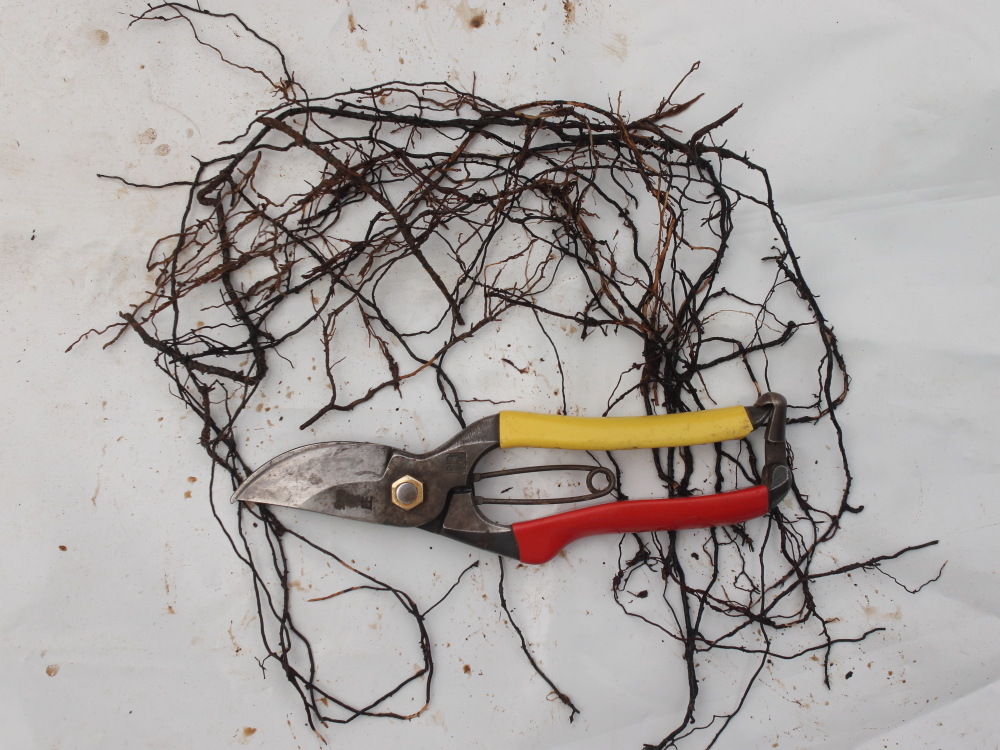
Today I dug it up and the presence of numerous black rhizomorphs threading through the brown root system left no doubt as to the culprit; honey fungus.
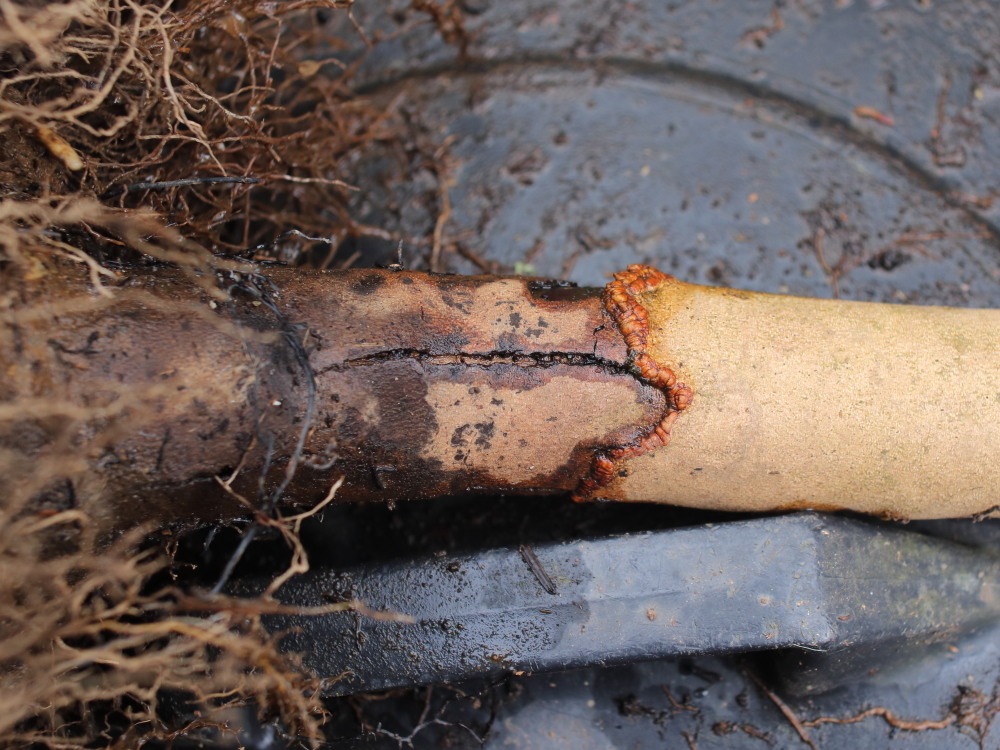
What I expected to find was for the stem to be dead near ground level with fans of white fungal mycelium under the bark. What I actually found suggested that the honey fungus had done its damage quite a long time ago and moved on. The bark was dead for the bottom three inches of the stem but when I peeled it away, there was no mycelium beneath. Along the bottom edge of live bark the camellia had been producing callus in a vain effort to heal the damage. You have to hand it to Camellias, they are remarkably tough. I have seen one survive complete ring barking with a strimmer, callusing over the inch or more gap in its bark from both sides over a period of three seasons.
No such survival for this one sadly, Ariel will sing no more. I have others I could replace it with but that would be folly. A nearby Skimmia looks like it might be the next victim. I find rhizomorphs wherever I dig in the garden, honey fungus is part of my garden’s “wood wide web”, breaking down dead woody remains in the soil but making sure it doesn’t run out by attacking and killing seemingly random live plants as well.
The standard narrative would be that healthy plants are able to resist the fungal attack and that it only parasitizes plants that are not in good health. The classic predator paradigm, weeding out the weak and ensuring the survival of the fittest. If that is the case, climate change with its sharp increase in more extreme weather, makes it very hard to keep woody plants in good shape over long periods, with prolonged wet, drought and strong winds all putting great strain on plant root systems. I have a Japanese maple which I suspect is fighting for its life and I have for the last couple of seasons tried to make sure it is never stressed by drought, throwing any and all spare dirty water its way and even giving it some from my stored supply in last summer’s heatwave. I fancy it has arrested its decline and perhaps even allowed a measure of recovery.

 garden ruminations
Bot rot is what killed the Leylands here.
LikeLike
Sorry to hear you have that, nothing stops the advance of this. I knew whole areas of Kenilworth that had it with slowly dying shrubs and trees all down one road. My friend’s gardener found the culprit was indeed honey fungus.
LikeLike
Hi Jim,
I sympathise, I have honey fungus caused by cutting down an old cockspur thorn tree some years ago, or it may have been there before. Most years I get a large group of honey fungi in my lawn which I have to dispose of followed by scraping back the area administering a dose of nearly neat Jeyes Fluid. It stops any more fungi that year and the lawn survives. Question – I noticed that when tree felling on Dartmoor they often treat the stump with a staining chemical. Is this to rot the stump or to stop infection ? A garden professional treated my Oolin’s Golden Gage with strong stump killer when he cut mine down, I guess for the same reason ? Like vine weevil I guess it’s something we have to live with when plantings are close to each other.
Thought you would like to see a magnolia seedling of mine grown from seed from the RHS group seed list before the protocol regs came in. It’s a Yellow Lantern seedling and has taken about 12 years to get to this size (about 13′), first flowering about 5 years ago. Normally up here the frost gets it because it flowers early but this year it has missed it or it is flowering later.
Kind regards,
Mike Timberlake
LikeLiked by 1 person
I don’t know what they would have been treating stumps with on Dartmoor but my efforts to find out led me to Mycosolutions and a product called Avengelus, based on Trichoderma atrobrunneum, which they claim parasitises the parasite, it is a fungus that attacks Armillaria, another fungus. Sorbus International are doing it, and I have bought from them in the past, so I must check out what they are offering and how much it costs. Who the hell came up with “Avengelus”?
I did want to see your Magnolia, where should I be looking?
LikeLike
Gads! Perhaps ‘liking’ was inappropriate.
LikeLiked by 1 person
That is wicked!
LikeLiked by 1 person