I just spent a lovely day visiting a couple of gardens down in west Cornwall. The National Garden Scheme people were putting on a do at one garden and we visited another while in the area. I just looked up the route on Google maps, 53 miles, going from well inside the east end of Cornwall to well inside the west end, and the last several miles on the sort of roads that freak out so many visitors to the county, twisty single track lanes with passing places. Caervallack and Trenarth the two gardens, should you be in the Constantine area when they’re open.
The NGS had a plant swap, you take along a plant and come away with something someone else brought along. I took along a couple of plants and came away with five, picking up three of the leftovers that no-one seemed to want. Just what I needed, more plants; I can’t help myself.
The weather being atrocious, I turned my attention to dealing with mealy bug which had got a bit of a hold on some of Sue’s cacti. It can be number one of this, my six on Saturday, the meme where gardeners strut their stuff and sometimes air their dirty washing by talking about six things happening in their garden each week. There’s a participants guide, but you hardly need it, just post a picture and a few words about six things plus a link in my comments below so we can all find it.
One.
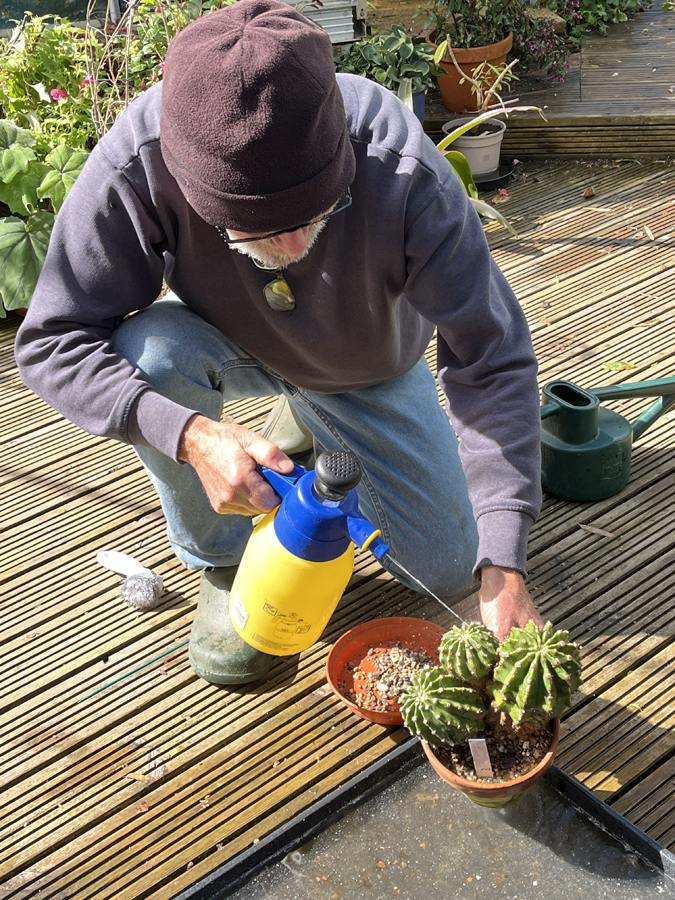
Mealy bug is a persistent pest and has taken a liking to some of Sue’s cacti as well as some other plants we grow. I sprayed it with a mix of SB Invigorator and Monterey garden insect spray and after a day or two could see no sign of life. What I could see though was lots of eggs and somewhat predictably, they survived the spray and after another couple of days there were tiny crawlers moving about, the juvenile and pretty mobile hatchlings of the bugs. Plus the dead adults and all their waxy crud were still on the plants. Time for plan B. I filled my sprayer with water and pumped it up, then washed all the bugs, crud and eggs included, into a plant tray and disposed of it all. I will follow up with a spray in a week or two to get any hatchlings from eggs that remained, repeat a couple of weeks after that. In the second picture you can see lots of cream coloured eggs and at the top, a few adults. The crawlers are the same size as the eggs, perhaps 0.5mm long.

Two.
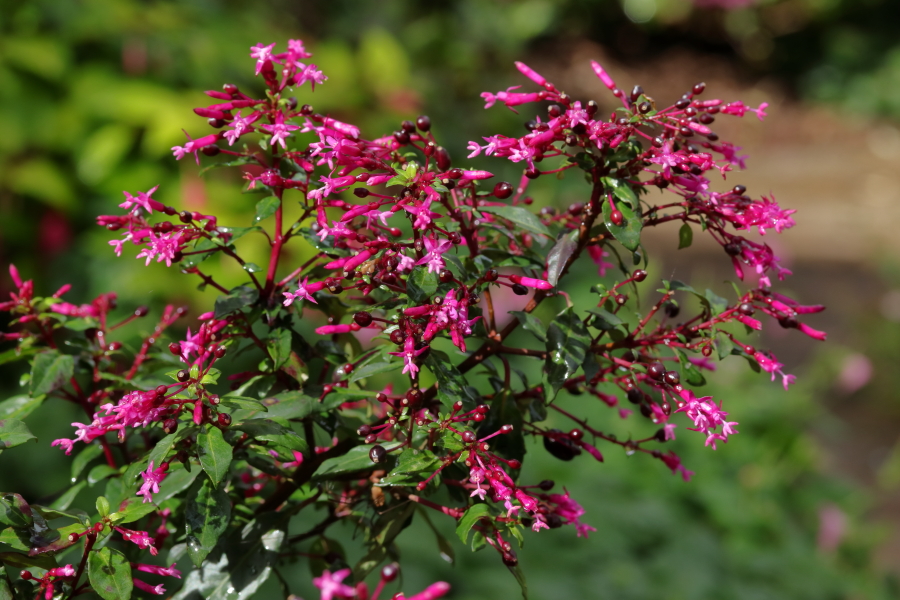
I grew this Fuchsia from seed I took from a National Trust garden a year or two back. One day I must get in touch with them and offer them a plant of it, or perhaps I should grow one and take it down there without warning them up front. I’d probably not get it past the people on the door. Anyhow, it’s utterly different from what I remember of the parent plant and really rather good. The flowers are tiny, half the size of a typical encliandra fuchsia, but there are lots of them and they’re followed by very glossy black berries.
Three.
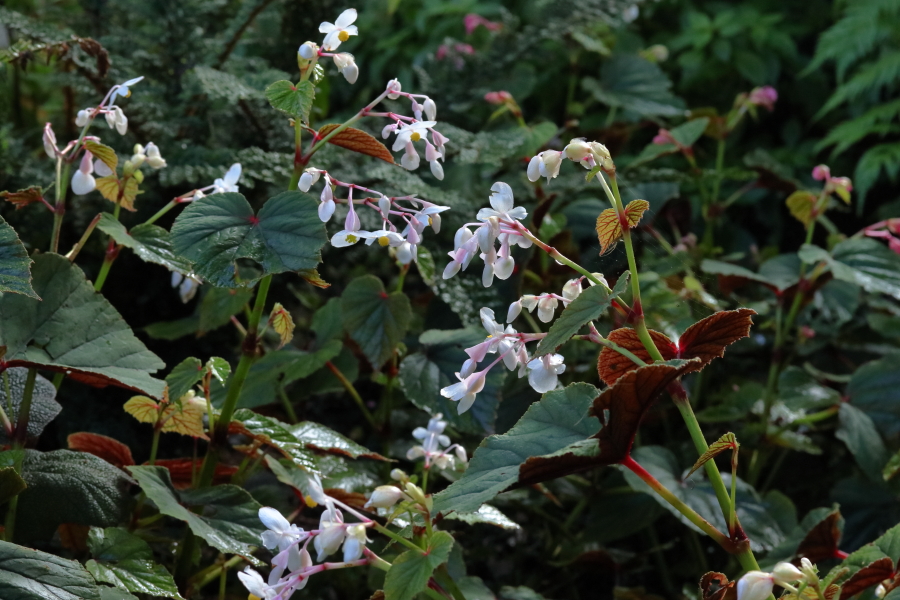
When it comes to keeping something going in the garden as far into autumn as possible, Begonias and cyclamen are great where there is quite a lot of shade. This is Begonia grandis subsp. evansiana var. alba, fully hardy and reliably perennial for me, growing in ‘woodsy’ conditions where it gets covered by fallen leaves in winter.
Four.
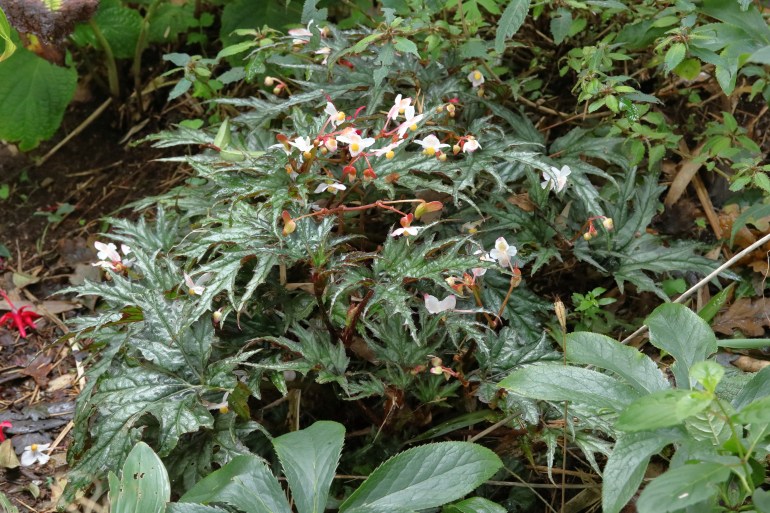
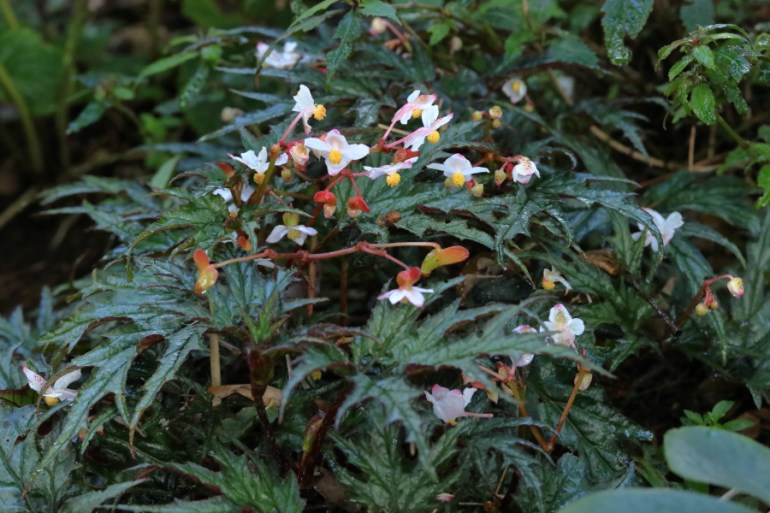
Another hardy Begonia, this is the one that for me, kicked off the realisation that there are hardy Begonias beyond Begonia grandis. This is an unidentified species so goes under the catchy name of Begonia U614, as allocated by the American Begonia Society. Its origins are a little murky, so I’ll not dwell on them. It survives in the ground for me, even without protection, but comes up very late, giving itself too short a growing season to get much bigger year on year. Overwintered under glass it gets an earlier start, flowers earlier and for longer and increases in size quite nicely. It sets seed, I have grown a few, they’re variable and potentially could produce something really interesting.
Five.
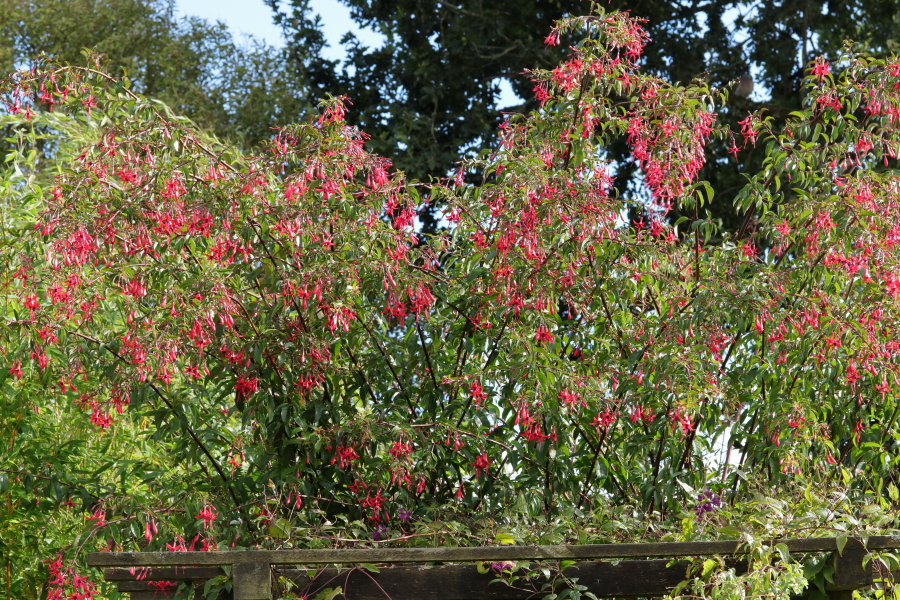
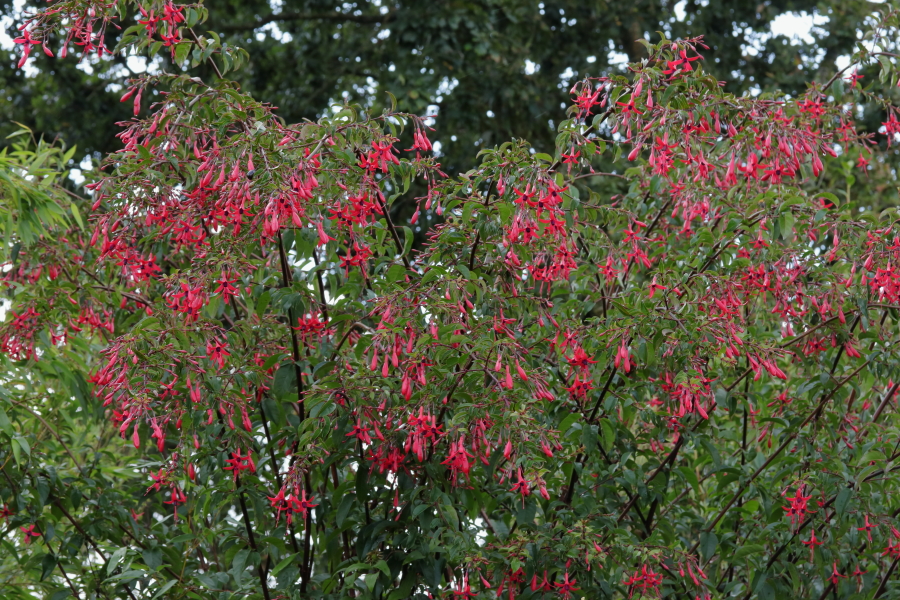
Fuchsia regia serrae is growing on a wooden arch and gets cut back to the top of the arch each year in late winter. It then produces shoots 4-5 feet long which start flowering in August.
Six.
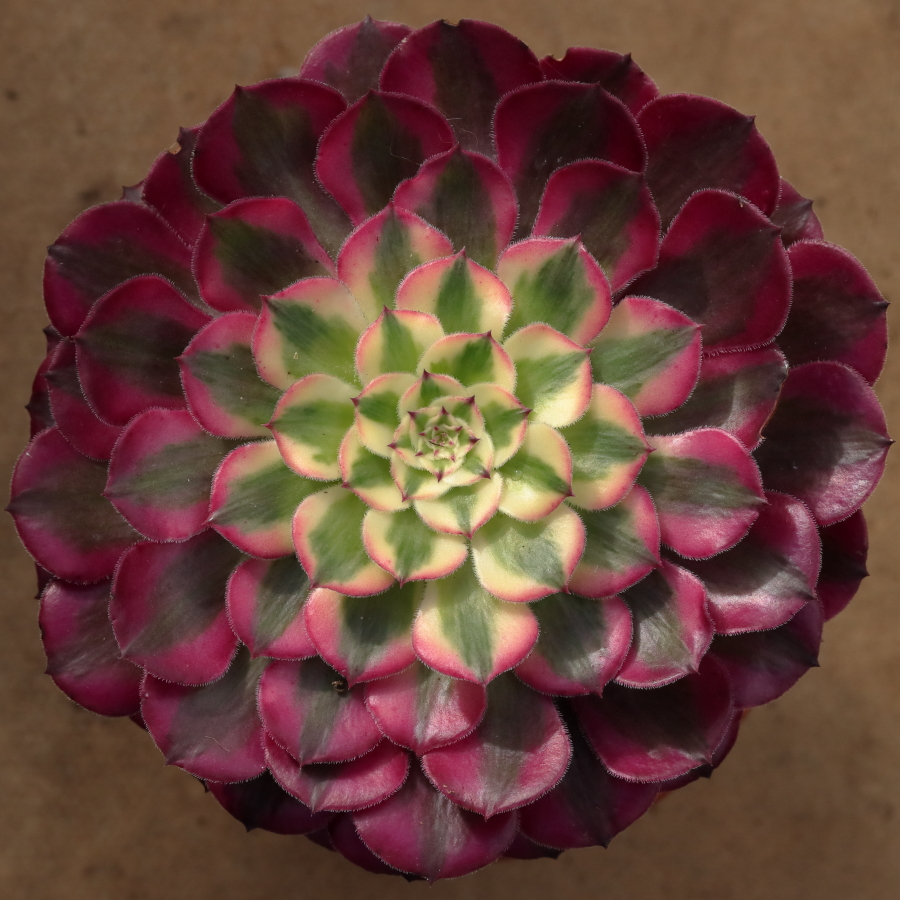
Having spent a couple of days this week in Sue’s greenhouse, trying hard not to trip over any of her precious plants, it seems appropriate to include one in this six. Aeonium ‘Red Garnet’.
And just like that, another week has gone. Soon be Christmas. Have a good week.

 garden ruminations
It’s good to know I am not the only one to have a problem with mealy bugs – I am not sure I have seen them mentioned on blogs in our community before. I do have SB Invigorator but tend to forget about it as an insecticide – why do you use it in combination with the Monterey spray, which I have not come across before? Your Fuchsia regia serrae is astonishing, and your aeonium looks wonderful compared to the very small specimen I have! Thanks for hosting, Jim. https://ramblinginthegarden.wordpress.com/2025/09/13/six-on-saturday-autumn-is-a-coming-in/
LikeLike
I mixed the two insecticides because I’ve only ever found SB partially effective and the Monterey is a few years old so I thought it might have lost a lot of its efficacy. It may be that one or other or even both would have worked on their own. Even the combination failed to kill the eggs and within a couple of days there were young’uns crawling about, so simply washing them off, eggs and all, was more effective. There are bound to have been a few survivors though, in crannies I missed or washed down into the compost, so they’ll attempt a comeback and I shall be waiting for them.
LikeLike
That’s really interesting Jim, thank you. Admittedly, the rain seems to have washed them from the eucomis I moved outside recently, which is definitely a good thing, and perhaps a reason for keeping them outside over summer
LikeLike
Love seeing your garden finds! That plant swap sounds like such a fun way to discover new plants.
LikeLiked by 1 person
What do cyclamen do ‘after’ autumn? We do not even install common florist cyclamen until the summer and autumn flowers finish. They are more of a wintry flower that continues to bloom until the end of winter.
LikeLike
Cyclamen hederifolium leaf out as the flowers fade in autumn and stay leafy until spring. There’s an impressive range of leaf shapes and markings available so they make for good ground cover where the ground might otherwise be bare. Cyclamen coum and repandum flower later anyway.
LikeLiked by 1 person
So, they are just as active through winter as the common bedding sort, just without much bloom?
LikeLike
Yes. If what you have as the common bedding sort is what our garden centres are full of at this time of year, they are quite far removed from the wild species cyclamen but I think mainly derived from Cyclamen persicum. In our garden centres there is typically no information offered as to whether they are hardy or suitable for growing outside. In my experience some have survived in the ground over their first winter but most have not, but they do go on flowering until they drop dead from exhaustion. In a cool greenhouse they can survive the cold but often succumb to botrytis because of the cold damp atmosphere. They don’t much like being indoors, too warm and the air too dry. Your outdoor winter conditions are probably pretty close to optimal for them.
LikeLiked by 1 person
They can be perennial here ‘if’ they survive after their primary performance. I am not at all keen on them as bedding, not only because they are so expensive, but also because they are so disposable. To me, they should be perennials, not annuals. I have relocated some of ours into landscapes after their season, but only about half survive. Once they survive, though, they can be perennials. Some have survived for a few years. They are classified as Cyclamen persicum, although I do not know what they really are.
LikeLike
There’s a short section on the cultivated cyclamen, referred to as florist’s cyclamen, in my cyclamen book. They’ve been selectively bred since the 1830’s, using C. persicum, and until recently were open pollinated. Now there are just four major cyclamen seed producers worldwide and most if not all are F1. In theory there are hundreds of strains available but in practice growers and retailers only offer a limited range. They have been bred for a wide range of characteristics like heat and cold tolerance, longevity of flowering etc but that is information often not included in point of sale labelling. They all still broadly follow the cyclamen pattern of coming into growth in autumn, growing through winter and spring then going dormant in summer when they expect there to be no rain and plenty of sun. If they’re too warm and dry in their growing season they will go dormant and if they’re too wet when dormant they will rot.
LikeLiked by 1 person
https://tonytomeo.com/2025/09/13/six-on-saturday-more-impressive-roses/
I am sorry for the delay of sending this link to my Six on Saturday. It is still Saturday morning in this time zone, so it should not be too late.
LikeLiked by 1 person
That’s impressive that you grew the Fuchsia from seed–it’s a beauty! It sounds like you know how to handle mealy bugs. Hopefully they won’t be an issue for the cacti anymore. I’m a huge fan of Cyclamen and Begonias, but they can’t survive our winters, so I have to bring them into the sunroom if I want them to continue. Thanks for hosting. I didn’t have six this week, but I’ll be joining back in soon. Have a great week!
LikeLiked by 1 person
I hope I’ve got the measure of the mealy bugs but it’s still going to be a big job, sustained over a long period, and I very much doubt I shall ever eradicate them entirely.
LikeLiked by 1 person
I like the information on mealy bug control. That will be very helpful.
Hardy begonias are a favorite of mine.
LikeLiked by 1 person
The Aeonium ‘Red Garnet’. is one of my favourite Aenniums. Sadly, I’ve not been able to keep one alive 😦
LikeLike
LikeLike
‘Soon be Christmas’ !!! Argh!!!
Really interesting plants week (that first Begonia in particular) and thanks for the info on mealybug control. Just pollinators for me this week…
LikeLiked by 1 person
Your tales of irresistable plant swaps and ‘borrowed’ NT seeds (put to such stunning use too) made me smile, Jim. My this week’s no. 1 happens to be gardener’s lust.
https://tishfarrell.com/2025/09/13/for-love-of-patrinia-six-on-saturday/
LikeLike
LikeLike
Red Garnet is a delightful aeonium. But I shall resist. Mealy bugs are one reason I got shot of my houe plants, those and scale insects I just could not get rid of, so the plants had to go. I have an unusual one for you this week Jim. Nostoc commune I wonder if you have ever come across it?
And the area around Constantine is one in which I have got lost on several occasions! Definitely not one for the faint hearted (or big motorhomes…)
LikeLiked by 1 person
I don’t know that I have come across Nostoc commune. I just read its Wikipedia entry and see that as well as photosynthesising, it also fixes atmospheric nitrogen. Impressive stuff for a “simple” bacterium.
LikeLike
I was sorry to hear about your mealy bug infestation. What a war!
LikeLiked by 1 person
I was pondering over several holes in my woodsy end of the garden today. Perhaps it is time for me to embrace hardy begonias, I do like the unnamed variety! Here’s my link https://n20gardener.com/2025/09/13/six-on-saturday-back-to-the-gardening-fold/
LikeLiked by 1 person
Super fuchsia and Begonias, I’m sure the NT will be delighted to have it donated! Beautiful aeonium at the end, don’t envyb you sorting out the mealy bugs on the cactus!
My six are here………………https://www.leadupthegardenpath.com
LikeLike
You always manage to show us several plants that I really want in my garden, Jim… Thank you!
LikeLike
Lovely selections this week! I love that grand begonia. We have some shady spots where something like that might be ideal.
My highlights this week include a bumper crop of hazelnuts – we’ve beaten the squirrels to them this year – and some fancy gardens in Devon we recently visited. https://doingtheplan.com/2025/09/13/sep-8-six-on-sat-hazel-apples-a-mast-year-and-rainbow-weather/
LikeLiked by 1 person
Begonia grandis propagates itself by bulbils that drop all over the place as the plant dies back for winter so if you want to give them a try I’d be happy to post some to you.
LikeLike
Wow ‘Red Garnet’ a total champion, as I am sure your Fuchsia is and will be. Should you have a surplus of rooted cuttings, I would very happily try it for hardiness further up country. I had never thought to try growing Fuchsias from seed. Yes cuttings are fine but how exciting to bring on such a new and delightful new Fuchshia. Here are my Six: https://noellemace.blogspot.com/2025/09/whats-up-in-my-gardening-domain-six-on.html
LikeLiked by 2 people
I potted up a few rooted cuttings of the fuchsia today and wouldn’t have given much for their chances of surviving a trip in the post. Remind me late winter and I’ll do a few more with the new growth in spring and be happy to send it to you. We haven’t risked it in the ground over winter yet ourselves so I too would be interested to test its hardiness. I’m also going to collect some seeds from it when the fruits ripen, so I could send you some of those; probably be sometime in October.
LikeLike
Thanks Jim, I look forward to receiving the seed in due course, and thanks for offering to take some cuttings early spring.
LikeLike
’Red Garnet’ is a stunner. I lost several Aeoniums last winter and haven’t replaced them yet. Do you sow the Fuchsia seed after harvesting or keep it until the spring?
https://thequiltinggardener.wordpress.com/2025/09/13/six-on-saturday-13-09-2025/
LikeLiked by 2 people
I sowed the Fuchsia seed as soon as possible after harvesting it, thinking it needed to be sown fresh. However, Special plants list one Fuchsia, boliviana alba, and it is not on their must sow fresh list, instead they say sow it in spring. The tiny seedlings are not easy to keep alive over the winter, spring would be an easier time to do them. I think I would perhaps keep the seeds overwinter in the fridge salad draw. I feel some experimentation coming on.
LikeLike
Thanks Jim
LikeLike
Wow, I think you saved the best until last – that aeonium is amazing!
My six this week is here: https://mysanctuarygarden.wordpress.com/2025/09/13/six-on-saturday-13-09-2025/
LikeLiked by 2 people
What a fabulous photo of the butterfly in your header image. Your fuchsias always amaze me – I can’t get them through the winter when they’re planted in the ground. I’ve got to say, I admire the photo of Aeonium ‘Red Garnet’. It’s a beauty. My post for this week:
https://notesfrommygarden.co.uk/2025/09/13/not-quite-autumn/
LikeLiked by 2 people
That butterfly led me a merry dance before I was able to get near enough for a picture. Camera shy. We’re able to keep even some really quite tender fuchsias alive in the ground though they get killed above ground in the winter and take a long time to get going in spring. It’s then a matter of whether they flower before the frost gets them.
LikeLiked by 1 person
I have a lot of mealybugs here too, especially on my orchids in the house. I was lucky to have some SB ordered for me by an Englishman but I find that it only works for a given time so don’t hesitate to renew regularly! Very pretty last photo of this aeonium and here is my link for this week. https://fredgardenerblog2.wordpress.com/2025/09/13/six-on-saturday-13-09-25/
LikeLiked by 2 people
Mealy bugs are a pain, I get them too. Last year they too a liking to my lemon plants. Easy to handpick from a lemon than a prickly cactus.
Here’s my six
LikeLiked by 2 people
Fa la la la laaah la laah laah laaaaaa! That last photo of ‘Red Garnet’ is a beauty as is the National Trust fuchsia https://onemanandhisgardentrowel.wordpress.com/2025/09/13/six-on-saturday-13-september-2025/
LikeLiked by 2 people