Let’s not beat about the bush, I am well and truly pissed off.
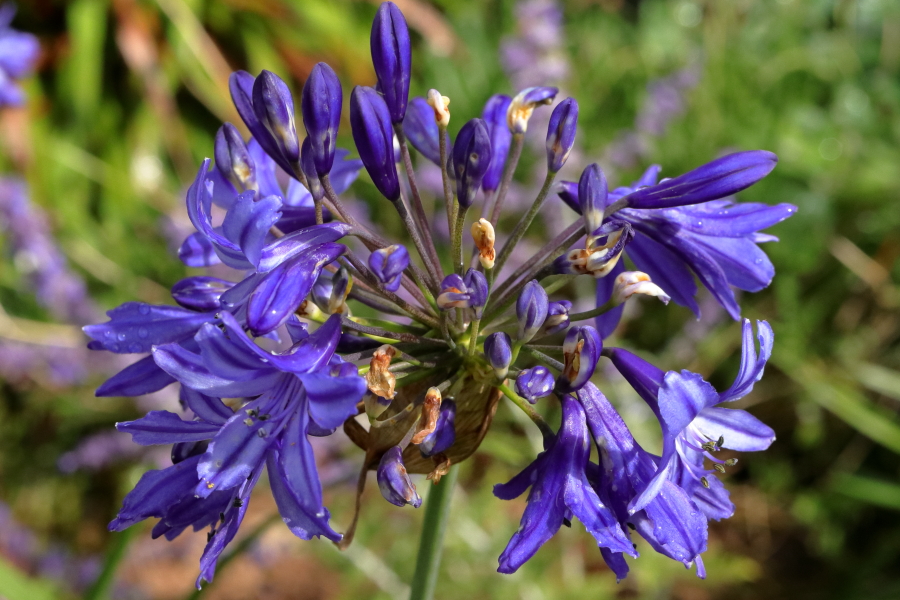
Last week I reluctantly dug out and got rid of an Agapanthus that had become quite seriously infested with Agapanthus gall midge, causing its flower buds to become distorted or destroying them completely. There is no treatment available, as far as I can determine. I took the action I did because I have other Agapanthus varieties in the garden, ‘Northern Star’, ‘Silver Moon’, an inapertus cv. which I was hoping I could prevent from becoming infected. They are all a little later flowering than the one I removed but it is now clear that all of them are also infested with the same pest. To say the very least, I am not happy about it.
I have posted an enquiry to the RHS, of which I am a member, so entitled to advice on such things. Their website makes it pretty clear that a chemical control is not likely to work and that cultural control measures such as mulching will likely only have a marginal effect. However, they do say that when they ran their research project on it that a grower who had had a serious outbreak in the year before the trial had very little in the year of the trial, irrespective of the measures used in the trial. It therefore may be one of these pests that is only serious in some years and not in others. If that were the case it might be possible to live with it.
They also refer to some varieties being more susceptible than others but say nothing about which they have information for beyond describing ‘Northern Star’ as very susceptible.
The pest seems only to attack the flower buds, then they fall to the ground and carry over to the following season by pupating in the soil. It seemed to me that it may be possible to clean stock up by digging plants up, cleaning all the soil from them and either planting them out or potting them up well away from the infected area. If the infected area was kept clear of Agapanthus for a season or two it might then be possible to move them back.



There are other questions I want answers to. How is the pest spreading? Are infected plants being sold by the nursery trade or is the pest “out there” and able to spread by flying from plant to plant. Are the flying insects emerging and dispersing to find new hosts and if so how far can they travel? How are the adults able to recognise host plants, is it visual or by smell and if the later would something like a garlic spray disguise the developing flower stems from the pest?
That last thought got me wondering about the Grazers range of pest deterrents, they have one for lily beetle and another for cabbage white butterflies and caterpillars. might one of them work to deter the adult midges from laying eggs? I have made the appropriate enquiries and await a response but will try it next year in any event.
Looking closely at the flower heads, there are those where all or nearly all the buds are affected and those where only some are. Would removing the badly infected heads and/or individual infected buds be practical and effective? Have any of the larvae already dropped to the ground to pupate? For someone growing very small numbers of prized varieties the effort might well be deemed worthwhile if it was effective.
The powers that be are prepared to take drastic action when a pest or disease threatens a significant native species or group of species but when the threat is confined to garden plants most threats are left to run their course. Gardeners like me don’t give up on growing the things they particularly like without putting up a show of resistance. I will try to take on this pest and will do follow-up posts to let you know about my successes and failures and to pass on any information from other sources that I come across.
If you have thoughts of your own about how to tackle it, or have come across third party information that sounds interesting, please let me know via the comments.
Postscript.
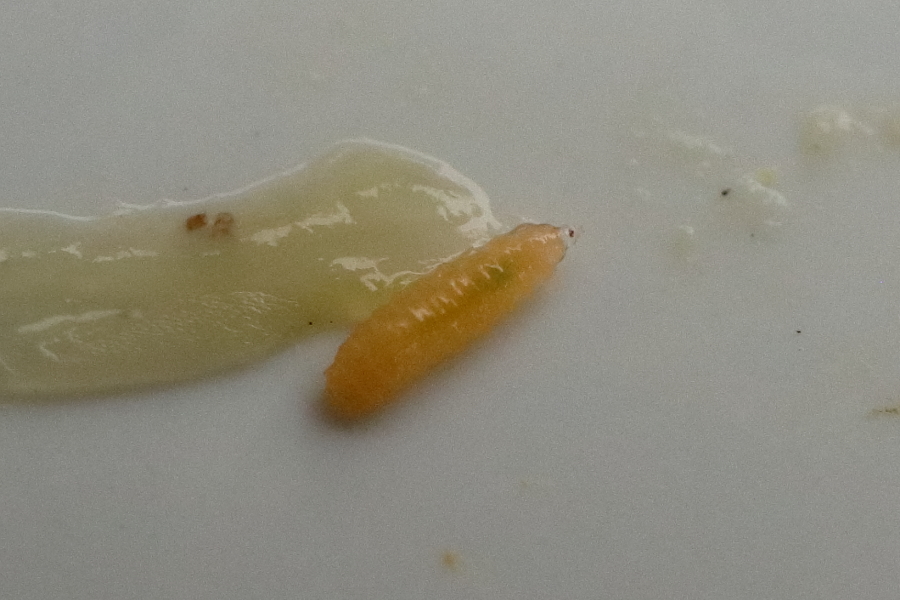
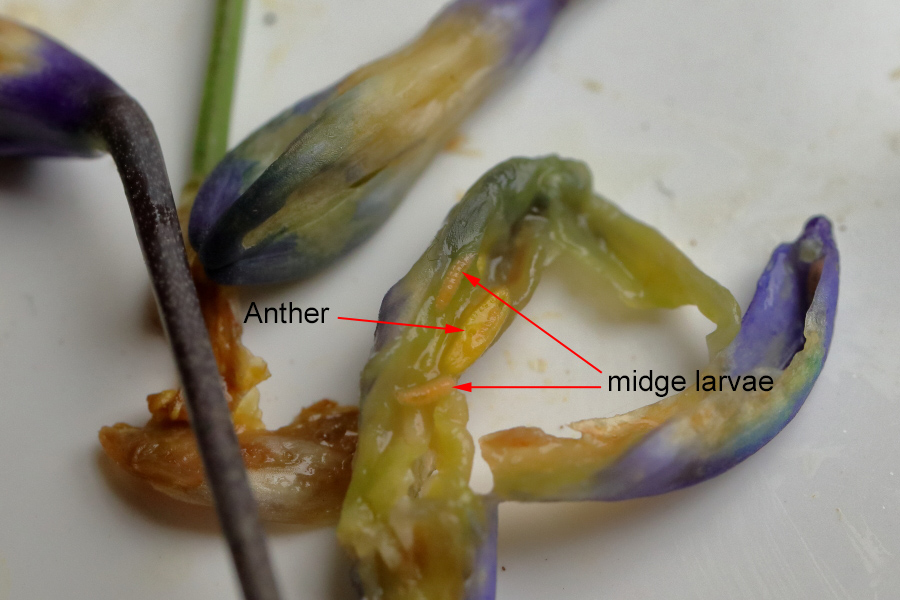
I picked off maybe 50 infested flower buds and put them in a jar, then cover them with water. An hour later I tipped them out into a plant saucer. I hadn’t broken up the buds at all but there were hundreds of larvae, some clearly moving, in the water. They obviously have no difficulty escaping from the flower buds and presumably in the garden will have been dropping to the ground freely. There are also thousands of specks which may or may not be eggs.


 garden ruminations
Such a shame that gardeners are being overwhelmed and the likelihood is that this is no longer a plant we shall be able to enjoy growing.
LikeLike
I think you’re justified in being well and truly pi$$ed off, I know I would be. As you say, the RHS’ and DEFRA’s attitude seems to be that we gardeners should just put up with it, which is maddening. Especially as they seem to have determined that Northern Star is particularly susceptible – why are they not curious as to WHY that is, and whether or not that could lead to some kind of control?
Apparently the gall midge has already been found to have overwintered in West Yorkshire, so I think it’s something we all need to bear in mind, not just those of us in the south.
I found this article from 2018 about tests involving nematode, specifically Heterohabditis and Steinernema. There are Heterorhabditis bacteriophora nematodes for all sorts of pests including chafer grubs – might be worth a try? There’s also one to kill ants which uses Steinernema feltiae.
Meanwhile, I might be tempted to put my agapanthus back into pots just to make potential pest management easier.
LikeLike
I don’t think WordPress lost your comment, it isn’t showing up because it was needing me to approve it. Most comments get approved automatically and I’m not sure why yours wasn’t but it may be because it contained hyperlinks. I’ll publish this reply and see if both your comment and my reply are showing, then I’ll read and reply to your comment.
LikeLiked by 1 person
I’m sure you’re right and the links caused it to fail. I have lots of problems with WordPress, though, I’ve even had to use the Reader to even “like” your replies.
LikeLike
OK, your comment is now showing up. It seems that Defra et al have effectively given up on this pest because it has spread very rapidly and nothing tried so far to control it has worked. I have a problem with providing nurseries with a solution when the plants are going to be supplied to a gardening public who don’t have access to the same solution or another that is equally effective. Essentially, if a plant is sold in the knowledge that it will almost certainly fail to perform, i.e. in the case of Agapanthus, to flower, then it is not fit for purpose and I would have thought breached the sale of goods act.
The article about nematodes was interesting; I was surprised that it was the pupae rather than the larvae that were susceptible. It would make treating pot grown plants worth a shot, particularly if I were using nematodes for vine weevil control at a suitable time of year. Nematodes are an expensive treatment though.
LikeLiked by 1 person
I hadn’t thought of your point about the Sale of Goods Act but I would agree that plants wouldn’t be fit for purpose if they’re infected.
I also agree that nematodes are expensive, but then so is buying agapanthus (which, let’s face it, aren’t cheap) and then having them die on you.
I think I’ll repot those of mine which aren’t in pots and keep my Northern Star well away from the rest of them, although I realise that’s probably a waste of time:-(
LikeLike
So sorry to hear ! Agapanthus is a lovely plant, I don’t have them in my garden as they are not winterhardy over here but plants do get illnesses, all plants but it is annoying to say the least, I do hope you’ll get this under control.
LikeLike
I’m horribly deficient in garden pest knowledge and even more so in figuring out what to do about problems such as this. Thanks for sharing the path you’re taking. I learned a lot today.
LikeLike
i have no experience with this pest, but if it was infecting my garden AND based on what you’ve posted, i’d de-head all the plants (yes, i know, it hurts my heart too) and burn the infected/removed flower heads. then, i’d at least try some sort of chemical to treat the ground space in an effort to destroy any of the bugs that are hiding in the soil for next year. … i am so curious what the approved, expert treatment plan is going to be. … extra good luck in fighting this battle. i feel for you!
LikeLike
Having seen how many larvae emerged from the buds that I immersed in water it appears that many will already have dropped to the ground where they will presumably pupate. Removing badly infested flower heads and perhaps on less badly infested heads just the affected buds, would no doubt reduce the numbers reaching the ground. Killing them in the soil seems to have largely failed in the limited trials that have been done, though I have now read that nematodes might have some effect. I doubt I would have any chemical treatment available that was more effective than those available to commercials growers. At the moment I’m seeing prevention of egg laying in the flower buds as the most promising intervention and will go down that route, while hoping that other people will try out other approaches and report on them.
LikeLiked by 1 person
Heart breaking.
but you will get to the bottom of this and all will be happy you took this on.
LikeLike
You are marvelous for seeking knowledge, sharing what you know, and being determined to solve a problem and sharing the results of your discoveries. Well done!!
LikeLiked by 1 person
Oh cuss! Although agapanthus is nice enough for its foliage, the bloom is very nice also. I would be infuriated if that critter shows up here. I am accustomed to agapanthus bloom getting ruined at work (by kids with sticks), but really enjoy them in my home garden. They are nothing fancy, but are Agapanthus nonetheless.
LikeLike
I need to have a closer look at the ones I have in flower – one which does appear to have distorted buds, and also does this affect the society garlic plants which have very similar agapanthus flowers (though much smaller). Hate it when yet another pest arrives.
LikeLike
I wonder if this is the report the RHS refer to: https://projectbluearchive.blob.core.windows.net/media/Default/Research%20Papers/Horticulture/HNS%20PO%20199_Grower%20Summary_2017.pdf or possibly this one (they might be one and the same) https://horticulture.ahdb.org.uk/hns-po-199-biology-and-control-of-agapanthus-gall-midge
My quick skim through – and totally non-scientific thoughts are: put an agapanthus in a pot, cover the top of the pot with a disc of yellow sticky paper (like the ones for houseplants), cover emerging agapanthus with a fine mesh net sealed to the pot. Obviously not practical but would be interesting to see what happens. Otherwise, very annoying and I do sympathise, though not an agapanthus grower myself. It does seem there is a midge for almost every plant (and several who like to bite me! )
LikeLike
Oh, that’s grave! I didn’t know about these insects.
My Agapanthus are in pots, because the winter here is too hard for the plants.
LikeLike