I put this in a Six on Saturday post in July 2024. Here is the entry:
Saccharum officinarum ‘Rubra’ is the name I was given this under but no such name is on the RHS website so I’m unsure. It may well be ‘Pele’s Smoke’, which Tony featured a while back, or S. officinarum violaceum. It roots absurdly easily in water and I have planted two plants that I rooted last year and overwintered in a frost free greenhouse. One is in a large pot, the other in the ground. They are growing fast and I’m interested to see how big they get before winter. It isn’t hardy as far as I know so I will take cuttings to overwinter and not try to keep the parent plants alive.
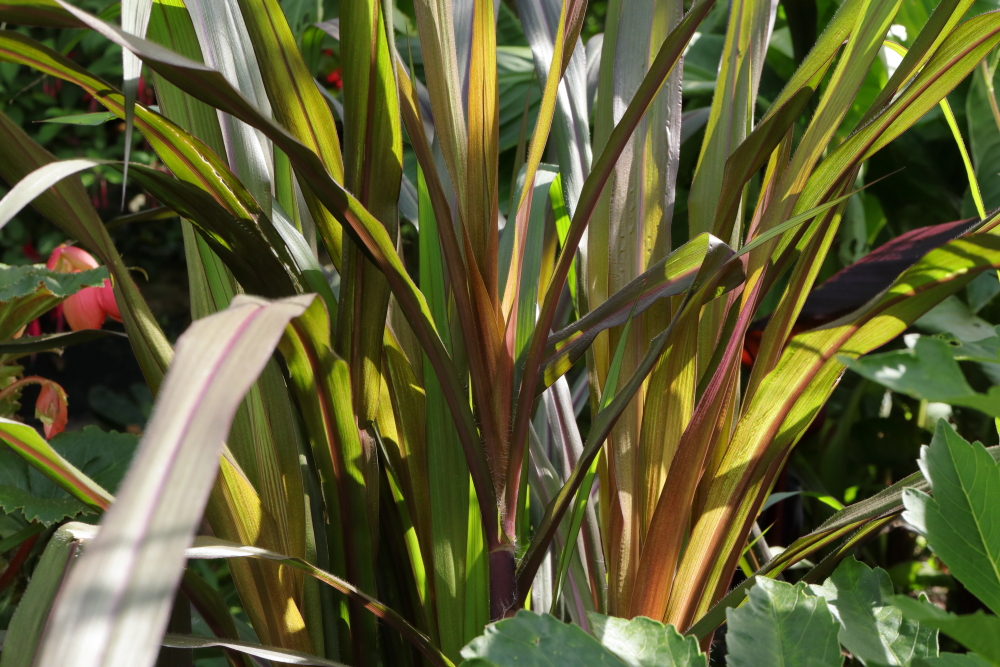

Not four months later the plant in the ground looks like this:
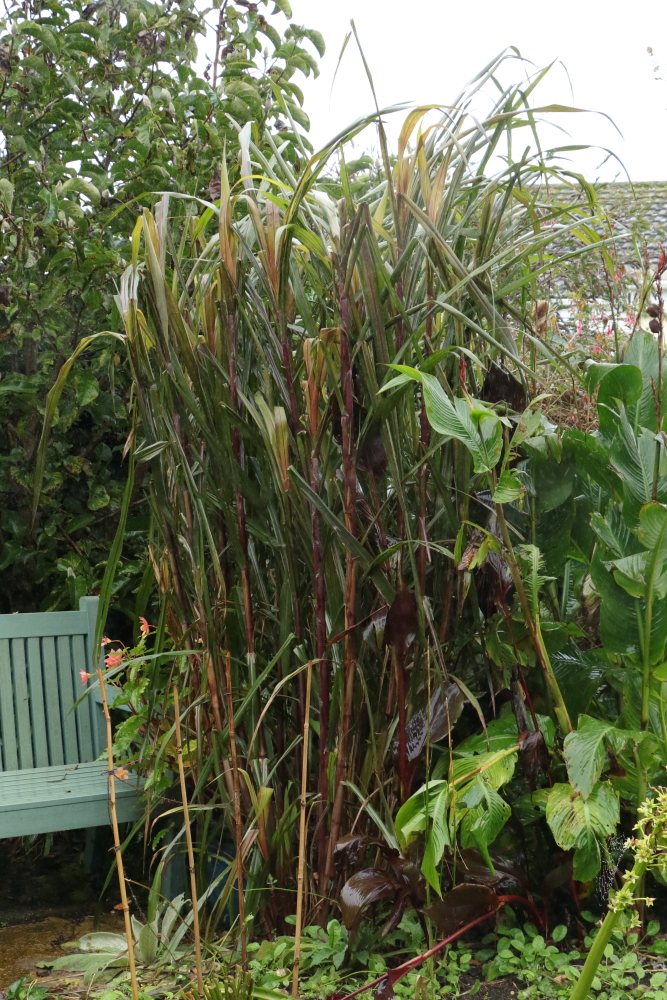
There are now 22 stems, all over 2m tall. I think I’d have to admit it doesn’t look as ornamental now as it did when half its present height but as far as I know it isn’t hardy so the canes are on their way to dying off completely.
I was given a few shoots last year which I rooted originally in a jar of water, then potted up to overwinter in a frost free greenhouse. This year I put some shoots in water several weeks ago and within a week or two had roots coming from the bottom and new shoots from the top. I’d taken shoots with three nodes so that meant there was a length of old stem up to 25cm long between the roots and the shoot.
I cut a couple of the cuttings 2-3cm below the new shoot and put them back in water. Within a short time roots emerged from the node at the base of the new shoot. I should have taken single node cuttings to begin with, perhaps cut 2-3 cm below a node, 7-8 cm above, for ease of handling. Those cuttings I potted up today.
Today I repeated the process with the rest of the cuttings, taking the piece with a new shoot off with 2-3cm of old stem below the node and they are back in a jar of water. The rooted lower sections I potted up, leaving 3-7cm of shoot above the rooted node. I expect them to shoot from the single node very quickly on a window ledge in the house.
I now have to decide what to do with the plant outside. Do I try to get it through the winter? If I do am I better to leave the tall canes in place or cut them down and perhaps pile leaves over the plant for frost protection? Is it in the right place, given how much bigger it grew than expected? How well will the canes stand up to winter weather if I leave them? It might have potential for a windbreak if the canes are robust against wind. Or do I cut the canes and shred them to use as mulch? There is an impressive amount of biomass in the plant, especially if there is sugar in the stems as well, so it would provide a great boost to my soil flora, fauna and fungi; all the better for being clean of weed seeds or roots that might shoot.
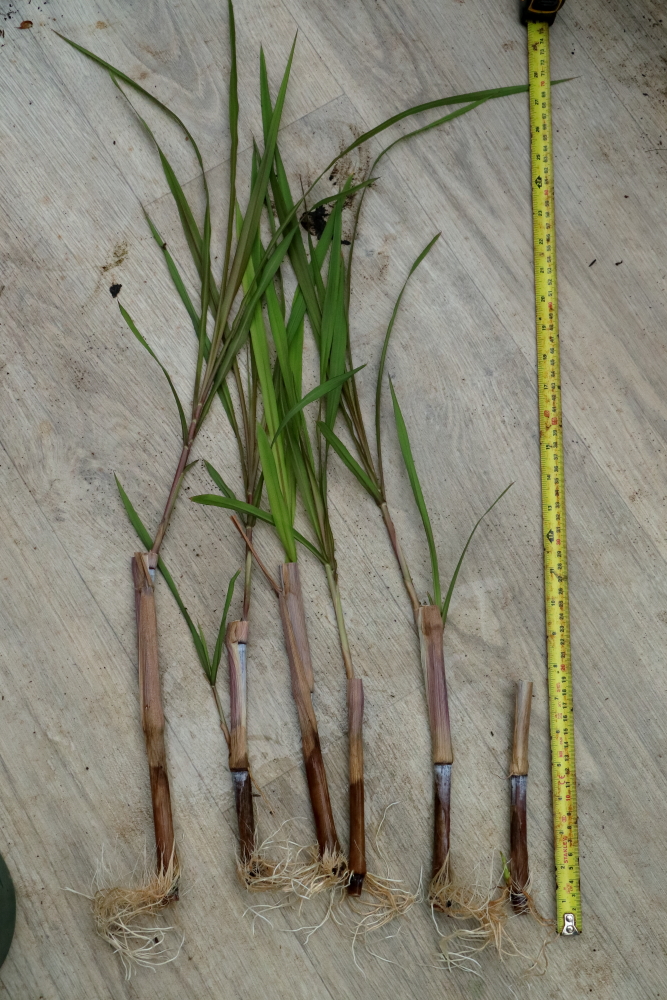

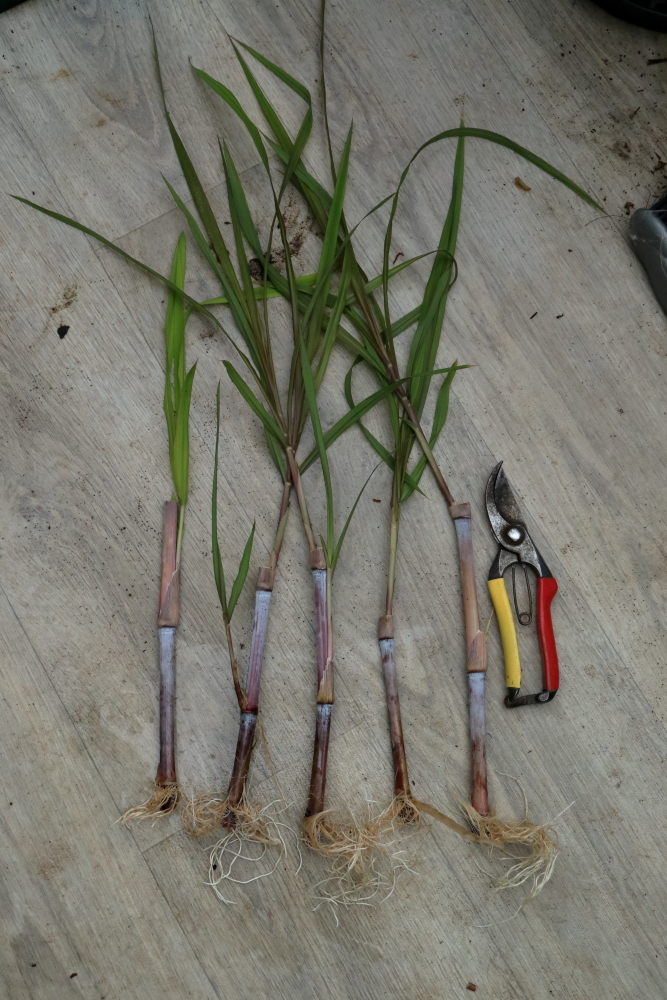
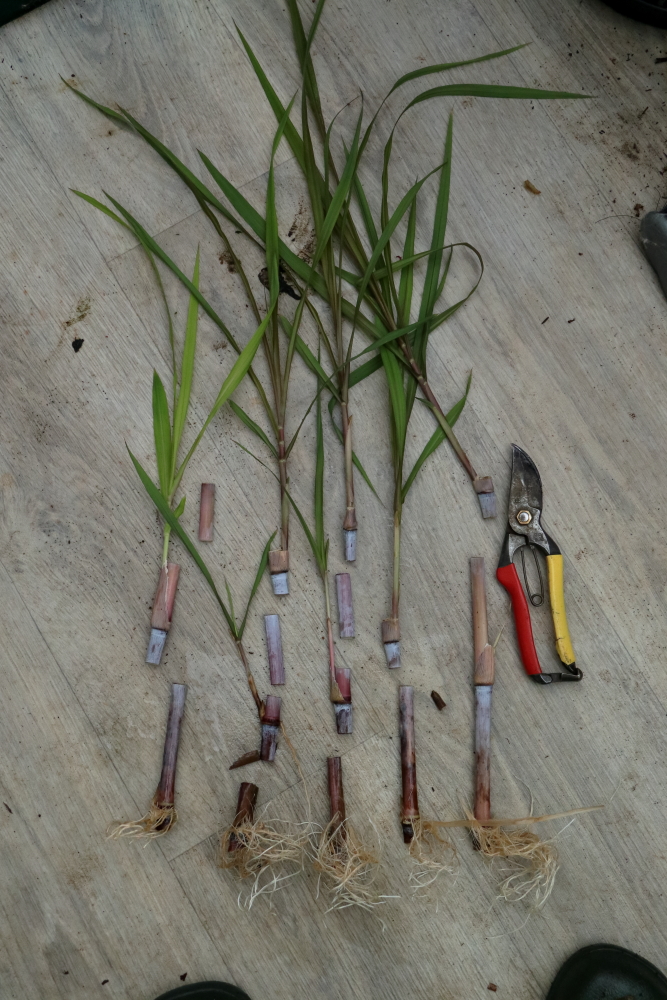

If all these pieces root I’m going to be somewhat overwhelmed but I will probably plant them in a row on my allotment simply to produce biomass for mulching and for the benefit to soil structure that their roots will provide.
I’d love to hear from anyone else who’s grown this beast and can share their experience with it. I’d particularly like to know how hardy it is.

 garden ruminations
Compressed bales of dried, shredded sugar cane mulch are sold in NSW. I use it thinly, instead of straw, around my strawberries, as it is weed free. If it covers the ground too thickly, water won’t penetrate to the soil.
LikeLiked by 1 person
I’m considering growing a row of it just to shred for mulch. Not much point me drying it, it wouldn’t stay dry for long.
LikeLike
A fun experiment, and it will be interesting to see what happens to the plant inside and outside in your climate. It obviously would perish in the Upper Midwest U.S. where I live, but I can see growing it outdoors May-October, and potting it up November-April. It will be interesting to hear how it turns out for you.
Beth @ PlantPostings.com
LikeLike
It is very pretty when it’s young. I’ve never tried growing it, but will look forward to your update.
LikeLike
Mine has not yet developed canes that are big enough to peel. I mean that after the tough exterior is removed, there is nothing left within. The original specimen, which is in the Los Angeles region, has been there for a few years, but its largest canes are not much more than an inch wide. I thought that it is ‘Pele’s Smoke’, but if it is, it is not satisfied with the mild climates here. Now that it is not providing larger canes, I intend to acquire a more common sugarcane when I return to Los Angeles at the end of winter. It seems to be ‘San Diego Yellow’, but is unidentified. Neighbors have been sharing it longer than anyone can remember.
LikeLike
Whatever it is, it is TOO easy to propagate! When I got long cuttings like yours, I just plugged the root ends so deeply that the bases of the upper foliar shoots were below grade. That way, the foliar shoots could root while sustained by lower roots that were down where the soil did not get so dry. They went into a somewhat sandy situation, . . . and, at the time, I was sort of learning that I might not want to propagate much more of it. Only a few went into the landscapes. Because the foliage causes paper cuts like pampas grass, I put it out of reach in the background of lower perennials, like lily of the Nile and pigsqueak. After giving away about as much as we can give away, we still have a dozen in #1 cans and fifteen (one flat minus one) in 4″ pots. I have no idea of what to do with it. I would put it on the roadside out front, but I think it would be ugly without irrigation. Ultimately, I still prefer it to red fountain grass, which looks great initially, but only for a few years.
LikeLike
In Mauritius, we used to love chewing on the canes when we were young: remove the outer tough skin with a paring knife, you get the knife behind the skin then lever it off, then just chew the inside. It is very stringy so don’t swallow. If you try this it will be interesting to hear whether the sap is sweet without loads of sun? My father used to order ‘bagasse’ which was the residue from sugar mills, and used to compost it before adding it as a mulch to the volcanic soils.
LikeLiked by 2 people