We’ve had a sister and a niece staying this week, diverting my thoughts away from matters horticultural and towards genealogy. My sister was researching the Plympton chunk of our family tree, that being where my dad came from and where my grandad had a nursery that sadly no longer exists.
The garden looks exactly the same now as it did a week ago and the week before that. Everything has slowed right down, meaning there’s nothing much new to report on and everything old has been mentioned already. That’s how it seems at any rate. Let’s see what we can scrape from the bottom of the barrel.
One.
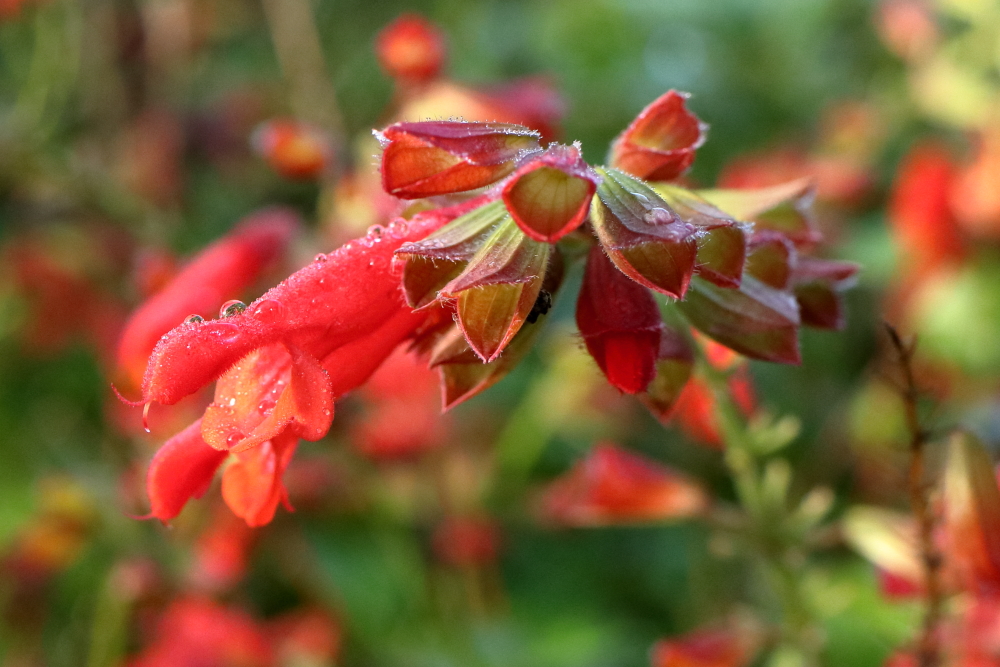
Salvia ‘Ember’s Wish’. There are a few in this series, this one , ‘Kisses and Wishes’, ‘Love and Wishes’ and ‘Wendy’s Wish’ are the ones I know about. Graham Rice gives the back story here. This one has been flowering for a long time but as other things have dropped by the wayside, has got better.
Two.
Fuchsia ‘Silverdale’. The value of Fuchsias for late colour has been remarked on before in these posts. ‘Silverdale’ came I believe from a nursery of that name in north Devon but Google Silverdale Nursery and you get a children’s nursery in Glasgow, so I presume the plant version is no more. Like F. molinae alba but slightly deeper colour.

Three.
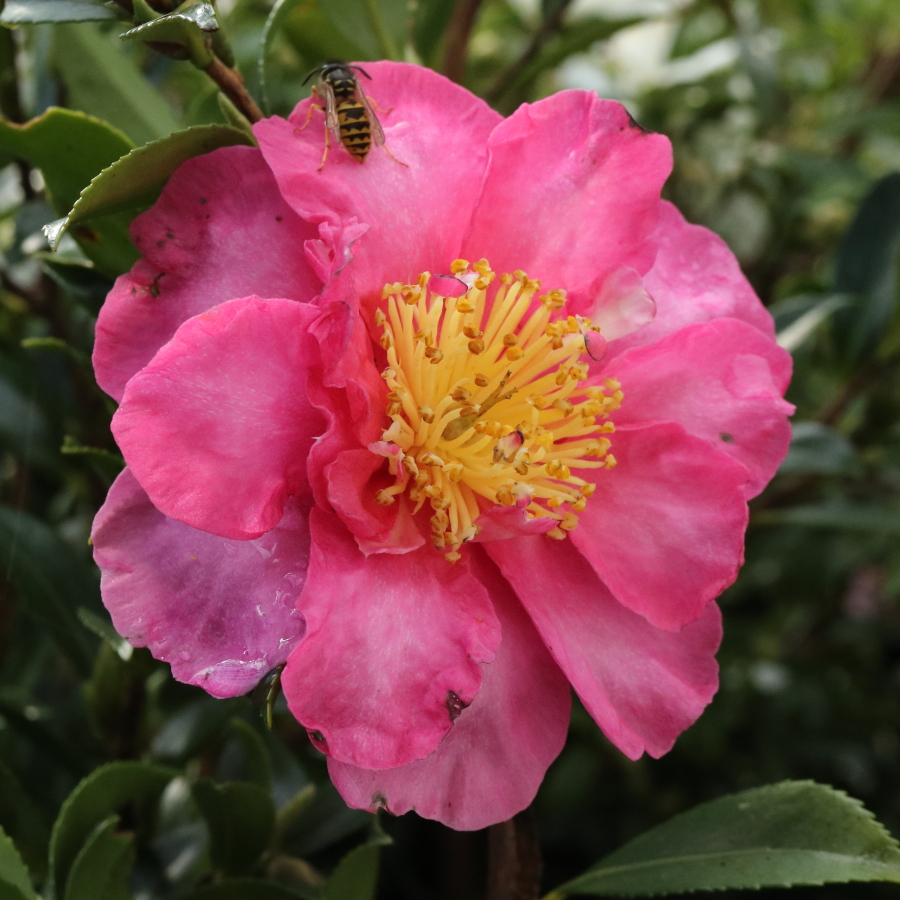
Camellia sasanqua ‘Paradise Belinda’. The Paradise camellias were raised in Australia and no doubt selected for performing well in Australian conditions, which doesn’t tell you much about their prospects in conditions as different as the UK. Even here, a variety may perform well in one place and not in another. I suspect that a handful of early failures has blighted the reputation of many a new plant that would have been good in the right place. No doubt the reverse is also true. I was sold ‘Paradise Belinda’ (by a French nursery) on the basis that it was the best of the series for UK conditions. I know more about them now than I did then and I’ve seen little evidence to support the claim. It’s started to flower relatively early this year, with a bigger bloom than any I’ve had before, 9cm across.
Four.
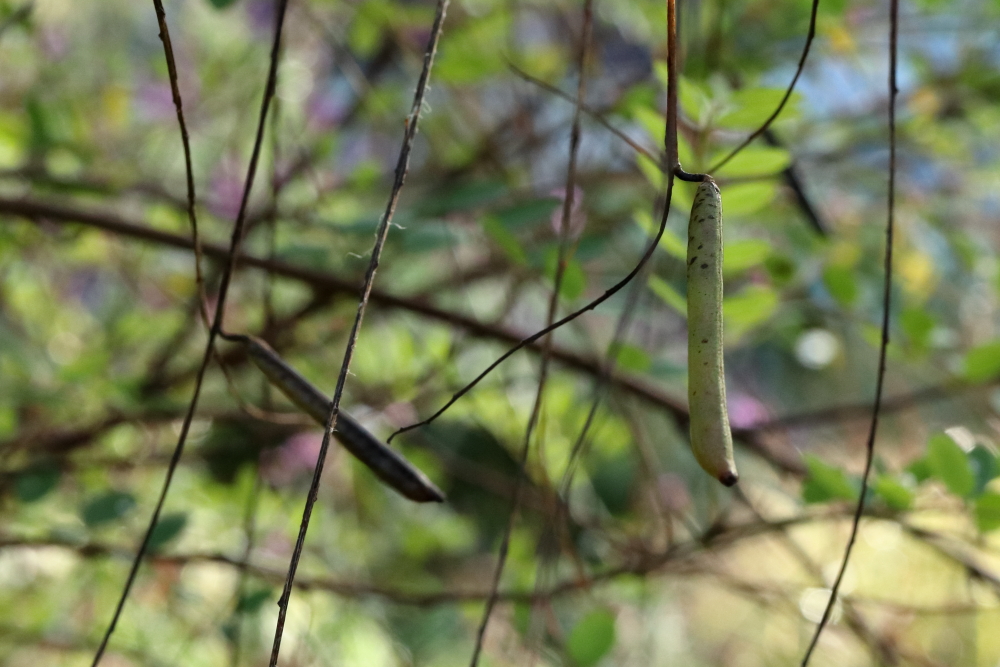
Indigofera pendula seems to be our star turn for garden openings and I must have included it a time or two earlier in the summer. Wanting a backup plant, I bought seed (Special Plants) and have a 30cm seedling from a March sowing in the greenhouse. Not for the first time, the plant in the garden has a few odd pods on it. I suspect that if I had two plants my chances of getting good seed would increase greatly. The picture conveys no sense of scale, the pods are 3cm long at most.
Five.
Salvia leucantha once again looked like it was going to flower too late to be of much use and once again it has confounded me and performed beautifully. I still want to get ‘Phyllis Fancy’ or some other hybrid of it but haven’t seen a good plant for sale. This plant was bought with a label saying Salvia leucantha ‘Santa Barbara’ but Ashwood Nurseries describe that as a dwarf form with white flowers, which ours emphatically doesn’t have.

Six.
OK, let’s go completely off piste. This picture hangs in one corner of our living room. It consists of a picture of my grandad’s nursery, with seven staff or family members in it for scale, with the header from one of their invoices. J. Counter was the lodger when my great granddad died and he then married my great grandmother. Her two sons were in their teens at the time and Counter’s occupation in the census was gardener, so he presumably set up the nursery and the two boys, sons, but not his sons, were put on an equal footing as partners. The nursery was purchased and a housing estate built on it in the 1960’s.

Usually when I put things like that into a six, I change my mind and replace it with another plant. I’m off to RHS Rosemoor today so I’ll not reply to anyone until I’m back.

 garden ruminations
You and the others have definitely got me looking into hardy fuchsias for next year! I’m glad you included the old photo — I love getting peeks into the past like that. You’ve also reminded me that we have some photos of our house/farm from the 40s and 70s that would be fun to show for comparison.
LikeLiked by 1 person
We’re expecting a killing frost tonight, so it’s the end of garden loveliness for awhile. Here’s my six for the week. Thanks for hosting! https://barefootlilylady.com/2023/10/28/coming-home-to-autumn/
LikeLiked by 1 person
Such lovely salvias! And the camelia is very pretty too. I have probably not seen a camelia in person since I left the pacific northwest. Things are winding down and getting cold now. Nothing left to harvest save some parsley, arugula and, of course, kale.
LikeLike
I am glad you didn’t take the last picture out – have you had the invoice and picture in your possession for some time, or have they been unearthed through the genealogy research? Interesting to know that plants are in your genes – most of the family on my Mum’s side seem to have an interest in plants, but the first to be involved in a work capacity is a niece who now works at Harlow Carr as a plant scientist. I still hope at least one of my girls will develop a passion for gardening, but work and young family precludes all hope of that for the time being! That’s a pretty salvia – to my mind more attractive thatn Phyllis Fancy which is a wishy washy colour, performs poorly here and flowers equally late. I lifted mine last year and overwintered it in the g/h and never got round to planting it out again as it is always such a let down…
LikeLiked by 1 person
My parents downsized from the house where they had raised five children, probably had a big chuck-out. Mum died, dad lived on but eventually went into a home. I lived a long way away so I guess my sisters who were closer made decisions about what to keep and what to throw out. There’d have been piles of stuff, my dad wasn’t one for throwing things away. Somehow the invoice book came through the process while other things didn’t.
I didn’t realise Phyllis Fancy flowered just as late, my main reason for thinking it might be better than leucantha was that I thought it flowered earlier. Better strike that from my wanted list.
LikeLike
Yes, that’a the trouble with ‘stuff’ – if we have too much of it our offspring won’t know what’s of value and what isn’t! Good that the invoices survived – and the photo 👍Yes, Phyllis has never flowered before mid September or so for me, but she might grow differently elsewhere. Let me know if you ever want cuttings, assuming I don’t ditch her altogether!
LikeLiked by 1 person
I was given a plant of Phyllis earlier this week, so I can try it out next year. The local people who gave it to me think highly of it.
LikeLike
I first came across it on the blog of another Midlands gardener and it was certainly a very healthy specimen there, although I can’t remember when it flowered for him. I hope it does well for you too 👍
LikeLiked by 1 person
Thanks for sharing that bit of family history. It really is fascinating to hear such snippets.
Also, interesting to hear your comment about Salvia ‘Ember’s Wishes’ getting better now as others fade, because I would say exactly the same about S. ‘Salmia Orange’. An orange gene thing???
Here are my six: https://frogenddweller.wordpress.com/2023/10/28/six-on-saturday-late-season-picks/
LikeLiked by 1 person
I’d not heard of ‘Salmia Orange’ but looking it up it looks like it has similar parentage to ‘Ember’s Wish’. At least one of the ‘Wish’ series is pink, so a genetic thing probably but not necessarily tied to a colour perhaps.
LikeLike
Beautiful, beautiful. Have a great weekend, and good luck with the family history. It’s always fascinating!
LikeLiked by 1 person
i’ve never seen a lavendar fuschia, so thank you for that! and i also enjoyed the framed print of your grand-dad’s nursery! here is my six: https://onerenrising.wordpress.com/2023/10/28/greetings-from-my-garden/
LikeLiked by 1 person
Love the salvia and what a great piece of family history.
LikeLiked by 1 person
That salvia is simply gorgeous. I have seen Wendy’s Wish but didn’t know there is a whole series of them. I have a weakness for salvias, but my climate is not the best for them… my S. leucantha was just about to finally flower when we got our first frost last week!
Also love that pale silvery fuchsia. I am happy to join in this week Jim. Hope you had a good day out!
LikeLiked by 1 person
Our Salvia leucantha is unlikely to get hit by frost until it’s been flowering for a month or two but it does look rather bedraggled when it gets rained on a great deal, like this year and most other years.
I had a lovely day out, the AGM of the western district branch of the RHS Rhododendron, Camellia and Magnolia Group; a room full of like minded people talking all day with a chairman who considers 15 minutes plenty long enough to get the formal business stuff out of the way.
LikeLiked by 1 person
There are several very fine Paradise Belinda in SE England and I think I agree with Rod White that it is the finest Paradise. Certainly the largest flower. There is a fine one on a wall at Wisley. Paradise Blush does spectacularly well at NT Standen and my Paradise Pearl is good. There is a good collection of them at NT Nymans. Love your photos and posts; thank you for the weekly treat.
LikeLiked by 1 person
My Paradise Belinda hasn’t been very free flowering and I’m pretty sure it’s not had a flower anywhere near so large before this year. Paradise Little Liane is right beside it and flowers well, though the individual flowers are small and don’t last long. Paradise Glow is perhaps the best of the Mount Edgcumbe Paradise varieties, there are two plants that produce quite different blooms but which are I think, the same variety in very different conditions. None of theirs, sixteen plants of nine varieties, is in ideal conditions, and some are in terrible conditions; steep north facing slope under heavy tree canopy. Having been bred mainly as hedging plants in Australian conditions, so in the open even there, they are certainly going to need very good light levels here.
LikeLike
Did you see the Nymans Paradise camellias? They are big plants now and do flower pretty well even though in a fairly shady area along what they call Winter Walk. Maybe it’s the extra warmth and dry in the SE. Little Lianne is in the open in the Sunk garden and is the only really good one I’ve seen. We are going to see them with Phil tomorrow.
LikeLiked by 1 person
I don’t think I saw much of the Paradise Camellias at Nymans. It’s never a good idea to visit a garden when you’re pushed for time; you inevitably find out later that you missed most of it. Little Lianne at Mt E is quite well budded this year, for the first time on a plant that has been there a very long time, though the records don’t show where they got it from.
LikeLike
Very interesting reading about the family business, you have obviously inherited their genes! Love the salvias, fuchsia and the camellia. My six are here………………https://www.leadupthegardenpath.com
LikeLiked by 1 person
That’s a very special photo; I bet your relatives love seeing it when they come to visit. And the Fuchsia – what a perfect colour for Easter. IS it in bloom that early?
LikeLiked by 1 person
I have an almost intact 100 sheet invoice book, from which I have just discovered that the one in the picture was taken. It is number 805 and numbers 801 to 804 are also gone. It’s a carbon copy book, with a blank sheet between each headed invoice, but blanks 801-805 are still in it and are still blank. What I would give for the previous seven 100 sheet invoice books, with all their duplicate invoice copies. The invoices all have a date entry field with 193_, so date from the 1930’s. The nursery didn’t close until 1960 odd, so someone has seen fit to keep hold of a blank book for the last 90 years but presumably not the used ones. I suspect that betrays a family trait that I did inherit.
As to the Fuchsia, it might flower for Easter if left unpruned, but cut to the ground as it always is, doesn’t flower until around August. Unpruned it would get huge, scruffy and have an earlier but inferior flower display.
LikeLiked by 1 person
The camellia is a marvelous plant. Our sasanquas will also bloom soon. They usually bloom late fall and into January. That you for the family history. I do believe horticulture is genetic.
Here is my six for his week.
LikeLiked by 1 person
It would be nice to think that horticulture was genetic but the nursery was only in our family for one generation. I think before that, in that branch of the family tree, were two or three generations of pub landlords, then the next generation, my father, was a civil servant, followed by me as a horticulturalist. Both my parents were keen gardeners and I came to love plants and gardening at a very young age. It always seemed an entirely natural career choice, but even so, nursery work, where I ended up and felt most at home, was not my entry point to the industry. That was public parks, which in the UK at least, are now a pale shadow of what they were in their heyday.
LikeLike
A wonderful ‘six’ today, Jim, particularly the last which is a fascinating bit of family history. It proves that the green hand (more than just a thumb, clearly) is genetic. What a wonderful place the family nursery must have been in its day. Your photos of the rest are lovely. It is funny to read your descriptions and hear how similarly things perform for you in the UK to how they perform for us here. The Mexican Salvia always seems impossibly late to bloom and then just wows. Our pineapple Salvia is doing that now, like a daytime fireworks show. (none of the Mexican sage in my home garden that made it through last winter survived the summer in good enough shape to give much bloom this year. It is marginally hardy here.)
And so this week I’m celebrating our Camellias, which are stunning this year. There are photos of six different cultivars: https://woodlandgnome.wordpress.com/2023/10/28/six-on-saturday-camellia-sasanqua/
Glad you are enjoying a lovely visit with your family!
LikeLiked by 1 person
Lovely photos. Would love to know the names of the varieties.
LikeLiked by 2 people
Two of us! Some were planted before we bought the property. I didn’t keep up with the names of the shrubs that I planted in our first years here. I’m glad you enjoyed the photos 😉
LikeLiked by 1 person
It always seemed to me that hearing about people in very different climates growing the same plants we grow here would teach me something useful about those plants. I think if anything it’s deepened the mystery. Some plants are very adaptable and within reason will grow anywhere, others need to be moved several times to find a place that they like in just one garden. Pineapple sage was one we left in the ground last winter and it never reappeared. I’d thought it to be one of the hardier species and it may not have been cold that killed it. At this time of year anything flowering is much appreciated but if it’s left it until this late to flower but has been taking up a big space since spring, it isn’t the type of plant you can accommodate many of in a small garden.
LikeLiked by 1 person
Exactly. I’ve been nurturing Pineapple sage in a few pots, and have a single clump planted in the ground that made it to its 4th or 5th autumn. They make a very attractive background foliage plant for much of the year here, and tend towards being both thirsty and hungry. You can’t forget about them and still expect flowers come October. I made the hard choice that Solidago was taking up both space and resources from more desirable plants and have spent the entire season eradicating it. A few plants slipped through, and I’ve been removing those after a week or so of bloom, before they can set seed. They are a beautiful golden yellow in late autumn, but aren’t worth what you must give up through most of the summer to enjoy that show at the end of the season. Garden making is as much about editing as it is about planting, I’ve learned after a few decades of trial and many errors… 😉
LikeLike
It’s a tricky balance isn’t it. I have Golden Rod and feel exactly the same way about it, but every time I suggest replacing it I get told how good it is for insects (it is, for a week) so I back off. But plant a garden only with long season flowerers and you limit your palette dramatically and miss out on the pleasure of big seasonal changes. Hey, if it was easy it wouldn’t give us half the satisfaction when we pull it off.
LikeLiked by 1 person
The conventional wisdom about goldenrod describes its benefits for insects. I made an effort to really observe it last fall and this month to notice which, and how many insects visit it. It gets very little traffic in our garden. We have had fewer butterflies and wasps this year than ever before, even with efforts to plant to support them. I left the smaller Solidago species which looks like the cultivar ‘Fireworks,’ and only removed the tall ones, which were ‘volunteers ‘ to begin with🍀. I try to have something interesting and blooming every day of the year. An interesting challenge….
LikeLiked by 1 person
Back again, SOS for the week written. Have a lovely time at RHS Rosemoor. Here’s my link to weird things growing on the lawn and other delights https://n20gardener.com/2023/10/28/six-on-saturday-taking-the-plunge/
LikeLiked by 1 person
I wish I had as much luck when I scrape the bottom of the barrel, Jim…
LikeLiked by 2 people
I am just back from a wonderful evening of ballet – a brief post again this week. Interesting colour on the Fuchsia ‘Silverdale’.
LikeLiked by 2 people
I grew S. ‘Love and Wishes’ for many years, a great plant. F. ‘Silverdale’ is such a delicate looking flower. After a few years off, I’ve grown a few Fuchsias this year without any sign of gall mite (probably shouldn’t have said that out loud) so I’m going to try a few more next year.
LikeLiked by 2 people
We’ve had a bit less gall mite this year than last, so it does seem to come and go. I find it manageable most of the time, just picking off infected bits as soon as I see them.
LikeLike
Amazing to see the heads of the men appear through the plants. A great momento. The salvia is a delight even if it’s not white! I’ll be back later with my link.
LikeLiked by 2 people
Indeed, 9 cm for a camellia Sasanqua flower is already a good size! Nice old photo that gives character to your Six… and we can see that growing plants is a family affair: https://fredgardenerblog2.wordpress.com/2023/10/28/six-on-saturday-28-10- 23/
LikeLiked by 3 people
Wait, WHAT?! ‘Santa Barbara’ has white flowers?! Is that those silly white bits that protrude from the otherwise purplish blue bloom? I can see that they are white in the bloom of other specimens, including some right near here. (Although I do not know what cultivar they are, I know that they are not ‘Santa Barbara’ because they are too big; but I know what you mean.) Oh, this is confusing. I can not even see what color yours are. They look purplish blue to me. Are they really purple?
Incidentally, I will be going through Santa Barbara in a few days. I will be going to Silverdale in Washington at the end of winter.
Otherwise, here are my six:
LikeLiked by 2 people
The Salvia is nearly all bracts and very few (purple) flowers. Maybe they’ll turn white or perhaps that’s just wrong info.
LikeLiked by 1 person
or they were labeled wrong. I have seen at least one (unidentified) cultivar bloom white from within blue or maybe purplish blue, so I know at least one cultivar does so.
LikeLiked by 1 person
Wrongly labelled! surely not! That is the most likely thing, just looked at last years pics of it, reddish purple then too.
LikeLiked by 2 people
I’m glad you included the framed picture of your granddad’s nursery and the invoice header. Very interesting indeed. We have the odd nursery record in the archive collections where I work, including a letter from Margery Fish in the Kelways collection & Gertrude Jekyll’s planting plans for Hestercombe. Fuchsia ‘Silverdale’ is a delicate beauty https://onemanandhisgardentrowel.wordpress.com/2023/10/28/six-on-saturday-28-october-2023/
LikeLiked by 2 people
It’s a shame we have so little info on the nursery. You think you leave a huge paper trail in your life but it pretty soon vanishes when you die.
LikeLiked by 1 person