Nowhere in our garden does more effort go into forcing a quart into a pint pot than in the one corner that is shady. If Sue is never happier than when she’s furtling about in her greenhouse full of cacti, I’m at my most content surrounded by greenery in the shade. The greenhouse is her greenhouse, the shade area is my shade area.
We have one sizeable tree in the southwest corner and its shadow, along with that of a row of assorted shrubs just beyond the reach of its canopy, gives me what I refer to as my one tree woodland. The degree of shading varies greatly, the tree is deciduous and its lower branches quite high. In full leaf in mid summer, with the sun high in the sky, it cuts off a lot of light.
I see it as an opportunity to grow a range of plants that thrive in full or part shade, and what a range of plants it is. So many choice plants enjoy protection from direct sun in summer and there are plenty more that take advantage of reasonable light early in the year before the tree is in leaf. Now, in mid May, the performance has reached Act Two. The Erythroniums, wood anemones, Tulipa sylvestris, Cyclamen and bluebells are receding. They will die away completely until next year and the space they occupy is already filling with other things. Some of these will stay green until, even right through, next winter.
On a sunny day, it enjoys dappled shade; the type that is lovely to see but tricky to photograph. Here is a photo taken from a high viewpoint, looking over the top of a section of Holboellia brachyandra covered trellis that is part of the boundary.
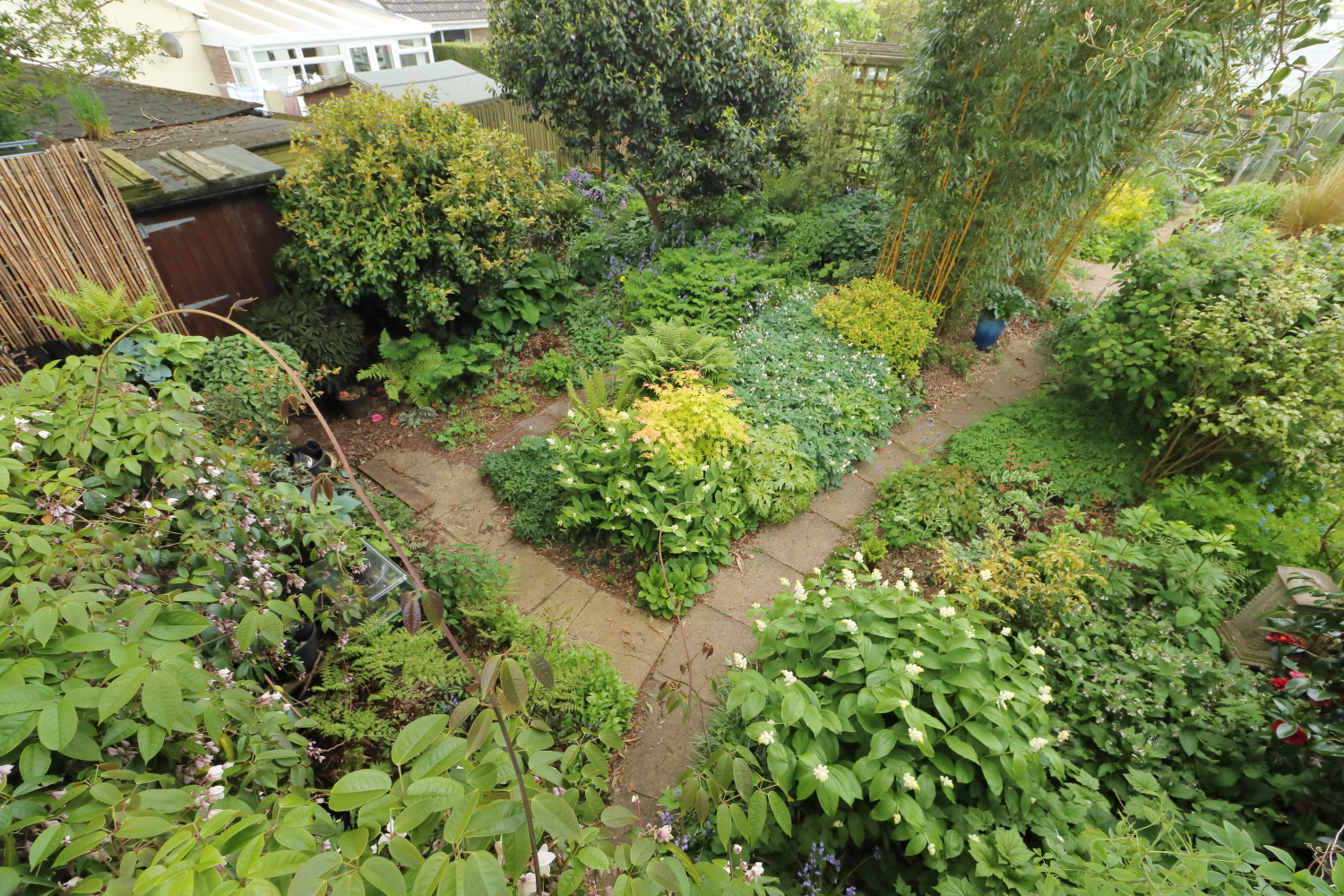
The Holboellia is in the bottom left corner. Moving clockwise, there is a section of fence/staging/storage, then my two stacked IBC’s, full of water and disguised with a home-made bamboo screen. My miniscule shed is the final structure before Camellia ‘Debbie’. The tall camellia at top centre is ‘Charles Colbert’ and there is in fact a young Camellia transnokoensis between it and ‘Debbie’. Between ‘Chales Colbert’ and the bamboo is Eucryphia lucida ‘Gilt Edge’ and the trellis supports Fuchsia regia serrae on the visible section. The Bamboo is Phyllostachys aureosulcata ‘Spectabilis’, a clump former that has spread towards and away from its original location, leaving a planting gap just behind the blue pot. I just put Begonia koelzii in that very space. Across the path is Hydrangea serrata ‘Shojo’ and in front of it, Camellia grijsii. At bottom right a few flowers of Camellia japonica ‘Bob Hope are still hanging on. Only just out of shot in that corner is a 25ft Ligustrum lucidum ‘Excelsum Superbum’, which brings you back to the trellis, supporting at the right hand end a Clematis viticella. The path where it heads off past the bamboo is taking you due north.
Another angle shows all the same things, from another angle. As you can see, our neighbour’s all have proper, man-size sheds.
I kind of envisage this area as akin to a woodland clearing and planting the golden Acer bang in the middle has felt like a mistake from the time I did it. I keep telling myself that in time it will rise above the forest floor and become part of the canopy, the question is whether I will live to see it. The term “garden room” is often used to describe a more or less enclosed space within a garden, so I suppose this area qualifies for that title too. It has a different feel from the rest of the garden, smaller in scale, a little more intimate.
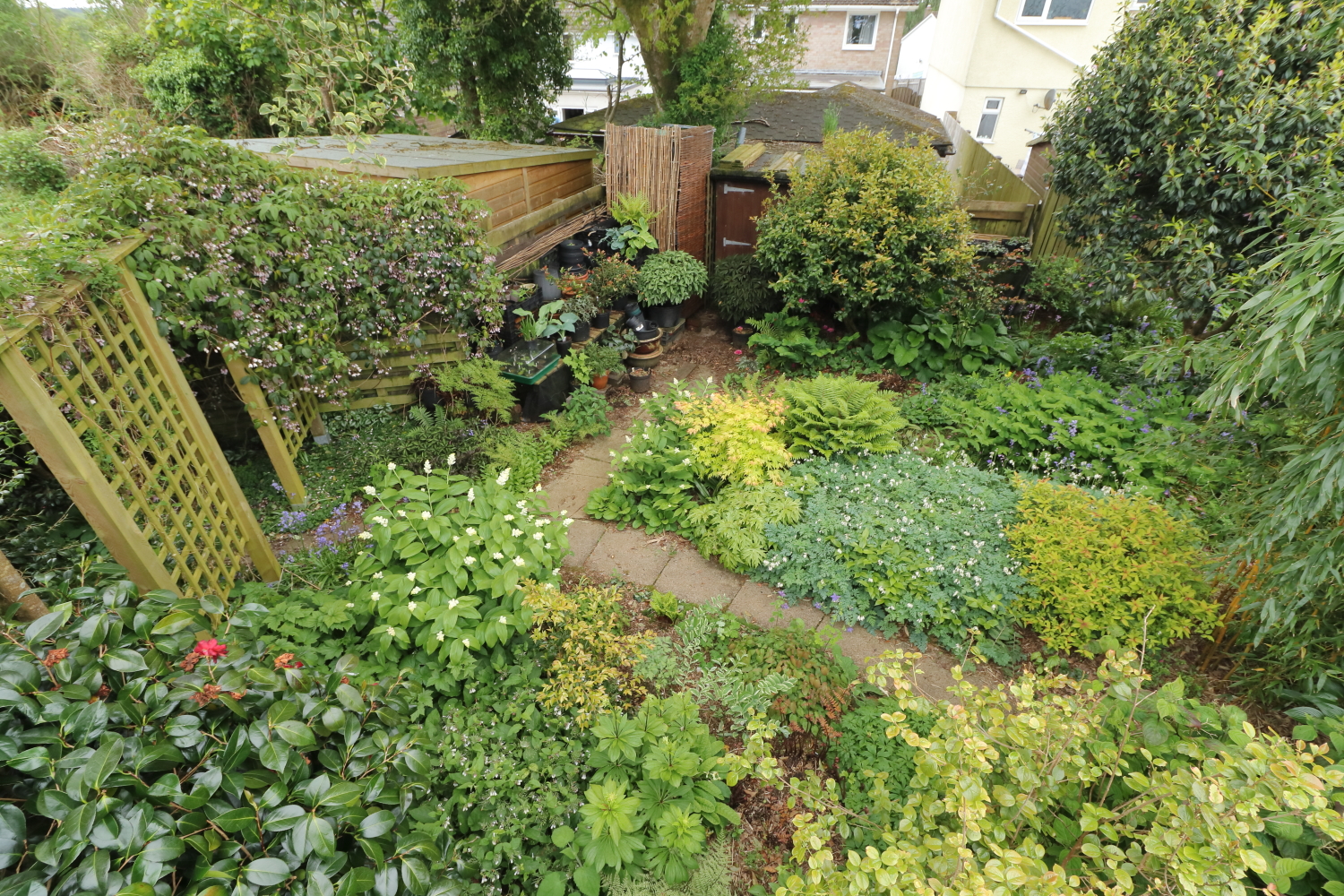
And so to the cast list.
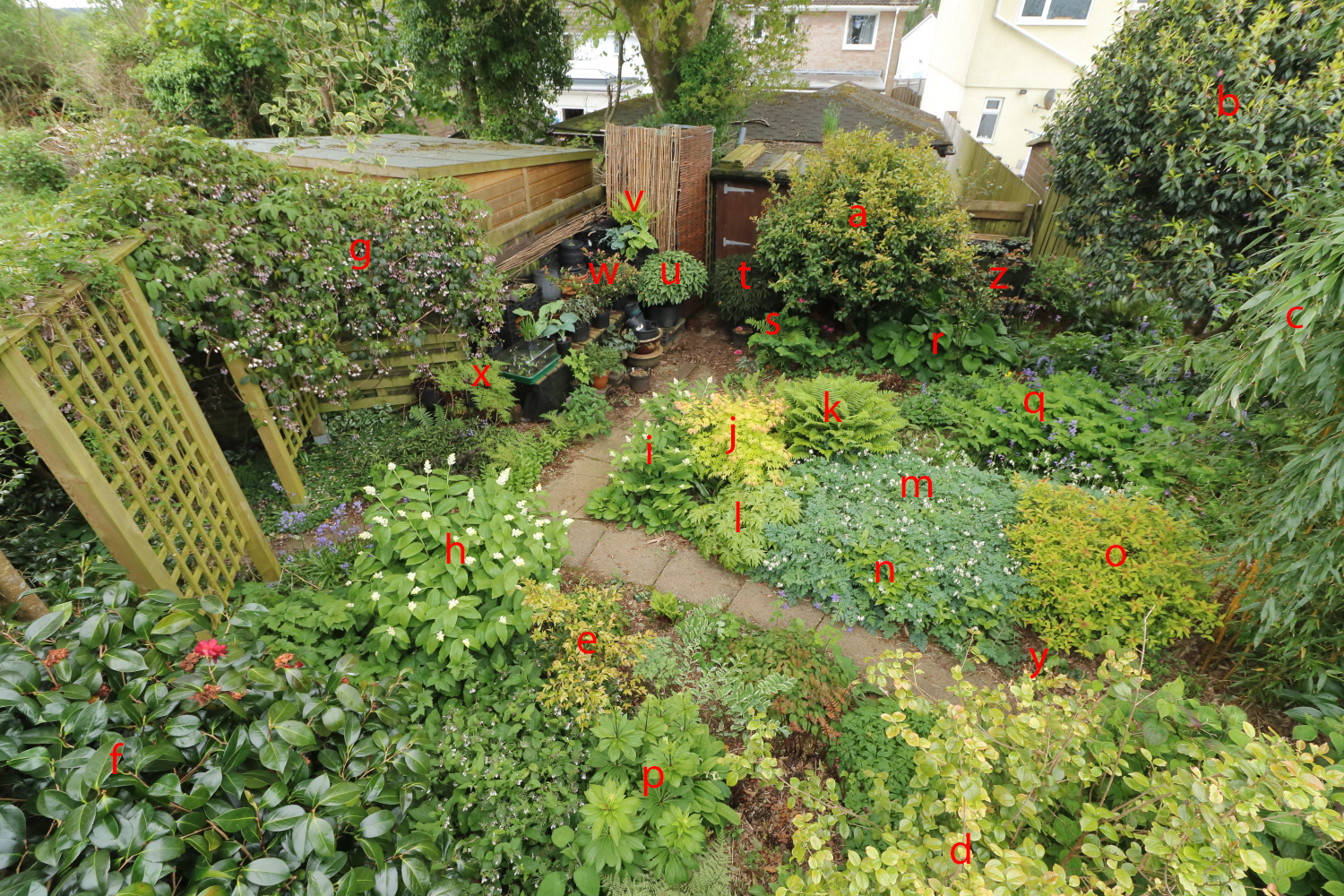
- a Camellia x williamsii ‘Debbie’
- b Camellia x williamsii ‘Charles Colbert’
- c Phyllostachys aureosulcata ‘Spectabilis’
- d Camellia grijsii
- e Camellia lutchuensis
- f Camellia japonica ‘Bob Hope’
- g Holboellia brachyandra
- h Maianthemum racemosum ‘Emily Moody’
- i Maianthemum racemosum
- j Acer palmatum ‘Orange Dream’
- k Polystichum polyblepharum
- l Begonia pedatifida ‘Apalala’
- m Dicentra formosa cv. white.
- n Disporum sessile macrophyllum BSWJ4316
- o Spiraea japonica ‘Goldflame’
- p Lilium martagon ‘Guinea Gold’
- q Polygonatum x hybridum
- r Trachystemon orientale
- s Dryopteris cycadina
- t Impatiens omeiana ‘Chen Yi Red’
- u Impatiens omeiana ‘ Ice Storm’
- v Blechnum tabulare
- w Camellia ‘Fairy Blush’
- x Araiostegia parvipinnata
- y Begonia ‘Wavy Green’
- z Maianthemum bifolium
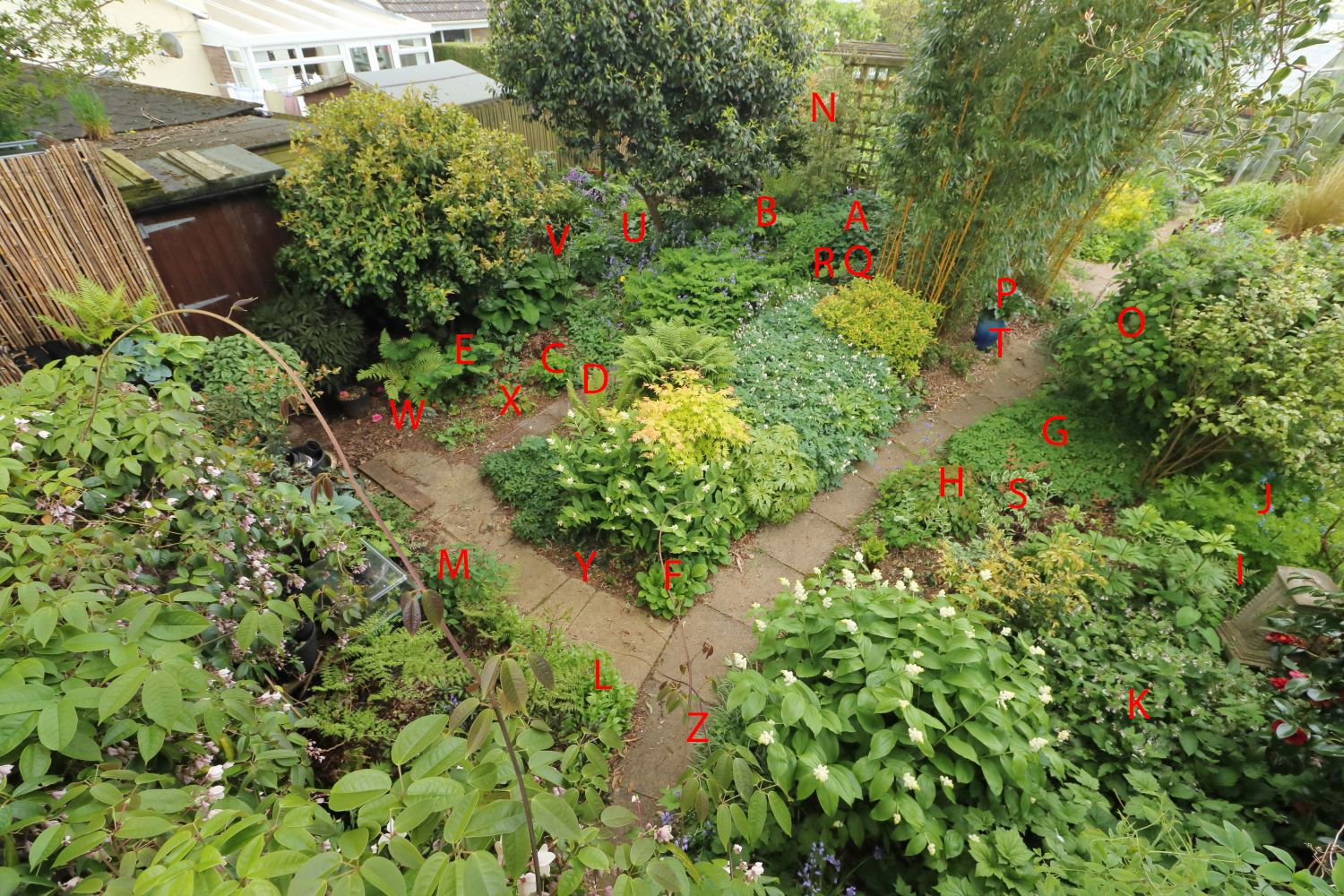
- A Lamium orvala
- B Polygonatum x hybridum ‘Betburg’
- C Jeffersonia dubia
- D Polystichum setiferum ‘Ray Smith’
- E Polygonatum odoratum ‘Purple Stem’
- F Primula vulgaris sibthorpii
- G Anemone nemorosa ‘Robinsoniana’
- H Epimedium grandiflorum ‘Lilafee’
- I Athyrium ‘Ghost’
- J Corydalis flexuosa cv.
- K Symphytum cv.
- L Disporum viridescens
- M Impatiens arguta alba
- N Eucryphia lucida ‘Gilt Edge’
- O Hydrangea serrata ‘Shojo’
- P Hosta ‘Devon Green’
- Q Impatiens stenantha
- R Deinanthe caerulea pale f.
- S Polygonatum x hybridum ‘Striatum’
- T Begonia tengchiana
- U Pachyphragma macrophyllum
- V Disporum longistylum BSWJ2859
- W Athyrium nipponicum ‘Godzilla’
- X Begonia grandis evansiana ‘Alba’
- Y Epipactis gigantea
- Z Melica uniflora ‘Variegata’
Add in the things I’ve missed and the things beyond and amongst the boundary planting and the things that have already gone underground and the things that haven’t come up yet and you wouldn’t be far short of as many again. It’s one of the things I love about gardening; you can take one small part, like hardy shade loving plants, and you will never get to the bottom of it.

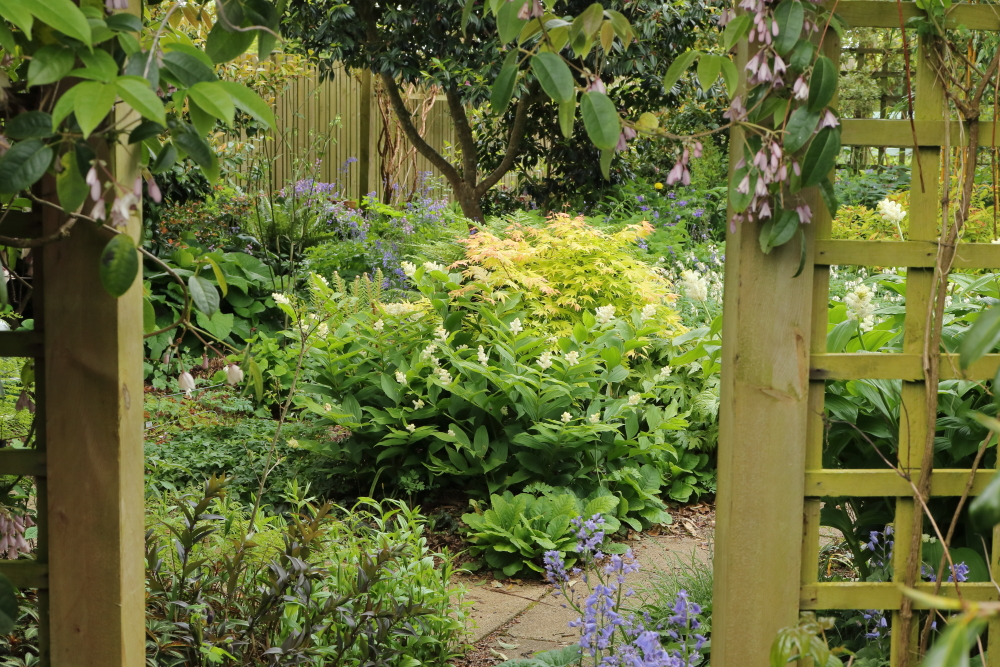

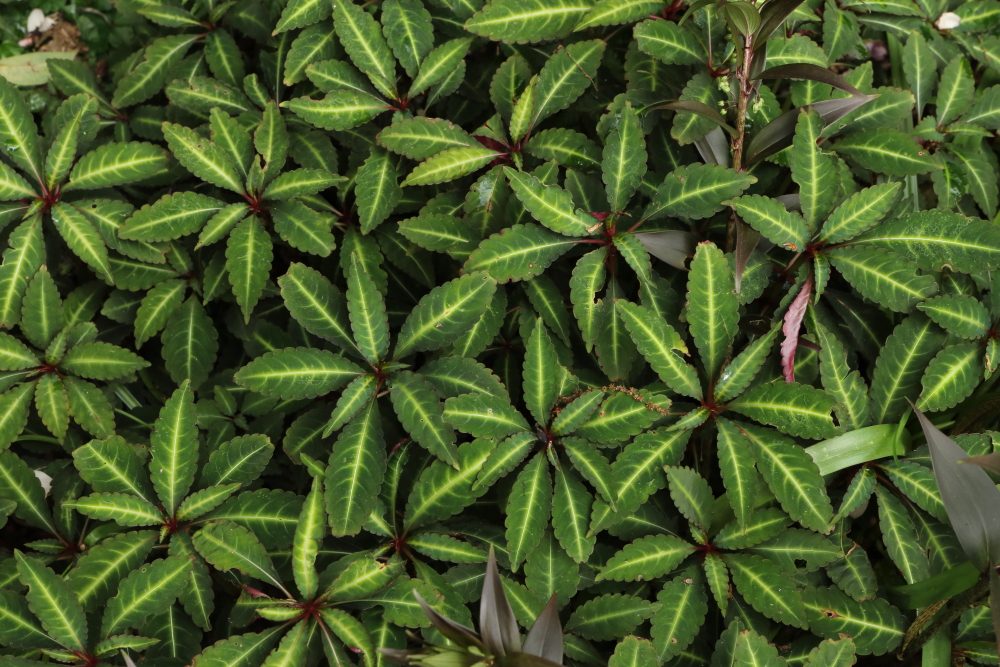


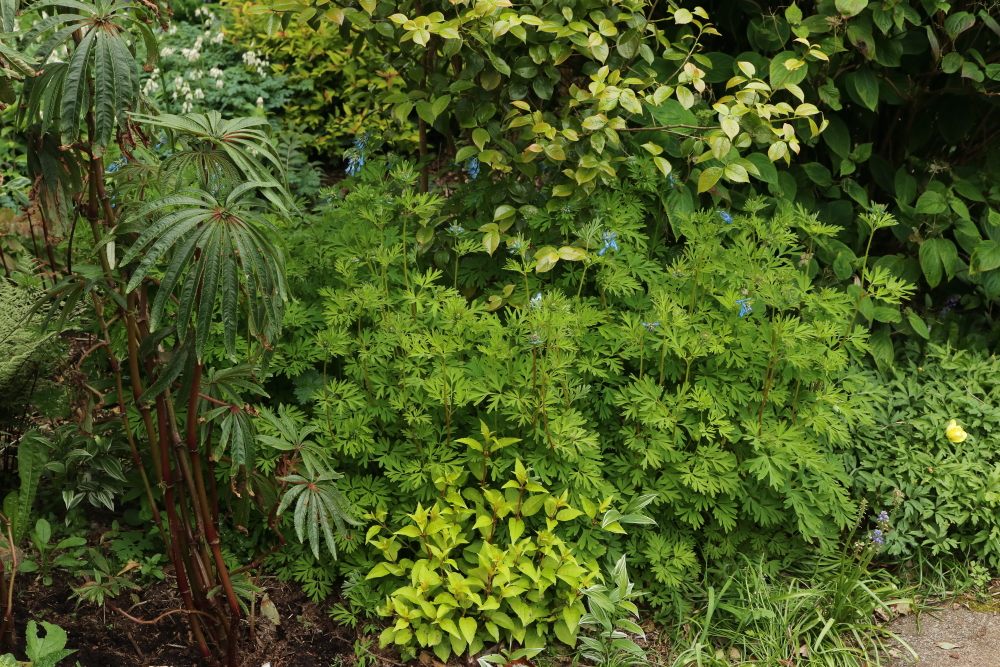

I think it’s fair to say that our garden visitors will see more in our small garden, tucked away in the middle of a housing estate, than they will find in many gardens fifty times as large.

 garden ruminations
I apologize if I missed it, but what kind of tree do you have that provides so much shade? And what do you do for the soil? Do you top dress your garden with compost or mulch every year?
LikeLiked by 1 person
It’s an oak tree. The tree leaves are left where they’re not smothering things, otherwise they go through the shredder along with all other garden debris and get spread straight back. It’s not as regular as everywhere, every year.
LikeLike
Wow. It’s so lush, I assumed you dumped 6″ of composted manure on it every year.
LikeLiked by 1 person
Living in Cornwall helps, our climate usually encourages lushness, to the point that encouraging it further is neither necessary nor desirable.
LikeLike
Okay, . . . there are many items on these lists that I can not recognize. That can not be good.
LikeLike
On the contrary, it can only be good.
LikeLiked by 1 person
? I should be more familiar with such species because I work with so much shade.
LikeLike
Good in the sense that there’s always so much more to learn.
LikeLiked by 1 person
It’s great to see plants that you’ve featured in other blog posts in context in the garden. And yes, a wealth of plants for visitors to see, a perfect example of why shade doesn’t need to be a problem for gardeners.
LikeLiked by 1 person
Great post. Beautiful and informative.
LikeLiked by 1 person
This is such a beautifully written post! I love how you’ve created a woodland clearing in your garden and filled it with shade-loving plants. Your cast list is so impressive, and it’s amazing how many different species can thrive in this type of environment.
LikeLiked by 1 person
A plantman and plantwoman’s dream!
LikeLiked by 1 person
The dey shaded areas under trees can be challenging to plant, particularly so if one doesn’t water them, which we don’t as we couldn’t manage it. I recall a book on growing plants in such conditions which, in the first few pages, recommended putting in an irrigation system which I felt rather missed the whole point of what challenged most gardeners. It continues to be a challenge here. Re your plants: Epipactis gigantea is one I’d like to try as some stage. I grow that cross between E. palustris and E. gigantea – E. ‘Sabine’ which I like very much and E. palustris is my favourite of the native orchids.
LikeLiked by 1 person
Love this. I’ve got a shady area to plant (not until the autumn) and you’ve given me lot’s of ideas to mull over! It’s also a small area, bounded by a very tall euonymous hedge and a red maple. At the moment it is prey to ferns and running ivy, but not for much longer!
LikeLiked by 1 person
Wonderful and the labeling is really useful. Your visitors are in for a treat.
LikeLiked by 1 person
Jim, I can’t imagine regretting anything about your lush green garden. It looks stunning! I’m impressed with the mix of plants, and I marvel at the various shades of green. It looks terrific.
LikeLiked by 1 person
What a stunning collection, and your slide show and labeling are so impressive. The foliage and the blossoms are fabulous!
LikeLiked by 1 person
Beautiful – love the variations of foliage – just as lovely as blossoms!
LikeLiked by 1 person
I’m a big fan of foliage but I believe you still need contrast to make it interesting, so I’m always looking for the widest range of foliar effects as possible.
LikeLike
When you start listing plants it’s incredible how many can be in an area, all looking very happy.
I can vouch for the fact that your visitors are in for a real treat. Your garden’s looking great Jim.
LikeLiked by 1 person
I try to blur the edges of adjacent plants, letting them grow into each other; and to allow a few things to spread into quite large clumps. When every plant is of similar size and allocated the same space, it looks very contrived. Sometimes thuggish things, like the Dicentra and bluebells, get bits pulled out so they don’t take over completely.
LikeLike