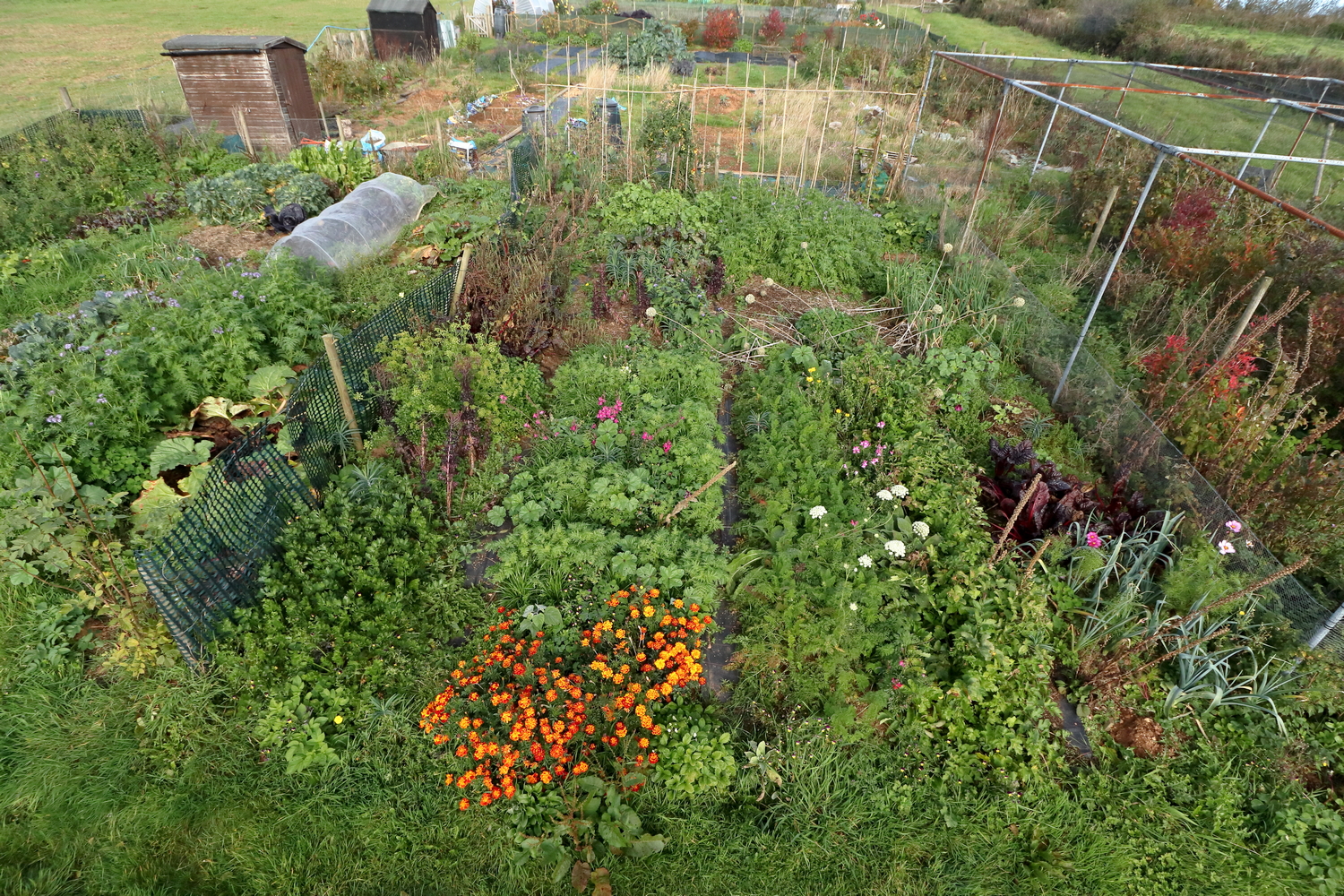
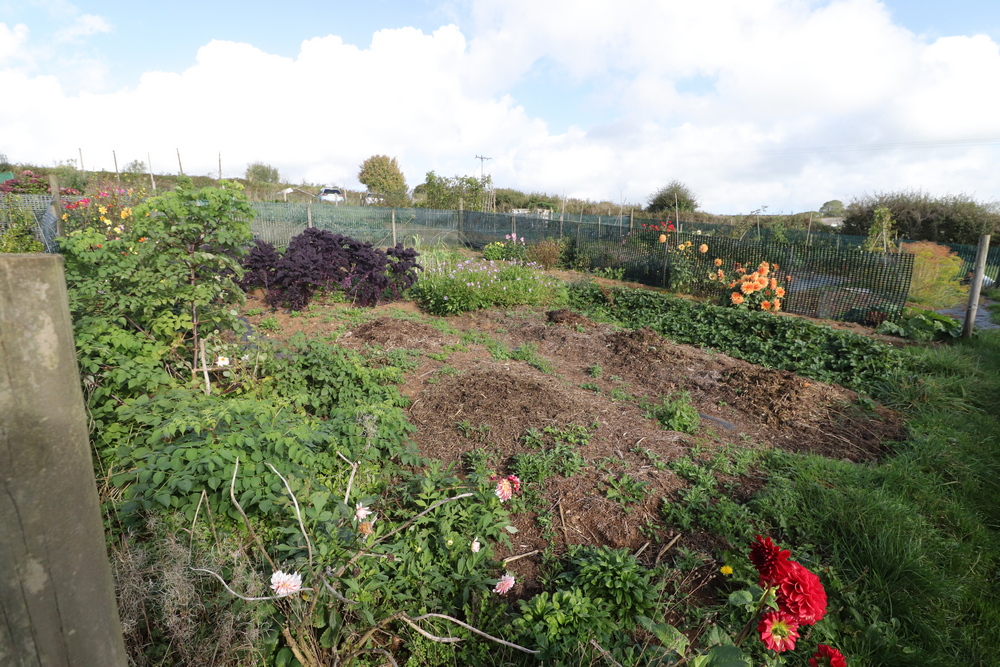
Here we are in the middle of October and this is how my allotment is looking. The plot next to mine (the one behind me) is all but bare, just some cabbages and Brussels sprouts, the rest cleared and dug over.
This is Cornwall; it is not natural for ground to be bare in winter. The climate is benign, we are only likely to get frosts on a few occasions during the winter, mostly ground frost, so not even down to zero, and it will warm during the day. It is very unusual to get more than three or four frosty nights in a row. We hardly ever get snow. Normal is for vegetation to cover the ground throughout the winter and to be growing slowly whenever the temperature allows.
My assumption would be that worms and the rest of the soil fauna remain near the soil surface and active to some degree throughout the winter. Molluscs on and near the surface certainly do! The vegetation that does die down in autumn will provide shelter and food for detrivores, the growing plants will provide food for herbivores, the detrivors and herbivores will provide food for carnivores. Below ground exudates from live plant roots will supply fungi and bacteria with an energy source. In short, it’s business as usual, life goes on.
Vegetable growing isn’t natural either, at times during the season ground is cleared. I don’t see much reason for it to stay clear though, so I aim to have as much of the ground as possible covered with growing plants for as long as possible.
In the picture, let’s start with the marigolds. I grew more than I needed, a space appeared at the end of a bed so I popped them in. Just above them is where my onions were until late August. I grew Phacelia and Italian rye in cell trays and planted them out as soon as the onions were gone. Self sown Antirrhinums and mallow had been allowed to grow between the onions once they were just a few weeks from harvesting. At the top end of the same bed I sowed beetroot at the end of July, which should give me a crop of small roots, and above that is mooli, some of which will get eaten and the rest will just feed and protect the soil.
To the right of the marigolds the bed has carrots on the left and parsnips on the right. I meant to put a mesh barrier around it to stop carrot fly and didn’t get around to it. I have usable, but not pest free, carrots. They will stay in the ground and get pulled as required. One of the carrots is flowering and there are antirrhinums dotted among them too. Just above them there are stems of elephant garlic going every which way. I grow it because it’s easy to grow and ornamental, we don’t use it because Sue doesn’t like the taste. Above it I had maincrop potatoes and again, I had cell grown cover crop plants of ryegrass, phacelia and clover ready for the ground to be clear; today I went over it with shears to top the phacelia which was about two feet tall.
Down either side of the centre beds are various crops, celeriac, chard, leeks (with self sown cosmos), perennial onions, parsley; with some lettuce going to seed. There is almost no soil showing and not a lot of weed either. Come spring I will slice it off at ground level and get the next season’s crops going. The “harvested” cover crop material will get shredded and spread where seed potatoes get planted or any other bare ground not immediately required.
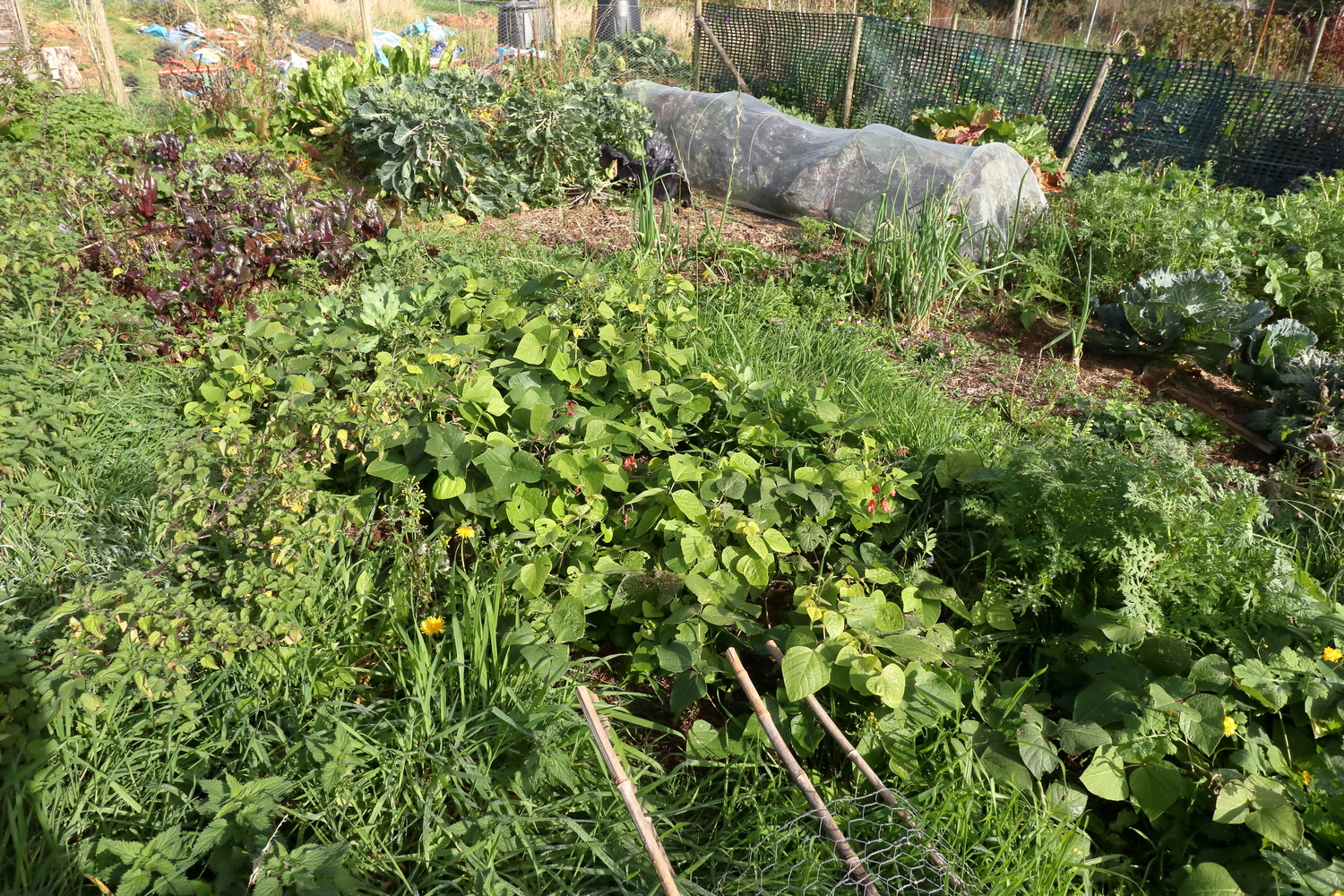
I’m less pleased with the other half of the plot. Early peas and broad beans were fine. Beetroot and brassicas didn’t enjoy the hot dry summer. My attempt to get cover crops growing where the peas and beans were worked for one but not the other. The unsupported runner beans in the picture were surplus saved seed which I shoved in as the emerging cover crop rye, phacelia etc slowly disappeared. At least something is growing. Overall the ground is less well covered and more weedy.
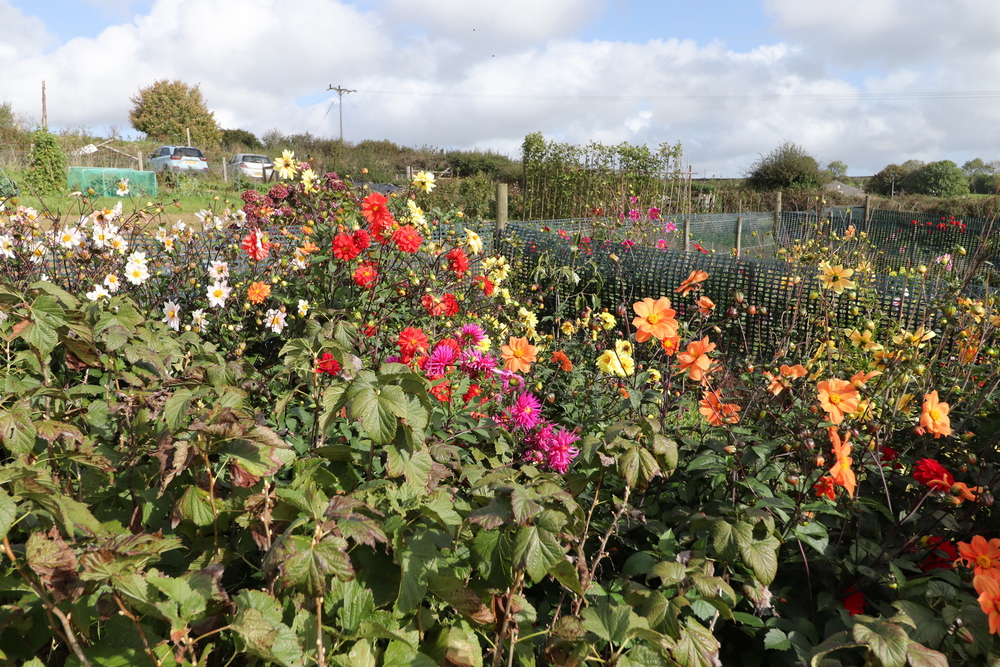
Up on my other plot I have Dahlias looking very colourful. These are plants I grew a few years back from seed off my garden plants. In the foreground is a row of blackcurrants, ‘Titania’, an excellent relatively sweet variety. In among the Dahlias are Camellia bushes. I’d given up on the Dahlias in early summer; nothing was showing so I planted the Camellias between the Dahlia rows. The Dahlias then came back fromthe dead and are now providing shade for the Camellias, which they won’t mind at all.
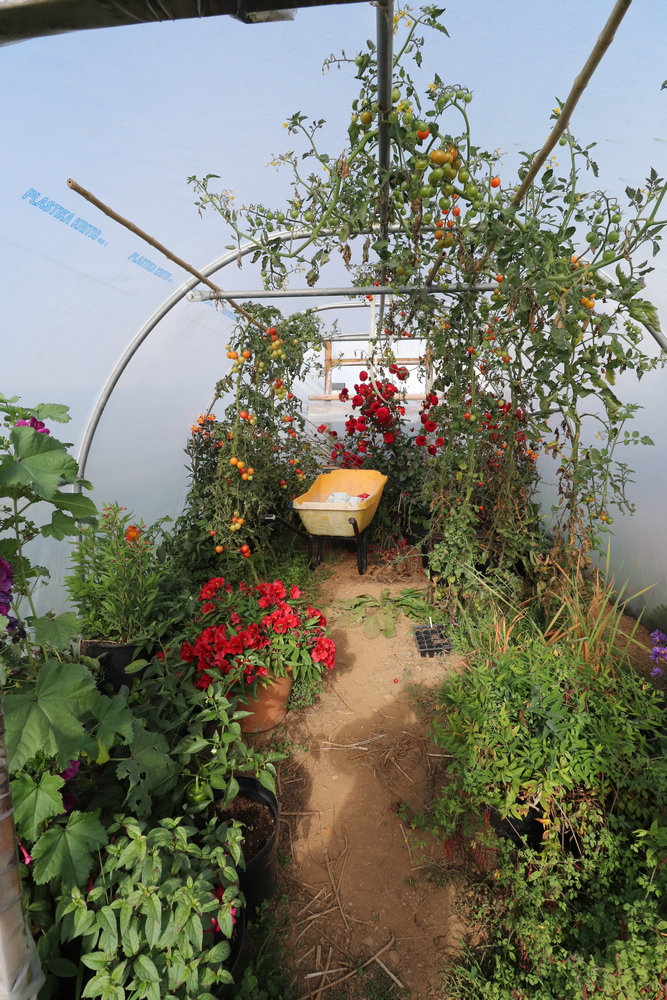
I haven’t really made the best use of my tunnel on the plot. There are still dahlias in it which were in the ground before I put the tunnel up. The tomatoes have been good. I started them in 3L deep pots, then rather than planting them properly I plunged them to the rim in the soil. They will have rooted out the bottom and had their roots in fairly evenly moist soil, but they weren’t able to put shallow feeder roots out sideways because of the pots and needed more feed than they got. I did pretty well with peppers too but had to pick them green and ripen them at home because they were otherwise rotting on the plants. The rest is back up stuff for the flower garden back at the house.
The rest of that plot either has stuff growing or will have shortly. I have one bed of strawberries where I foolishly put a row each of two varieties. I will move all of one to another bed and top it up with new plants from the runners. THe other empty bed is to be a new home for my rhubarb, which is not doing as well now as it has in the past; hopefully fresh ground will give it a new lease of life. That Dahlia on the left is D. campanulata. It has buds; I may yet get to see it flower. Last year the frost got it, this year most of it has snapped off in strong winds. 🤞

 garden ruminations
Wow amazing plot! You certainly have green thumbs! I did not know allotments were so spacious! Your dahlias are superb. It is a bit hot and dry for me to grow them her in summer.
LikeLiked by 1 person
A really interesting read. Dahlias so late here too. I’m into my third year of sowing green manures and they really do keep the weeds down. Here mallow, rocket and calendula self seed, the calendula run riot if I’m not careful. It really does make sense not to leave the ground uncovered so I hope you do get some trickle down. Love the TV progs btw.
LikeLike
Just the fact that calendula does that with you but not for me shows up the horses for courses nature of green manuring. It seems crazy to spend money on seeds of some designated green manure subject when free, self sown calendula or foxgloves or whatever will do the job much better. How different can rocket and mustard be from each other in efficacy, yet one is sold as a green manure and the other not, as far as I know. All you want is lots of winter growth and no seed set until after it’s cut down. Glad you like the TV progs, I’m thinking about November’s now.
LikeLike
Oh my, two allotments and your lovely garden. You are busy. Interesting about keeping up with ground cover. I’ve not thought about that.
LikeLike
Half of one allotment is informally sub-let. It seems to me that regenerative agriculture is currently the cutting edge of soil management thinking, there’s a real urgency about the need to adopt sustainable practices and maintain food security. It will trickle down to gardeners, though the urgency isn’t there as gardeners don’t put nearly so much pressure on their soils as farmers do.
LikeLike
It does look busy. I had no idea your temps were so mild . Makes for year round gardening.
LikeLike
Pretty much, though things slow down drastically in winter.
LikeLiked by 1 person
Cover crops in modules for plugging gaps is a stroke of genius, I’m definitely going to do that! Those dahlias are beautiful. Mine were so slow to get going this year. Do you lift yours overwinter or do you leave them in, since your climate is so amenable? I lifted mine for the first time ever last year and I must, reluctantly, admit that being spared the cold wet Welsh winter did improve their performance… eventually!
LikeLike