It’s all still growing! The garden is becoming impenetrable, the paths disappearing under lush vegetation. Will it get stopped abruptly by cold or storm, or collapse under its own soggy weight? I’m tidying the bits that have really had it, but so far that’s not much. The glasshouse tomatoes copped it yesterday but those in my tunnel are still going strong. Six items still in reasonable shape; here goes.
One.
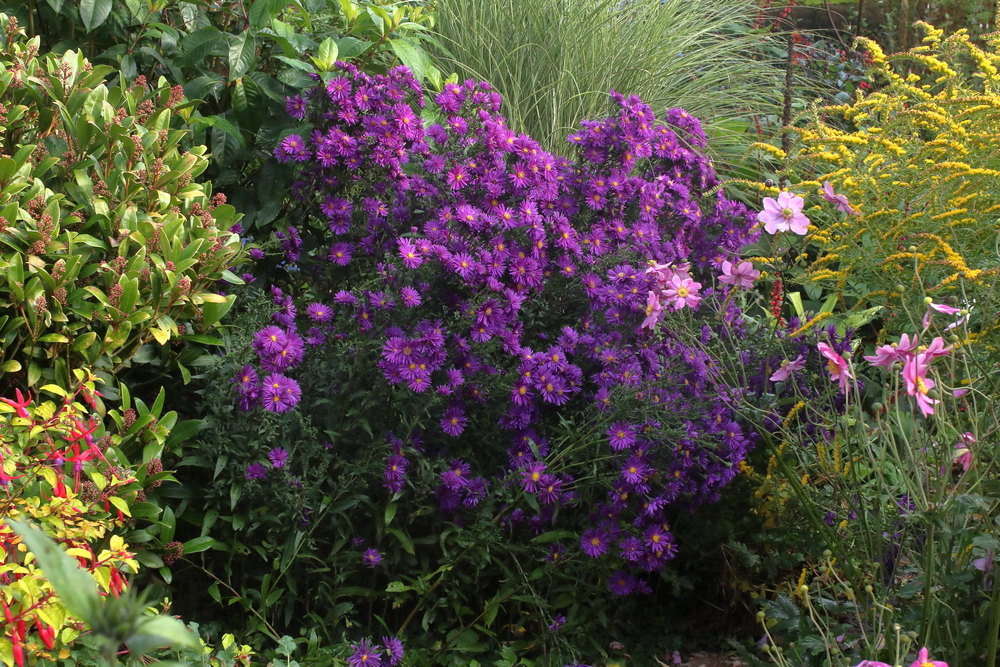
Curiously, there is a Symphyotrichum novi-belgii ‘Purple Dome’ and a Symphyotrichum novae-angliae ‘Purple Dome’. I’m pretty sure that’s not permitted under the rules of nomenclature. I know mine is ‘Purple Dome’ and I’m leaning to novae-angliae because it doesn’t get mildew and I’m pretty sure it’s the novi-belgii forms that do. It’s also a better match for the picture on the RHS website. It’s a fabulous colour, purple, in domes. In theory there is a path between it and the golden rod.
Two.
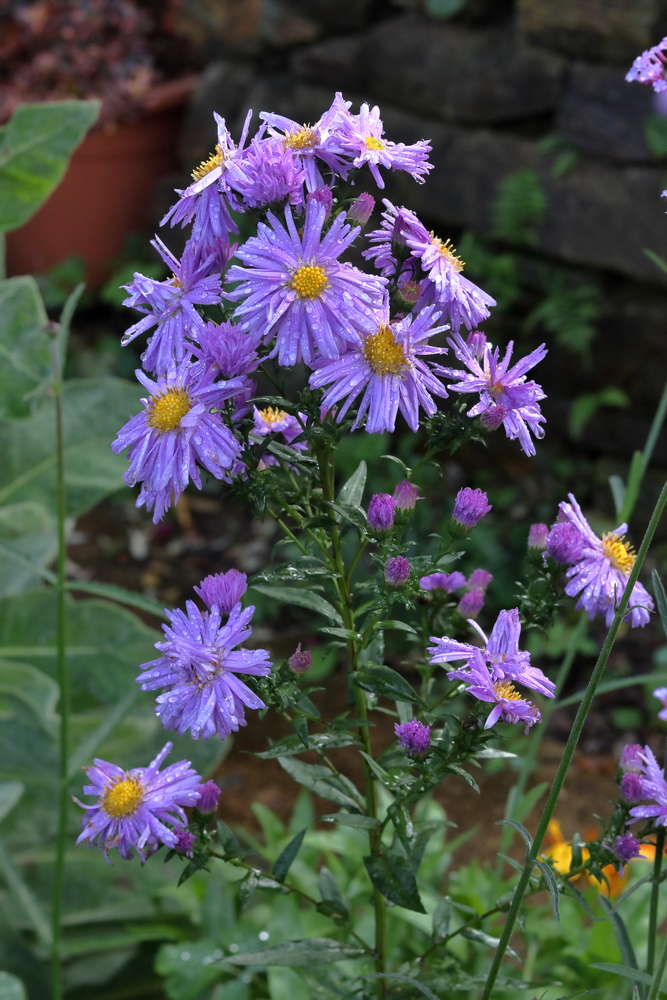
We had only two asters in the garden and the other one is pretty similar but not quite the same. We know it as “June’s Aster” because it came from the garden of someone called June. On Tuesday I noticed a third, which appears to be self sown. It has one flower stem which is sporting lots of good-sized daisies in a pleasing mauve shade. For now, it’s very definitely a keeper. It might need a name, like ‘Purple D’ohm’ perhaps.
Three.
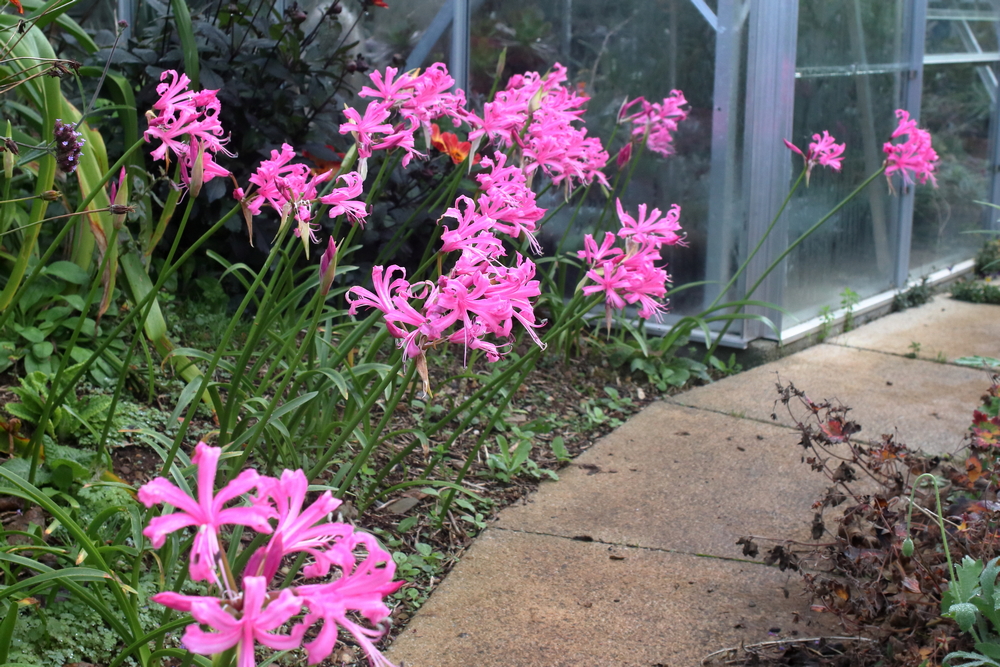
Nerine bowdenii. Having replanted these along the north side of a path, so they wouldn’t be overshadowed at any point in the year, I had such high hopes of them. They are a lot better than last year but far short of the best they’ve been in the past. I’m getting an ear bashing because the ground there is bare when our NGS visitors come in mid summer. I might be able to hold out another year, who knows.
Four.
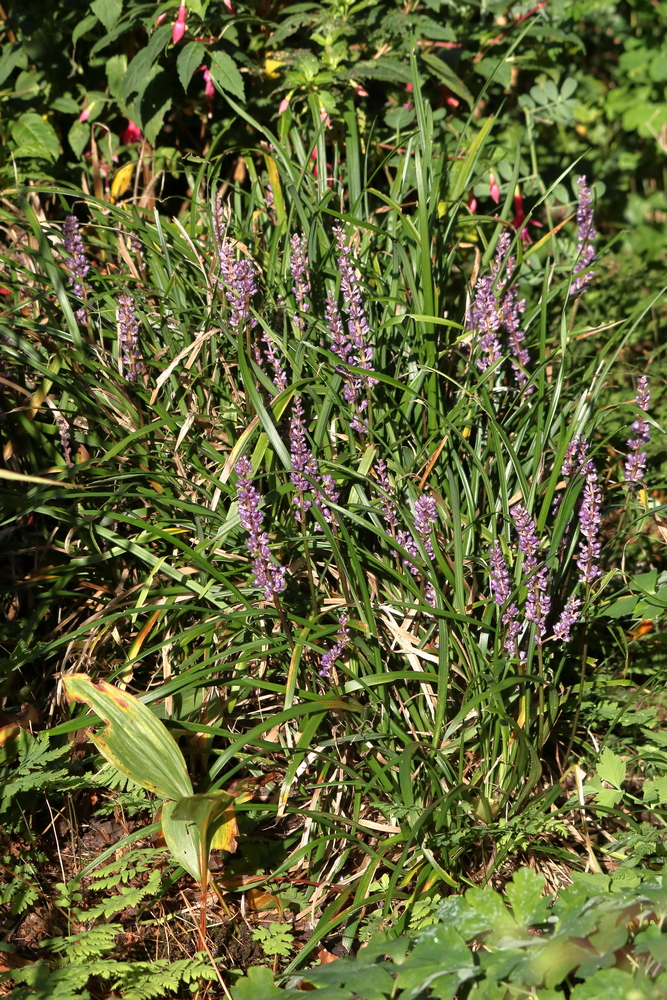
Liriope muscari. This was planted many years ago and has barely had a flower on it since. This year I was checking nightly for slugs on Dahlias very close to it and in spring I was removing a couple of snails from the Muscari pretty often. Later, as we headed into summer, I started noticing adult vine weevils on it and for several weeks I was finding two or three every single night. Since they must have hatched from grubs that were in the root system last winter and spring I’m somewhat surprised the plant is still alive, but it suggests it’s the damage done above ground by the adults that was stopping the plant flowering. So much for thinking the larvae were the real enemy and the adults just a nuisance.
Five.
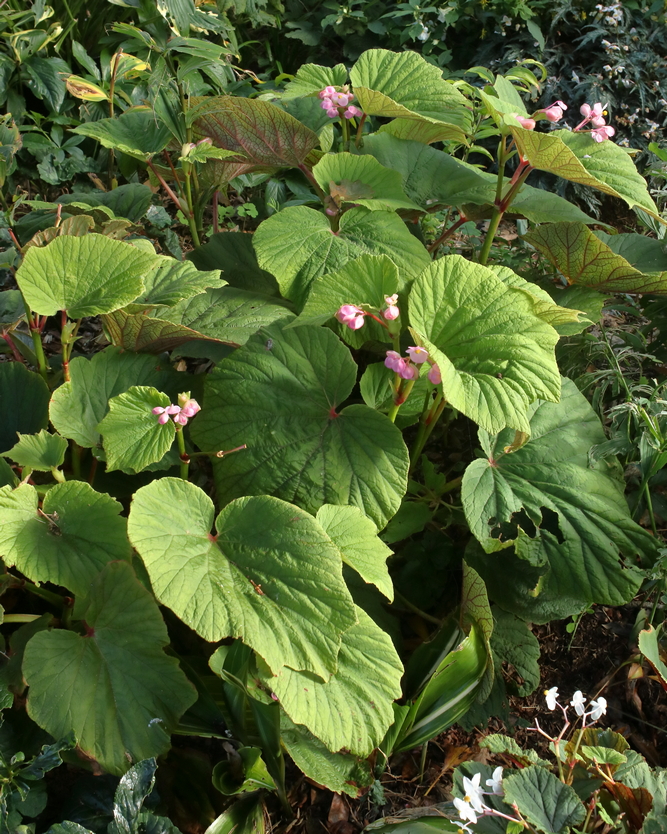
Begonia ‘Torsa’. Even in a bad year, and this has been a bad year for the things that like moist woodsy soil, ‘Torsa’ is an impressive plant. I’m not expecting a great flower display and the leaves are not as big as they were last year but it still really stands out. The light green leaves have just enough of a sheen to catch the light and by size alone contrast strongly with everything around them. I have lots of small plants in the glasshouse, this will stay out this winter with a covering of leaves; I’m confident it will be fine.
Six.
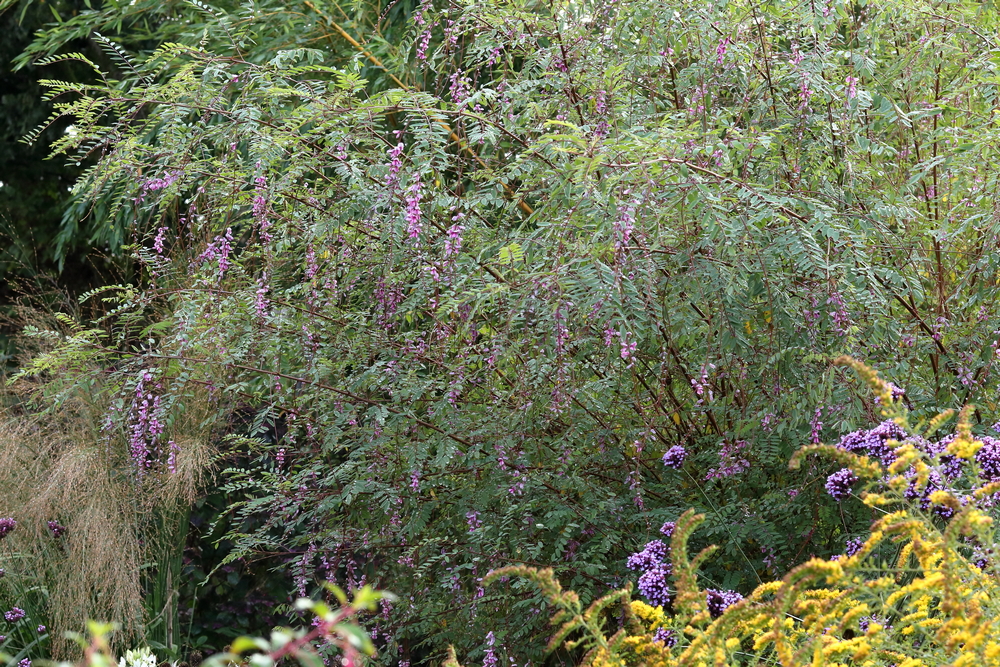
Indigofera pendula. This went into a six on July 16th when it was in full flower, then was repeated on September 9th when it was staging a comeback from the August heatwave. It’s still looking good, so I’ll be getting easily a three month flower display from it, pretty unusual for a shrub. Come winter I’ll prune it back pretty hard and next year it will do it all over again.
This morning we have an almost cloudless sky and no wind. Great gardening weather and I might just haul myself out to do a bit. Apple picking possibly, before they all drop, or chopping some of the Fuchsias down. I’m in no rush to start a big clean up and won’t be for a good while yet. Our host, The Propagator, is sitting around waiting for his to die too. Sounds like a good plan to me.

 garden ruminations
That purple aster is a great colour. The indigofera is certainly earning it’s place in your garden. The nerines may be a little disappointing, but mine (in pots) have produced just leaves for two years in a row. The compost heap beckons.
LikeLike
When you just bung something in and it performs well with no attention, you assume it’s an easy plant to grow, which in fact it is if the conditions are just right. For years that was me and nerines. Now it’s seeming like a difficult, challenging plant; presumably because something has changed a bit and it has a narrow range of conditions in which it will thrive, and I’ve moved out of it in some small way.
LikeLiked by 1 person
Lovely plants and colours again. Most of them I don’t recognise, so I learn new ones every week.
LikeLike
It’s not as easy to keep track of them all as it used to be, which reminds me, I meant to relabel some of the varieties on my apple tree.
LikeLike
Like your Purple Dome, whichever one it is! Also like your Nerines, I’m going to have to grow mine in pots in future as I think we are too wet in the winter for them, they never seem to do well for me unfortunately.
LikeLike
Mine have been very good in the past but have not done well the last two or three years, for no very obvious reason. Frustrating.
LikeLike
‘Purple Dome’ with the unpronounceable unspellable name is fabulous.
My Nerines always succumb to the slightest frost as soon as they flower which makes growing them seem a bit pointless, really. But I persevere.
LikeLike
My Nerines came from my sister’s garden in the north of Scotland so must be as hardy as nerines get, they do vary a lot, especially when you get away from N. bowdenii.
LikeLiked by 1 person
I always find some words that tickle me. Today they are, “In theory there is a path…”
LikeLiked by 1 person
Begonia ‘Torsa’ is impressive. My colleague down south ‘may’ grow one. We always knew it as such, and it mostly fits the description, but the foliage is a less appealing darker green, like the vinyl roof of the old 1972 Electra. I should have gotten a picture while I was there last week. Actually, I did get a picture, but deleted it. On the entire plant, only a single leaf was unblemished. All others were torn, broken or otherwise damaged. In the future, I may get a copy of it. I just do not want the commitment right now.
LikeLike
The size of the leaves makes them vulnerable to wind and they don’t like to be too dry either. It produces lots of bulbils as it dies down, a propagator’s dream.
LikeLiked by 1 person
Dream or nightmare? You know how difficult it can be to refrain from propagating everything that makes itself available to propagation. I brought back a bunch of debris from Brent’s garden, and even after giving most of it away, canned more palms, strelitzias and blue ginger than I can accommodate.
LikeLike
As much as I hate to admit it, nightmare is probably more accurate. I’ve already packeted up seed of 20 or more plants in the garden, most of them perennials of which I have absolutely no need of more. The propagator has no room left in it. ‘Torsa’ is the worst, I will probably get 100 or more bulbils this year, which one online nursery here is selling for £7 each! I have at least 50 plants from last year’s crop getting under my feet. What am I supposed to do?
LikeLiked by 1 person
If I knew, it would not be a problem. I actually appreciated the confinement of my suburban garden in town because it compelled me to share what I grew rather than trying to fit it all into such limited and mostly paved area. I make a point of not allowing anything but saleable commodities onto the farm. For the moment, I have exceeded my own limitations here, but can justify it by knowing that most will go into landscapes at work over winter. Even there, I am careful to not fill up the area with plant material just because we can. Also, we enforce strict conformity to ‘style’, which does not allow for palms or ‘tropical’ looking plants. Even Canna have limited application.
LikeLike
I do give away a fair amount of stuff and one of the benefits of garden opening is that it’s a chance to sell surplus plants. We took a decent amount on plant sales this summer which is good; gaining some space is even better.
LikeLiked by 1 person
We use some of our surplus at work, and sometimes leave a bit outside the Post Office for neighbors.
LikeLiked by 1 person
I added my first Pygmy date palm yesterday, and will be adding a matching specimen later. We will add a few canna after winter. They do not conform with the style, but they will be confined to a small area where we want flashy plants.
LikeLike
The advantage of your own rules is you can break them with no consequences.
LikeLiked by 1 person
GUILT is a consequence. Besides, the Pygmy date palm went into a landscape that is not mine. I like the material to conform to the style of the redwood forest. However, some guests are not from California, so expect to see palm trees, at least to some degree, while here, and are not aware that they do not conform to the style of the redwood forest.
LikeLike
I remember finding the sight of European trees in rural parts of New Zealand pretty jarring. Purple beech looks very out of place in the same settings here, to me. You have to know what should be there to see these things as wrong, and “what should be there” is nowhere near as clear cut as it sounds. Or is it a case of what you expect to be there and the things you dont expect are jarring. Palms growing in Australian swamps took a bit of getting used to, though they were native and had every right to be there. Not at all what I’m used to or expected to see though.
LikeLiked by 1 person
Palms are traditional in much of California, particularly Southern California. People from other regions expect to see them here. However, only one species is native here, and it is somewhat rare in landscapes. Oklahoma has as many native palms as California does. Although a few species of palm are native to Hawaii, all are of only one genus.
LikeLiked by 1 person
Love that Aster, and picked up a few pointers in the script. I do like your new Aster self seeded in the garden too.
LikeLike
I think I’ve struck lucky with the Aster, it’s the exact colour of Verbena bonariensis.
LikeLike
Nice one then!
LikeLiked by 1 person
Thank you Jim, lots of colour. Thanks for including your Aster it has helped me confirm the family for my mystery plant, although mine has one small white flower, the stem and leaves all look similar.
LikeLiked by 1 person
The Purple Dome is an ace! I have one that looks very similar and is called ‘Violetta’ which is about 1.60m tall but maybe a little less flowery than yours. Nice six this week, well coloured !
LikeLiked by 1 person
I’m a great fan of Liriope muscari as I find it a great plant for dry areas, under trees etc.
LikeLike
I’m hoping I’ve found out how to achieve its potential, I’ve often admired it elsewhere.
LikeLiked by 1 person