Here we go again, six on Saturday episode 280. Things just keep on happening in this garden of mine, which is just as well, that being the point of The Propagator’s excellent Saturday soiree.
One.
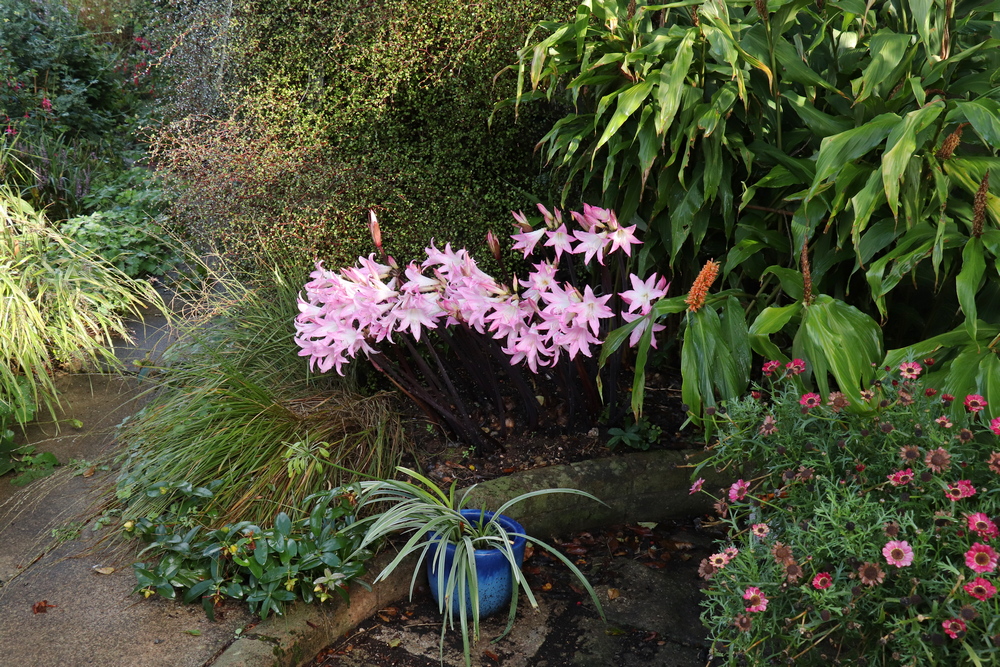
Amaryllis belladonna. Again; not quite a repeat of last week as it’s a different clump of them, in the back garden rather than the front. Sugar pink amongst the green, they are alongside a big clump of Hedychium which is dormant when the Amaryllis are in leaf, then arches over the bare area when they go dormant. Now the Hedychium is trussed up out of the way except for the one shoot that thought a bit of late orange would add something to the picture.

Two.
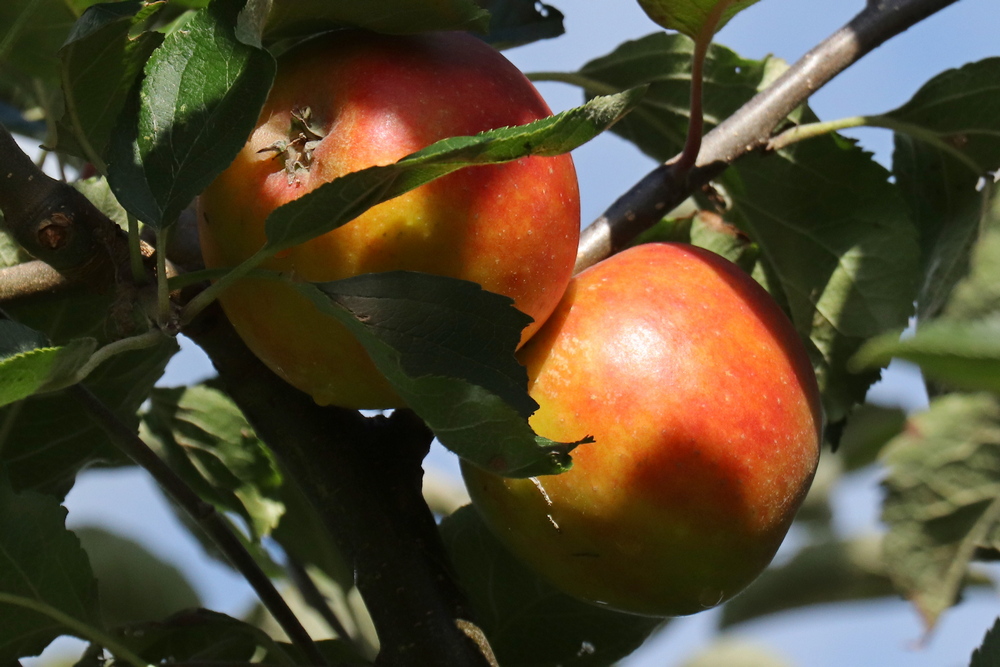
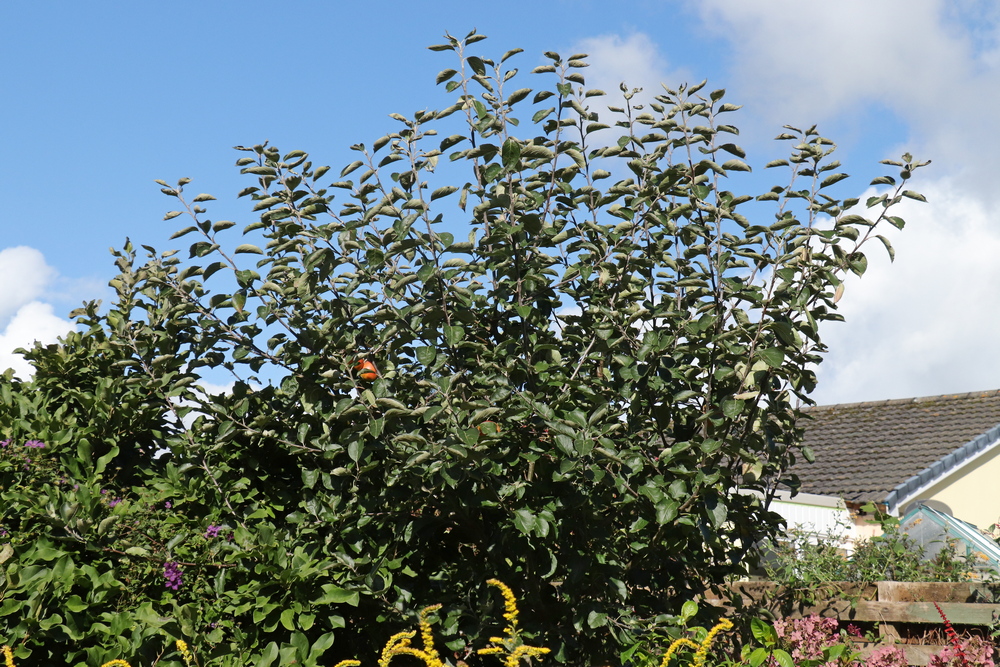
Malus domestica ‘Holstein’, syn ‘Holsteiner Cox’, Vahldiks Cox Seedling No. III. A German raised apple from 1918 that may have ‘Cox’ in its parentage. A German work colleague gave me some scions years ago and this tree was raised from one grafted onto MM106 rootstock, a medium vigour stock that in this instance, combined with a vigorous scion variety, is rapidly making a sizeable tree. I picked up a windfall yesterday and had it with my tea, it was absolutely delicious. It is also very healthy, with no sign of scab or canker, which plague many varieties in Cornwall’s damp climate. Unlike my other tree, which I summer pruned a few weeks back, I am intending to prune this in the winter again for this year at least. If anyone wants some shoots to graft onto a tree of their own, let me know. I can recommend the variety very highly and adding another variety to an existing tree is not difficult and will improve pollination of the host tree. I did a blog on it here a while back.
Three.
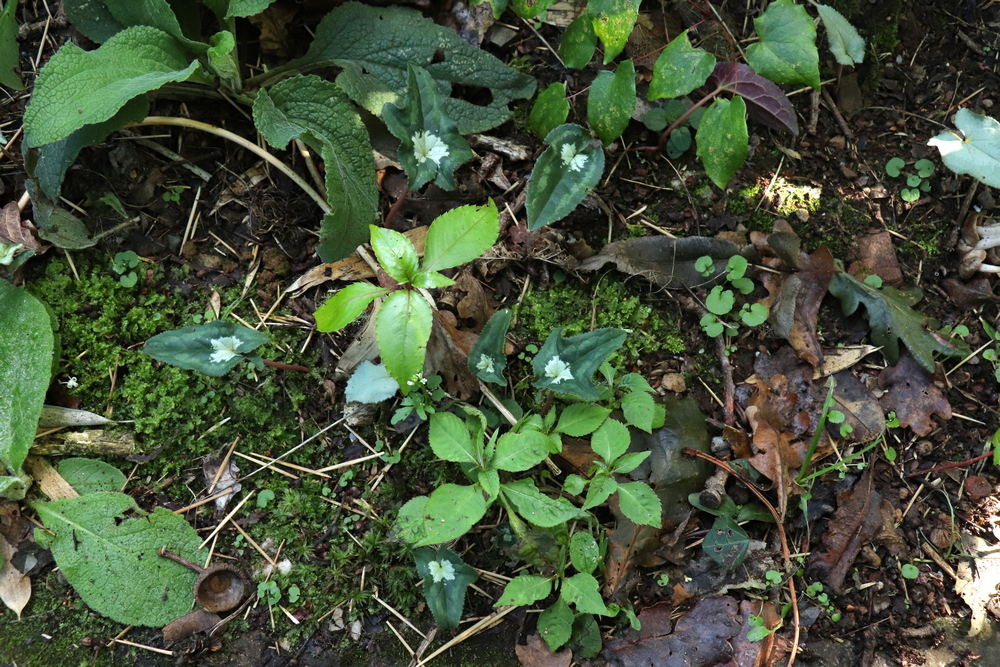
Most seedlings that come up in the garden are weeds or unwanted self sowers of cultivated plants, which I think makes them weeds too. Even so, I try to be careful, keep my eyes open, and not miss the occasional arrival of something more interesting. Hence I took a picture of this patch, which contains one possibly interesting new arrival. There are foxgloves, seedlings of cyclamen from seed that Noelle sent me, bittercress, Impatiens arguta (probably) alba and another Impatiens, with a glossier leaf and red midrib, which I will pot up and which will probably be a seedling of I. auricoma x bicaudata, except there is none growing anywhere near so it just might be something different.
Four.
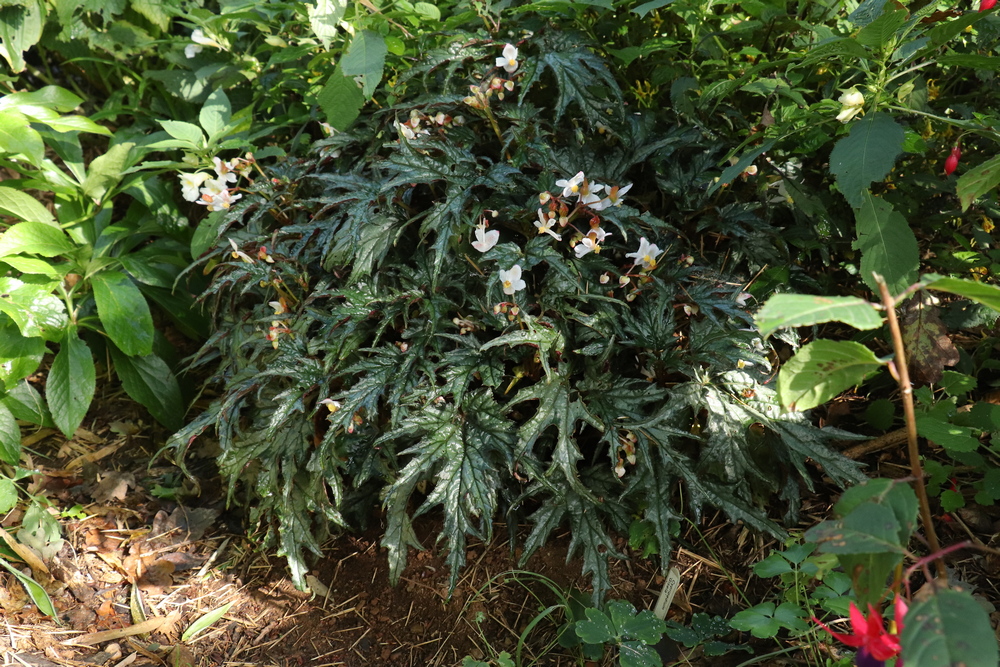
Begonia U614. Originally collected by Michael Wickenden of Cally Gardens and given to me with the name B. sikkimensis, which it subsequently turned out not to be. As far as I know it remains unidentified, perhaps a new species. With a bit of protection it has survived several winters in the ground here, though I lift and pot most of it and overwinter it under glass. Those plants, and this is one of them, come into growth much earlier and make much more growth than the outdoor plant. I have successfully raised several seedlings, all of which so far lack the silvering of the leaves that the parent plant has.
Five.
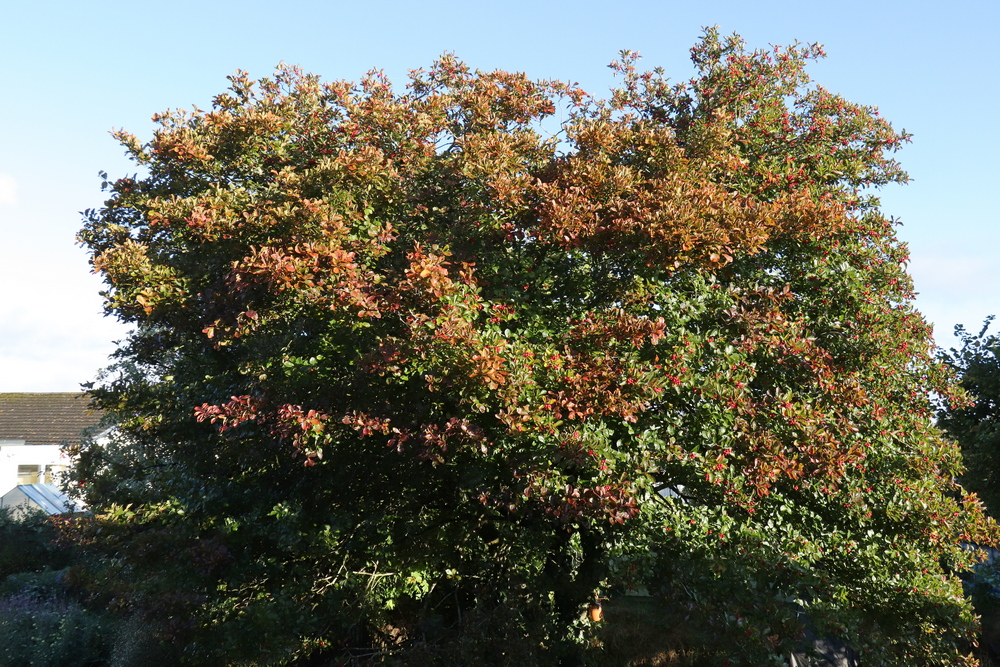
Crataegus prunifolia or C. persimilis ‘Prunifolia’. This is actually in our neighbour’s garden but planted only a couple of feet from the fence, so about a third of it is in our garden. I glanced out the window Friday morning and it was bathed in early morning sunlight. Like many a tree in many a garden, we get a better deal from it than our neighbours do. Most of it is in their garden and by mid morning it has stopped shading our garden for the day in favour of shading theirs. We’ve told them we’d be sorry to see it go and that the birds love it but that obviously it’s totally their call. It’s worked as a strategy so far and I doubt they follow my blog.
Six.
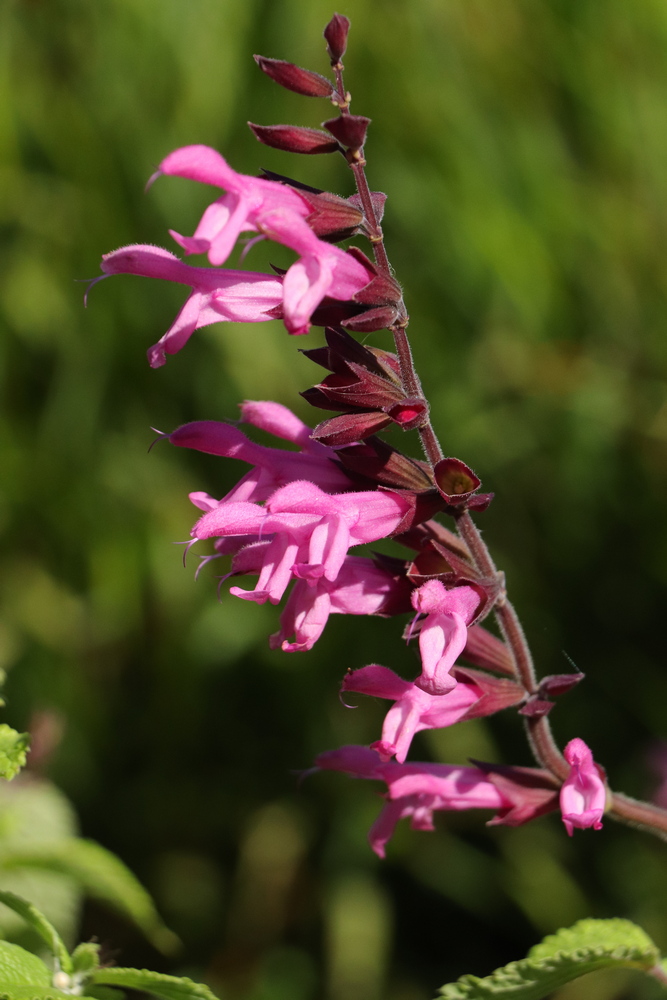
The salvias we have in the garden have made an amazing comeback since the dry weather broke. They are such valuable plants for their long season of flower and none is better than ‘Amistad’. I’d heard about ‘Pink Amistad’ but until last weekend hadn’t seen it in the flesh. Now I have and a purchase was made of a somewhat past its best plant. It lacks the richness of colour of ‘Amistad’ and there isn’t the striking contrast between flower and calyx but if it flowers as freely it will certainly find a welcome here.
That’s yer lot for this week, see you next week.

 garden ruminations
I must visit a garden centre for ‘Pink Amistad’. Well done on your garden tv spot. Having visited your garden in the summer it was lovely to see how it has changed since then.
Will you be making more programmes? I wish we had something like that locally.
LikeLike
They’re back to film an October programme on Monday! I hope the weather improves.
LikeLike
The amaryllis is a beautiful colour. Enjoying the neighbour’s garden is a good thing, sadly my favourite ‘steal’ a willow, became unsafe and had to go. Long may you enjoy your view.
LikeLiked by 1 person
Neighbour’s trees can contribute a lot, I helped fell a big sycamore on one boundary many years ago and was very glad indeed to see it go but still miss the big oak tree that was in the garden on the other side.
LikeLiked by 1 person
Wow, that Amaryllis is amazing! Like the salvia too, I can only keep them going by cuttings or bringing them inside over the winter.
LikeLiked by 1 person
I’m still trying to get a photo of the Amaryllis that I’m pleased with, it seems to be testing my camera more than somewhat.
LikeLike
Yes, picking and eating an apple straight from the tree in the morning is a good experience. I’m afraid both my little apple trees have given up producing any fruit but they did well for several years. Lovely amaryllis – such a perfect pink.
LikeLiked by 1 person
Ah, that’s more or less what I just said to Jane. I remember the apple ‘Greensleeves’ being pretty good straight from the tree and all but inedible after 24 hours, all its flavour having vanished.
LikeLiked by 1 person
‘Amistad’ survives the frost (sometimes as low as -7) in my garden. I recently had to dig it up and divide it as it had outgrown its spot. As a child in NZ I ate apples called ‘Cox’s Orange’ and I remember them very fondly. They were delicious. We don’t seem to get apples like that now, although ‘Pink Lady’ are pretty good.
LikeLiked by 1 person
‘Cox’s Orange Pippin’ is the yardstick against which all other varieties are judged here. It’s not an easy variety to grow and doesn’t succeed in SW England, so hybrids are very often planted instead. Most of what we get in the shops seem very disappointing, I suspect many go into storage until the price is better than it is at harvest time. Not many improve with keeping in my experience; I think a ripe apple straight from the tree takes a lot of beating. I suspect ‘Amistad’ survives the winter here but then can’t get going because of relentless slug browsing.
LikeLiked by 2 people
I saw the Pink Amistad for sale at RHS Harlow Carr but they only had a very large pot of it and I baulked at the price. I’m sure I’ll track one down soon though.
LikeLiked by 1 person
Otter Nurseries had a few small ones left at £8.99 and loads of big ones at £18.99. I went small, as any real gardener would. It’ll grow.
LikeLiked by 1 person
Do you grow your salvias outdoors in the ground? I don’t appear to be able to keep any through the winter months, but I do like Amistad and Pink Amistad.
LikeLiked by 1 person
We can’t keep ‘Amistad’ alive over winter in the ground, only ‘Hot Lips’ and the similar small leaved varieties, and they’re only good for two or three years.
LikeLiked by 1 person
The pink S. amistad is a lovely pink, but as you say, the contrast of petal colour to calyx colour is not as strong as with the purple amistad. The apple looks delicious. I still remember my surprise at seeing the huge apple trees growing alongside the towpath near Teddington Lock. The Amaryllis belladonna are superb.
LikeLiked by 1 person
There are loads of apple trees along the M4 between London and Reading, many of which look like they could be really good varieties; all presumably from apple cores thrown from cars. In many other places as well.
LikeLiked by 1 person
These apples look delicious but I’ll leave them to you because I have an astronomical quantity here. It’s been a great year for apples.
Very beautiful amaryllis belladona
LikeLiked by 1 person
I’m well short of having as many apples as I’d really like but this tree is very young and is only just beginning to be productive.
LikeLiked by 1 person
Sounds like a good apple variety and I do love the impressive Amaryllis.
LikeLiked by 1 person
It’s an excellent apple, I just had one chopped up on my breakfast cereal.
LikeLiked by 1 person
What is Crataegus popular for? It is rare here, but seems to be quite popular in Europe, and particularly in Britain. The few old specimens here bloomed with simple and . . . rather mundane white bloom. There was a single tree here that bloomed with red crabapple like bloom, but it was not an appealing tree. The foliar color in autumn is nice, but not overly impressive. I happen to like the genus, but can not explain why. Perhaps it looks distinguished, even while young.
LikeLiked by 1 person
C. prunifolia is an American species but it has much the same character as our two native species, so it looks kind of familiar and in keeping with its surroundings while being a bit more ornamental, with glossy leaves, autumn colour, bigger fruits. Our native Hawthorn is characterful, especially the sculpted specimens you see in extremely exposed places, somewhat ornamental in flower and fruit and of a suitable size for small gardens or confined spaces. There are beautiful specimens dotted around Bodmin Moor, windswept, gnarled and rugged, often heavily festooned with lichen like Spanish moss.
LikeLiked by 2 people
So they are sculptural trees, rather than colorful? That is sort of what I like about the few old specimens that I encounter, but because they are neither appreciated nor properly maintained here, they are less than exemplary specimens. I see some in Ben Lomond that were likely installed as a formal hedge, with symmetrical spacing and flanking a driveway, but then grew as small trees, only to be cut back down, with horrid stumps from which all the secondary growth emerged. I likely would have cut them down also, but would have coppiced them neatly to the ground. I can not help but wonder what they would look like, either as a renovated hedge, or as a row of small trees.
LikeLiked by 1 person
The Acts of Enclosure between 1600 and 1900, when common land was enclosed and given to private landowners, resulted in many thousands of miles of hawthorn being planted in England as hedges. I doubt there are many truly ancient ones left but it is still common as a field hedge.
LikeLiked by 2 people
So there was formerly a utilitarian aspect to their popularity that still makes them familiar now.
LikeLike
I believe many of the seedlings came from Europe, so the provenance of the UK population is possibly pretty mixed. I have no idea how common a tree it would have been before it started getting used for hedging on a large scale. It colonises open grassland areas very quickly in the absence of cultivation or sheep; an aggressive pioneer species.
LikeLiked by 1 person
Tony, I grow Crataegus prunifolius here also and value it as a garden plant – a good display of flower, of haws and of autumn colour.
LikeLiked by 2 people
It must perform significantly better there than here. The bloom here is no more impressive than that of pear. I happen to like the berries, but they are no more abundant than those of cotoneaster. Even the autumn color, although nice, is no better than that of crape myrtle. The trees are rare, but when I see them, I sort of wonder why they were planted. I should get better acquainted with them. I intend to add two of two different cultivars to my garden, but for their fruit rather than for their ornamental characteristics.
LikeLiked by 2 people
It sounds like it does with you much as it does with us. It’s a bit better on all those characteristics than our two native thorn species so it’s a bit more ornamental without looking at all out of place.
LikeLiked by 1 person
So, is it popular for the fruit? It makes one of the more traditional preserves in the South.
LikeLike
I’m not aware of the fruit ever being used over here. It would seem poor fare for the South where I’d have assumed they had an abundance of much more exotic fruit to play with.
LikeLiked by 1 person
It is made into jelly only, so it is not ‘real’ food. It is more of a specialized condiment.
LikeLike
Same with crab apples (Malus sylvestris) here. We served it with Pork when I was young and still ate meat.
LikeLiked by 1 person
Yes, it is sort of like an alternative to crabapple, which also seems odd, since crabapple performs well in the same regions in which it is popular. Malus angustifloia is native there.
LikeLiked by 1 person