Even though the weather has returned to normal the fallout from the dryness and hot spell is still playing out. Some things are growing like it’s spring; ferns that had shrivelled and gone dormant are greening up, Fuchsias are making new growth and flowering profusely, Corydalis flexuosa is re-emerging in fresh greenery. Winter may be coming but you wouldn’t know it. I’m intent on enjoying it while it lasts. In pursuit of The Propagator’s edict, I give you six things in the garden on this very Saturday.
One.
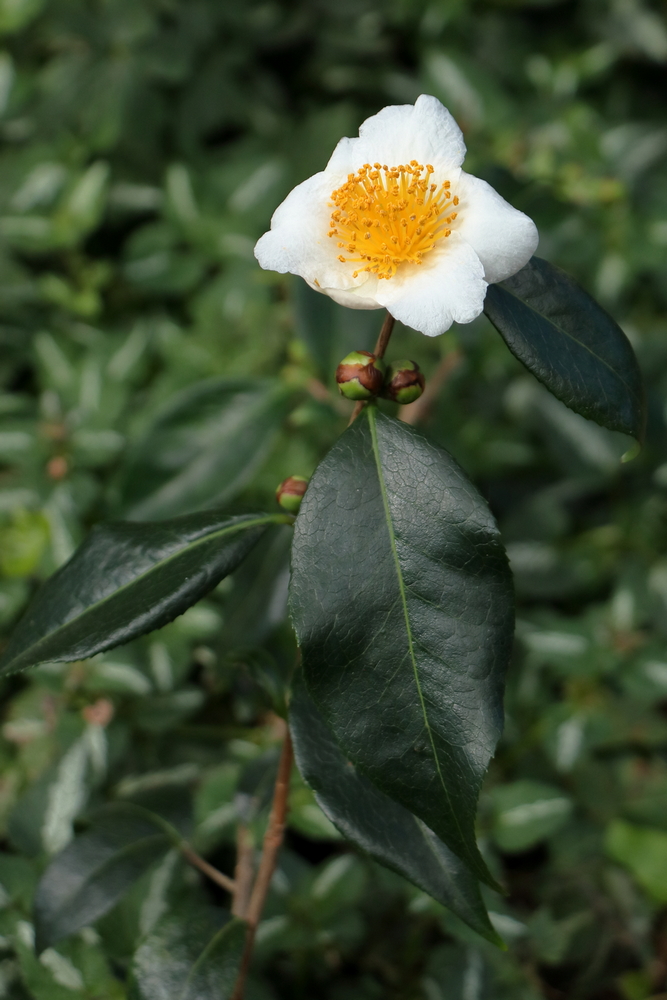
Camellia yunnanensis. First Camellia of the season. Even as a wild plant this species has a very long flowering period, with some plants flowering in autumn, others in spring. A few years back I was given propagation material of both and this flower is on a young plant that is clearly of the autumn flowering persuasion. Mid September is pretty early for any Camellia to be flowering, though it is in a glasshouse. The flower is not large, about 5-6cm across.
Two.
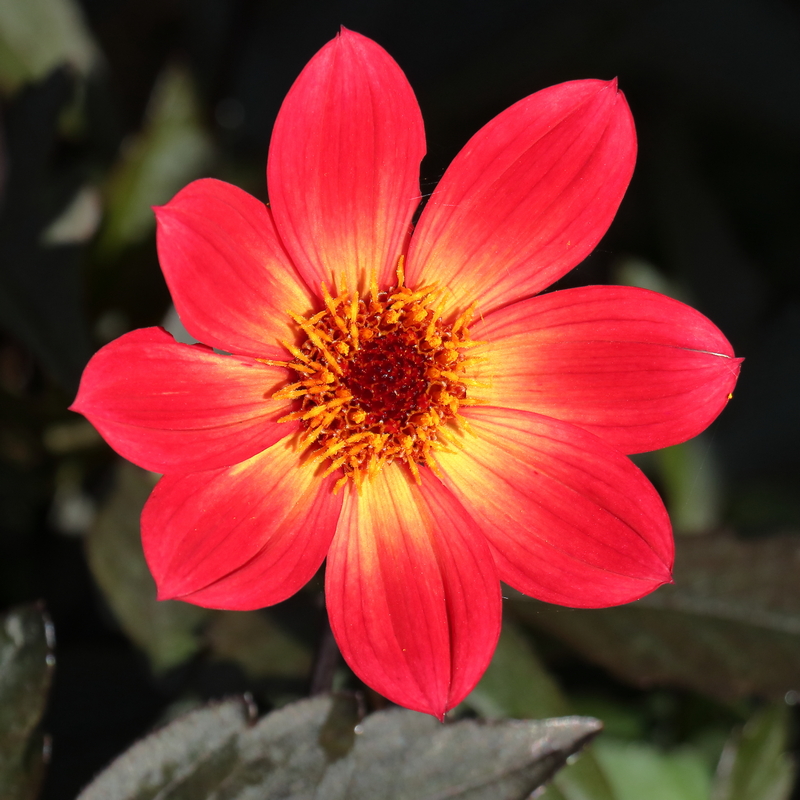
Dahlia ‘Happy Single Flame’. An Avon Bulbs purchase at the beginning of this year, this has never really got into its stride, frustrating since it is a fabulous colour and half a dozen blooms would be enough to grab your attention. Sadly it has never had more than two at any one time. Next year will be better and I haven’t given up hoping for better this year. I had ‘Happy Single Wink’ but seem to have lost it.
Three.
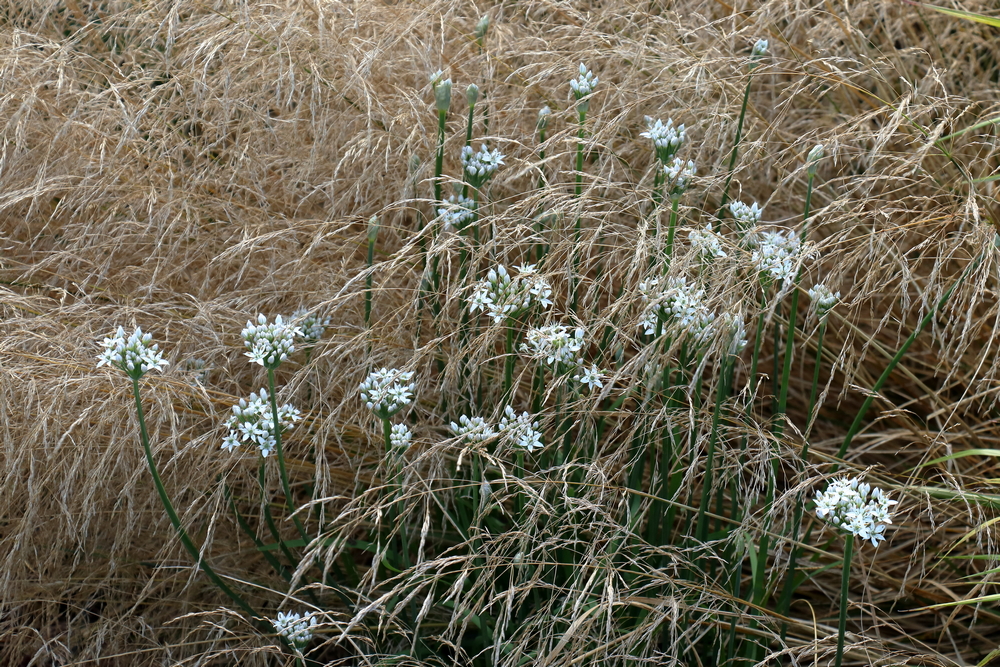
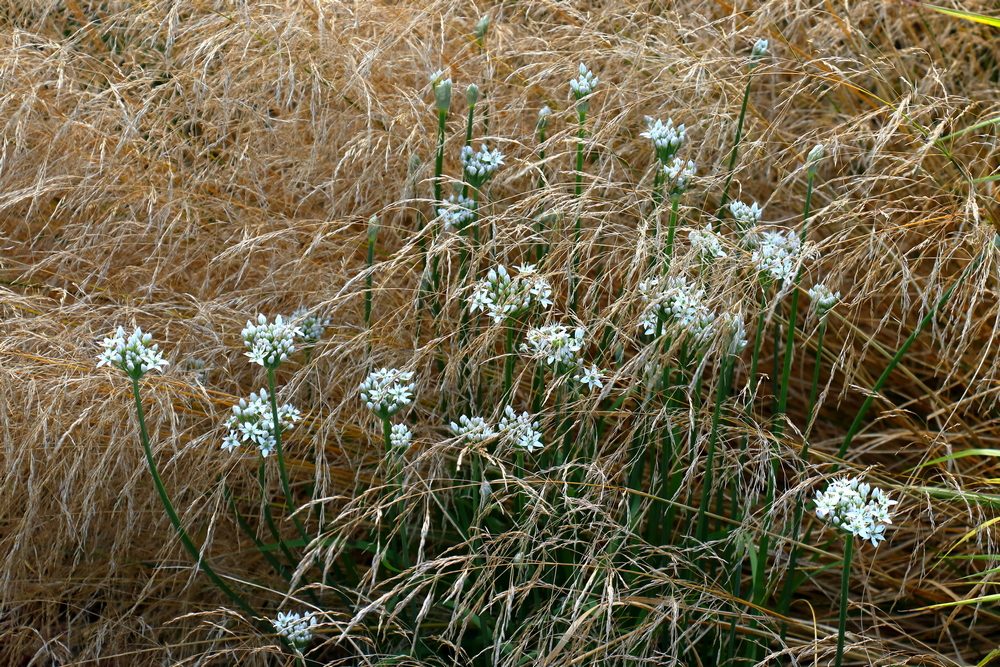
Sometimes something happening is no more than a plant combination that is pleasing on the eye. Garlic chives flowering amongst Deschampsia ‘Goldtau’. I liked the subdued tones and the contrast between straight green verticals of the onions and the arching fine grasses. Then I wasted an inordinate amount of time playing with adjustments on the photo editing program. So many pictures rely heavily on tweaked contrast and saturation; a picture that holds up well without that sort of exaggeration seems to me the greater achievement but people have become used to heavily enhanced images.
Four.
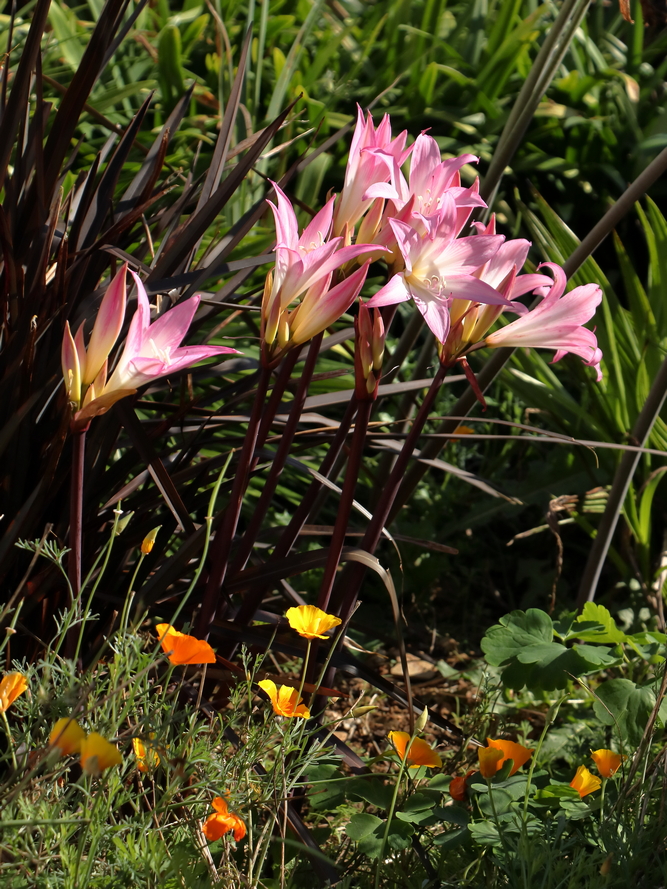
Amaryllis belladonna. Form two, as far as my garden is concerned. The later, and to my mind better form. These are having a good year, there is another clump in the back garden which needs the Hedychium that is leaning over it pushed back.
Five.
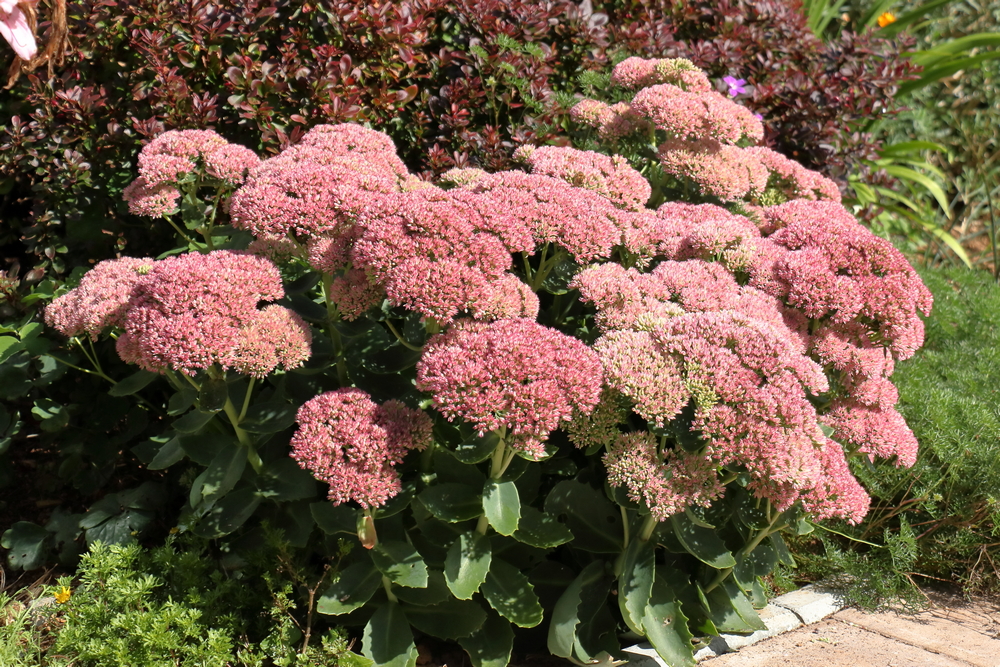
Sedum spectabile ‘Autumn Joy’ or Hylotelephium ‘Herbstfreude’, whatever floats your boat. It’s taken us 30 years and several failed attempts to finally find somewhere that this thing is happy. Out went I to take its picture in the warm morning sun, ready to fight my way through clouds of butterflies and bees. One bee. “Give me spots on my apples but leave me the birds and the bees, please”.
Six.
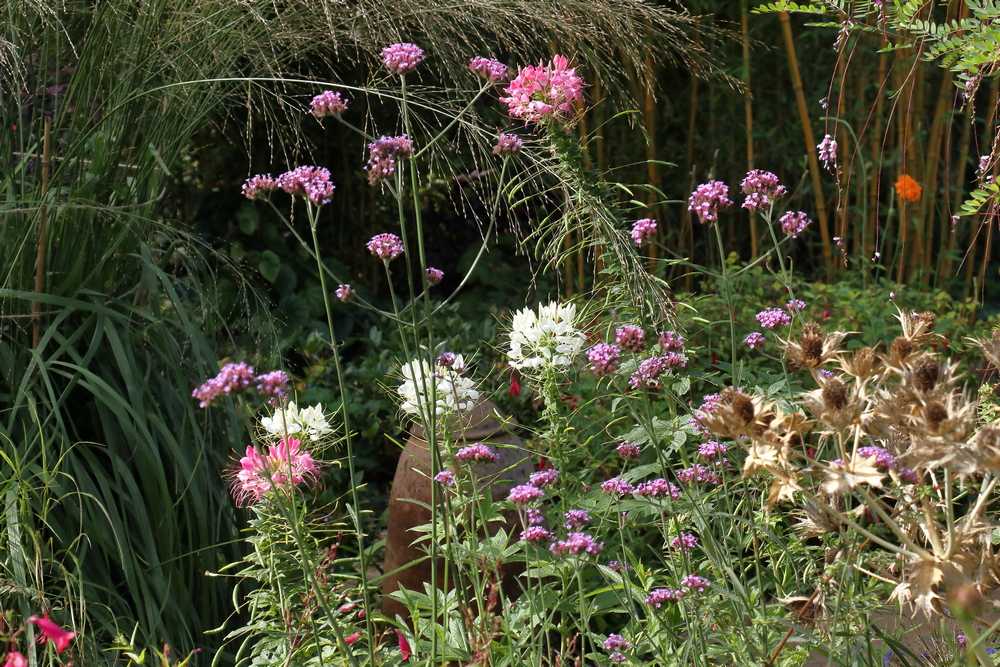
Five weeks ago the flowers on the Cleome were lasting no time at all, as fast as one individual flower opened, its predecessor shrivelled. Now they are sporting decent clusters of spidery flower on tall, wiry stems. Only in absolute calm do they stand still and in Cornwall we don’t get absolute calm very often. The same is true of the Verbena bonariensis, Molinia ‘Transparent‘ and Indigofera pendula in the picture; always moving. The number six slot is for the Cleomes though, with thanks to Becky for seed of the white one and to Fred for seed of the pink.
Another week gone, one in which life has carried on as normal against a background that suggests it is on hold for the whole nation. Roll on next Saturday, by then the circus will have left town and be long gone.

 garden ruminations
Your amaryllis is fabulous, I am pleased to see that my Amarine has put up three spikes. Still in a container though, I just daren’t plant the bulbs into the ground as it gets so wet in the winter. I see from your comment to Gill that you have many more flowers to come.
LikeLike
I have two or three Amarines about and not a single flower spike on any of them when I last looked. All in containers, one in the tunnel. Grizzle.
LikeLike
The spikes on mine only appeared a week ago, they came up quite suddenly.
LikeLike
Had a look at mine again yesterday, nothing happening.
LikeLike
Never mind OMAHGT and Big Yellow Taxi, I am still trying to stop “I’m gonna make you a star” going around my head! Lovely Six-on-Saturday, as usual, Jim.
LikeLike
Ouch! Not sure I wanted to be reminded of that one. Joni Mitchell has better stood the test of time.
LikeLike
Amaryllis belladonna was planted here by Carol Klein when she was filming here, she planted it deep, that was in 2006. Never saw it again until last year when the leaves appeared, but no flowers. Same again this year, think I’ll dig it up and put it in a pot!
LikeLike
The RHS encyclopaedia says to plant with the bulb tip at soil level and that they will adjust their own level, sometimes pulling themselves down some way. I have bulbs pushing out of the ground, a third above soil level, but in the main they are not flowering, the flowers coming between the visible bulbs, presumably from others that are down below. Sun and warmth seem to be the key, with nothing in front of them to cast shade on the bulbs or foliage, then left undisturbed for a few years.
LikeLike
I’m going to have ‘Big Yellow Taxi’ playing in my head all night now.
LikeLike
🤣 I’ll make future references more obscure, bury the ear worms deep.
LikeLiked by 1 person
So ‘that’ is why people grow Sedum spectabile! It looks like pink cauliflower. ‘Autumn Joy’ was the only cultivar available here for a long time. It seems that another cultivar became available recently.
LikeLike
‘Autumn Joy’ is supposedly a hybrid between S. spectabile and S. telephium. S. spectabile is native to China and Korea, S. telephium is native in the UK and grows wild hereabouts, often in shade. I have it in the garden and it’s as robust as you’d expect a local native plant to be, unlike S. ‘Autumn Joy’, which I see the RHS list as ‘Herbstfreude Group’, implying that there are several forms, not a single clone. Nobody seems to be offering seed of it though, so I don’t know where the variation has come from. I’ve seen dark leaved seed forms of S. telephium on sale.
LikeLiked by 1 person
That seems almost deceitful to sell a few forms as a cultivar. I think of cultivars as being genetically identical.
LikeLike
I think a cultivar is a clone but having read the Wikipedia entry for Group, or Cultivar Group, I am no clearer on what it means. Can a clonal cultivar be a member of a group? I will look into it further.
LikeLiked by 1 person
Cultivar is what some refer to as a clone. They are genetically identical copies of the original. That is how I learned it. The citrus and rhododendrons that I worked with were all cultivars. A variety can be a cultivar, but is generally grown from seed, so is therefore not a clone. It is generally true to type though. Seed grown Yucca of a particular variety would be naturally occurring varieties. Those grown from pups would be a cultivar.
LikeLike
I’m OK with all that and as confused as ever about what status “Group” has, as in Phormium tenax Purpureum Group, for which P. tenax ‘Purpureum’ and P. tenax ‘Atropurpureum’ are both given as synonyms. Is the implication that no clone ever existed of ‘Purpureum’ or ‘Atropurpureum’ or that many have been raised from seed of a clone or what exactly? It was Sedum ‘Herbstfreude’ that started this, and every name entry on the RHS website is given as a synonym, there appears not to be a definitive name.
LikeLiked by 1 person
Oh, of course. I misunderstood. I get it though, because I sort of wonder about that sometimes. I generally dismiss it as improper nomenclature. I do believe that the old and formerly common Cordyline australis ‘Purpurea’ was or is one of those sorts of groups. I gave up trying to figure it out. To me, it seems as if ‘Purpurea’ was or is a variety that is true to type from seed, and that cultivars have been derived from it. The cultivars and original variety are supposedly within the ‘Purpurea’ group, sort of like the Phormium group with a similar name. The original variety is sometimes described simply as Cordyline purpurea, as if it is actually a distinct species. I suppose that would make sense as well, but only one or the other (variety or species), not both.
LikeLike
Then things like vegetables that are normally grown from seed and not remotely clonal, still get cultivar names in single quotes as per the rules of nomenclature. Seed strains of annual flowers? How are they dealt with. Too confusing, my brain hurts.
LikeLiked by 1 person
They are varieties, which get the same single quotes as cultivars. Actually, cultivars are a type of variety, so get the same single quotes as varieties get. However, as you say, many seed grown varieties are described as cultivars. People just do not seem to care any more about proper nomenclature than about proper spelling and punctuation nowadays.
LikeLike
I care about proper nomenclature as well as correct spelling and punctuation but it’s a dodgy place to go with you in America and me here.
LikeLiked by 1 person
Facebook (if you go there) is a perfect example. I can not believe that some people expect to be taken seriously while they kant spel.
LikeLike
I rarely go there and bad spelling is some way down the list of reasons for not doing so. (WordPress is telling me I need a comma after “there”. I can’t understand how people misspell anything, or even use the wrong one out of there, their and they’re wen the bluddy masheen is puting them rite all the dam time)
LikeLiked by 1 person
EKSAKTLEE!!!
LikeLiked by 1 person
The Happy Dahlias all seem really good, this one looks a really intense colour. I can germinate Cleome but struggle to get them to grow. They ended up on the compost this year as they refused to go above six inches tall.
LikeLike
My Cleome were reluctant to get going until I started watering them regularly, they didn’t look dry but seemingly they were dry enough to stop growing. I put liquid feed in the water too. That was after they’d been planted out. It’s the same story as seedlings, they are fairly slow to get going and run out of feed before they’re big enough to move on, so they then stop growing. At least, that is how I read what was happening.
LikeLike
The Alliums look wonderful poking thru the grass like that, very meadowy. The amyrllys is truly gorgeous!
LikeLike
I’m not done with Amaryllis, see response to offtheedgegardening!
LikeLiked by 1 person
I’m happy to see the flowers of cleome. I had no white until yesterday! I found some while walking around and I took about ten seed pods for next year… it’s really a coincidence and it’s surprising that today you show these photos. Lunimous Dahlia !
LikeLike
I’m really loving the pink ones, which I wasn’t sure I would. They manage to be a vibrant pink without overstepping the line into garish or strident like some Diascias and Camellia ‘Debbie’.
LikeLiked by 1 person
Always good to see the camellia. Next year I think I might try cleome again, I remember struggling to get them going, or perhaps that was just me. The amaryllis is beautiful.
LikeLike
I just counted the stems on a clump of the same Amaryliis out the back, 43. Gonna be good! Cleome is worth cracking, I don’t think I did anything unusual with them.
LikeLiked by 1 person
That is going to be very impressive!
LikeLiked by 1 person
Your Sedum certainly looks happy where you have it now.
LikeLike
It’s by far the best we’ve ever managed, sitting over the concrete haunching for the new driveway. So long as it doesn’t get waterlogged in winter I think it will be happy there.
LikeLiked by 1 person