Last weekend we went down to the plant fair at Tremenheere, which netted me Begonia koelzii. On the way back we called in at Trevenna Cross Nursery where I found a reasonable plant of Begonia ‘Garden Angel Silver’. There were other purchases, mostly for Sue. I came home significantly poorer. Since then it seems mostly to have rained and I’d like to think I’d have to dig down a bit to find really dry soil, not that I’ve tried. Some things that had been all but written of for this season have rallied pretty well, notably Dahlias and Fuchsias.
One.
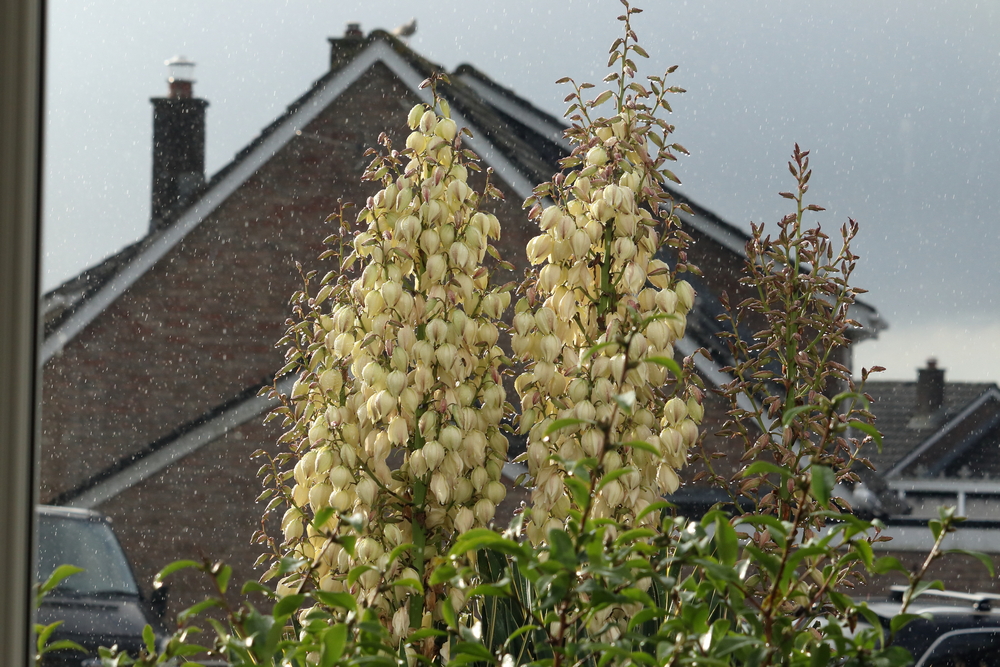
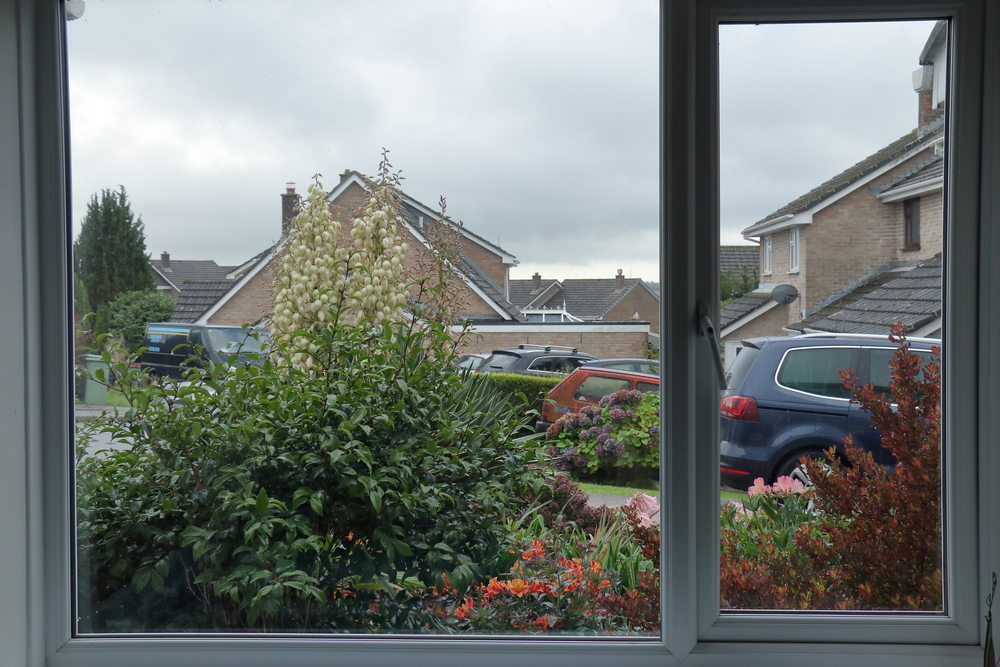
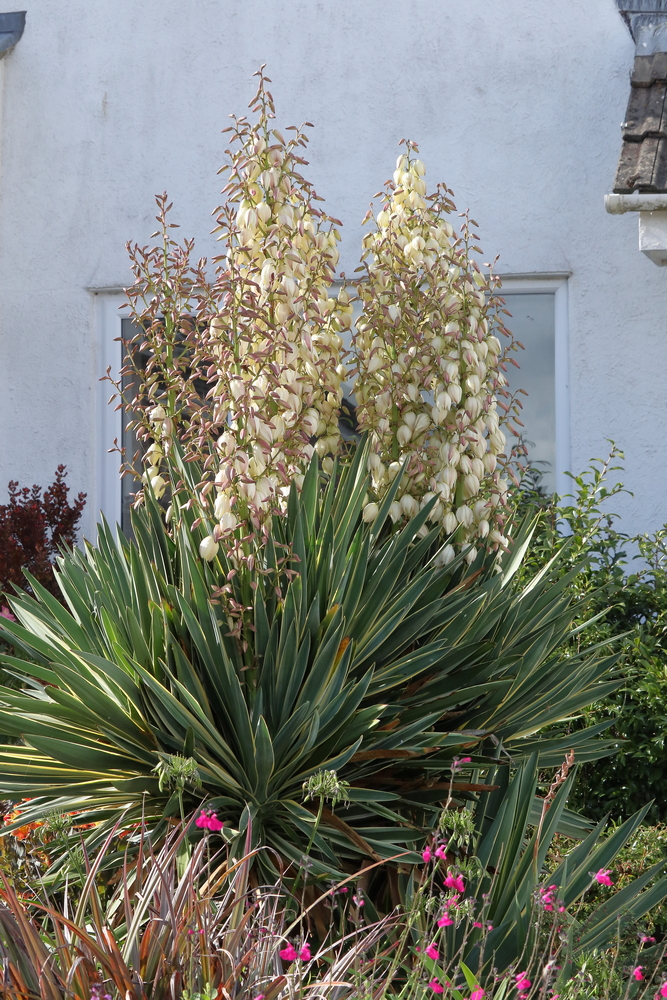
Yucca gloriosa ‘Variegata’. Three weeks ago I included this with flower spikes emerging. They have emerged and are now looking spectacular. It is right outside our front window and as much as the houses and cars are a distraction when I’m taking pictures, it is the yucca distracting attention from the rest that is the better take on it. The Camellia that is between it and the window comes into its own in November.
Two.
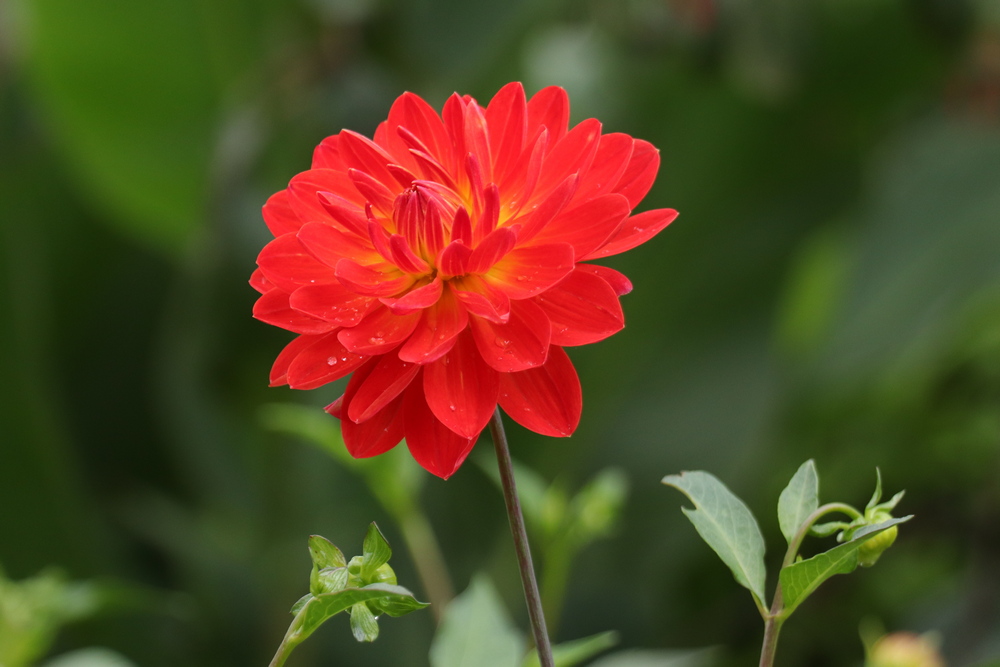
Dahlia ‘Red Velvet’. A single bloom still makes a better picture than the whole plant but at least the Dahlias now have flowers on them that are not shrivelling as fast as they open.
Three.
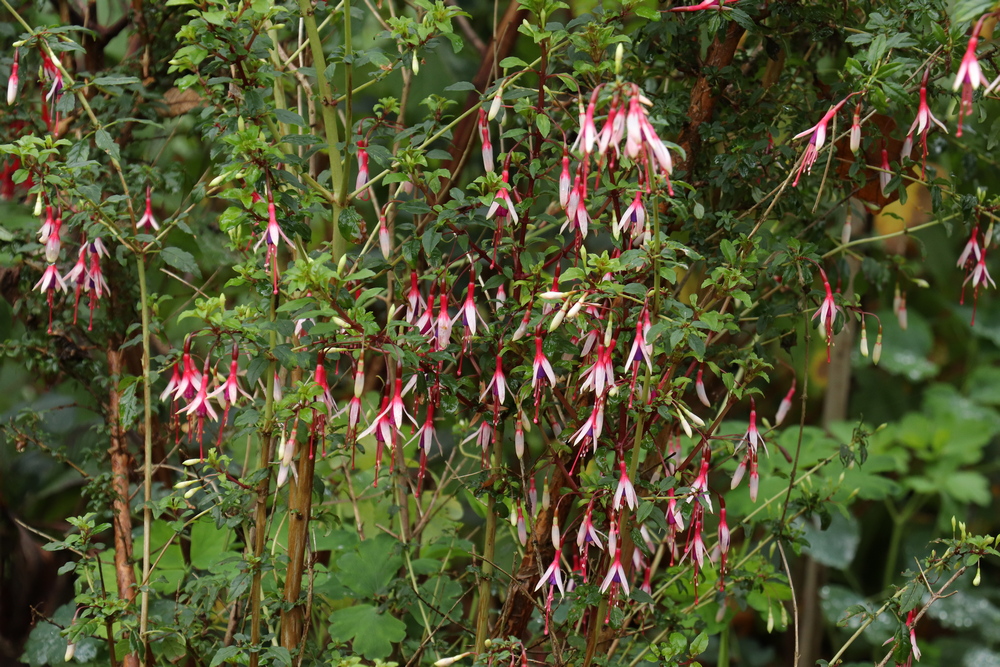
The battle against Fuchsia gall mite goes on but at least the weather is suiting the plants much better now. New growth is being made and some are now producing decent displays. Fuchsia magellanica ‘Arauco’ is a wild collected variant of the common F. magellanica, very similar to ‘Lady Bacon’, but much smaller in both flowers and stature.
Four.
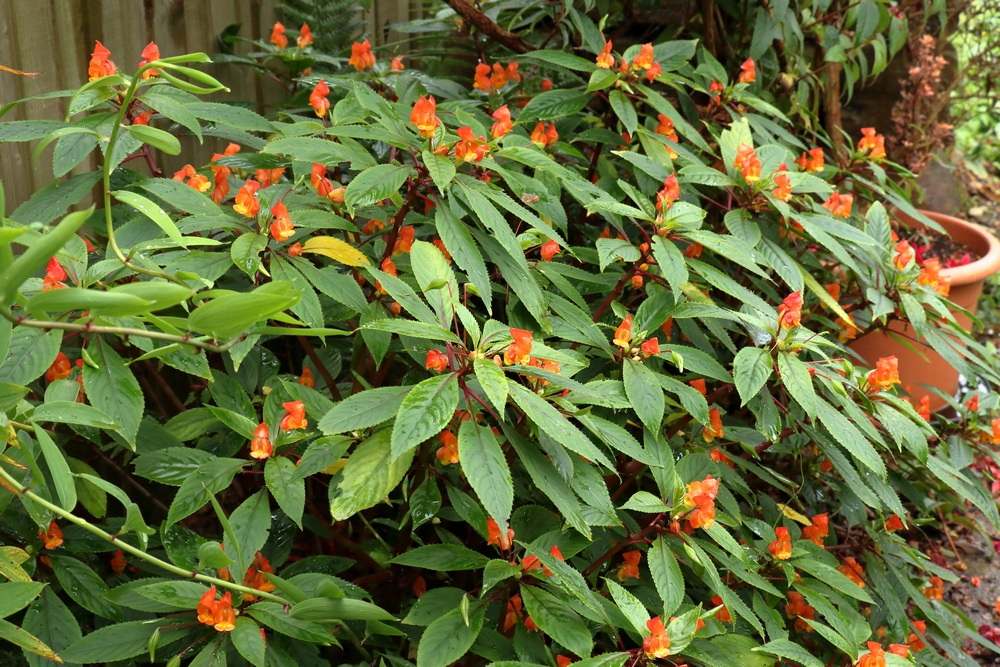
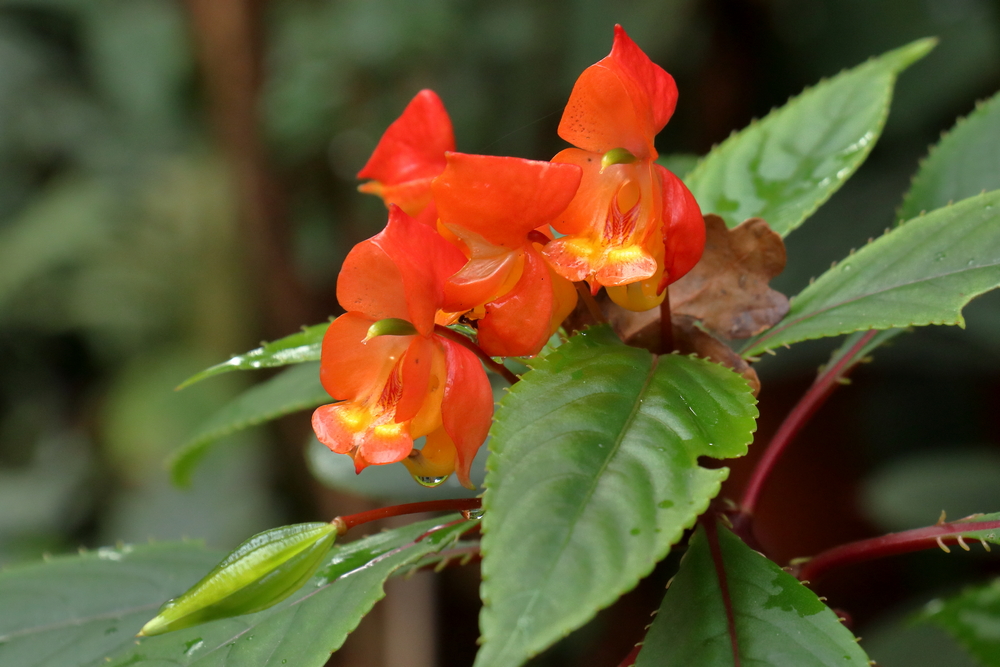
Impatiens auricoma x bicaudata. This is a very tender plant that will get trashed by the first frost, if it survives that long. It is absurdly easy to propagate; we take cuttings to overwinter small plants that get planted out around May. They then flower until October. The flowers are better coloured and more freely produced for being outside, all it asks for in return is a bucket of water a day, even when it’s growing in shade.
Five.
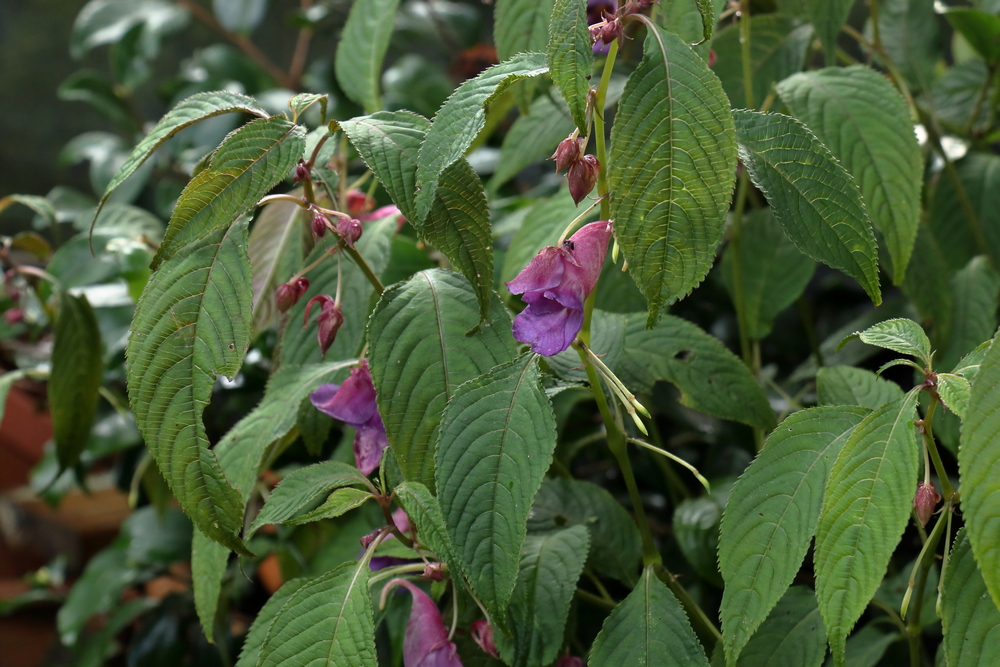
Impatiens arguta is also doing its thing in a pot. I tried planting one out but the slugs wouldn’t let it alone and it came to nothing. All the Impatiens seem insatiably thirsty but are otherwise undemanding. This one is hardy in the milder counties, as we Brits say. Won’t mean much to anyone else. They’ll take a degree or two of frost but not much more.
Six.
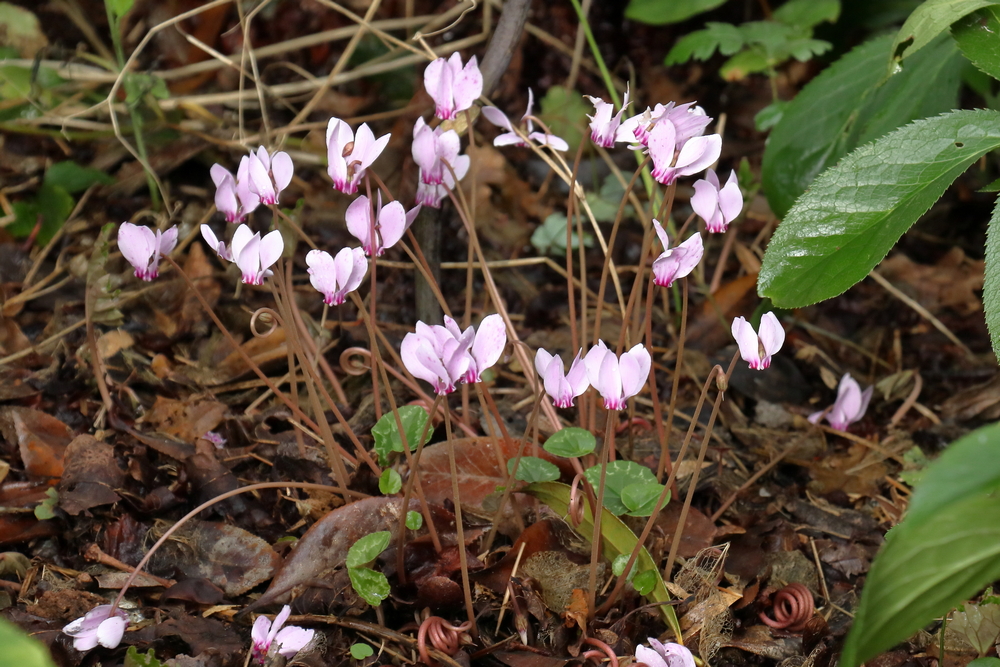
Cyclamen hederifolium. I had these flowering at the end of July, which seemed absurdly early. I’ve been collecting and sowing seed for the last few years, trying to build the numbers up and spread them around the garden. Now, when they are flowering, it is easy to see the spaces which they could occupy in the autumn and winter, but those spaces are full of other things in midsummer when the Cyclamen seedlings are dormant and happy to be transplanted. I took note of a lot of suitable places a year ago and planted dormant corms earlier this summer amongst various other things. The Cyclamen are popping up all over the place but are all still too small to have more than one or two flowers on each.
Bright sun here this morning and it would be nice if it stuck around for a bit. Don’t forget to check the Propagator for the rest of the SoS links, not that you would.

 garden ruminations
Wow some really great pictures! great job.
LikeLike
Thank you.
LikeLiked by 1 person
Beautiful plants, as always. I run out of original things to say about your garden and the individual plants. I do have a few tiny pink cyclamen but they didn’t like the dry weather.
LikeLike
Some of my oldest and biggest cyclamen are right under my big fastigiate yew tree. Either they tolerate extreme dry or intercept whatever rain falls on the tree before the yew gets it. I am at a loss to how they even survive, let alone thrive.
LikeLiked by 1 person
The Yucca is spectacular! You have a nice selection of impatiens which I have not seen before. The Cyclamen is pretty. Mine seem to do better in pots rather than in the ground.
LikeLike
Impatiens seems to be a genus where modern day plant hunters are frequently finding new species; with a fanbase of sorts getting excited for a while then losing interest as they turn out not to be as good as a garden plant as was hoped. Cyclamen are a lovely group of plants but there are only three species that I’ve found to be happy in the ground here. I’ve grown some of the other species in pots but they are more exacting in their needs so I can’t claim any great success.
LikeLiked by 1 person
Yucca is rad! Some of the species should be more popular in the chaparral climates here. Instead, I think that I see more Yucca in other climates farther north. Of course, they are not the desert sorts.
LikeLike
Only a few species are common here, gloriosa, filamentosa, flacida. That’s about it. Y. rostrata is getting a following, mainly I think based on plants from Italy. I have Y. recurvifolia ‘Banana Split’ but bring it in for winter. Are the others less hardy or less ornamental or just not well known?
LikeLiked by 1 person
Less hardy, but not in the common sense. Those that are endemic to desert climates are likely to rot there. Joshua tree and similar species of Yucca are not even happy here. As dry as our climate is, it is not dry enough. Some of the tropical species might not be happy there either, but I think that they would be easier to accommodate than the desert species. Yucca whipplei blooms spectacularly in the wild south of here, and I intend to eventually grow it here, but even that will be take some degree of effort.
LikeLike
Makes sense. I’ve seen Y. whipplei here a few times, even as far north as Edinburgh.
LikeLiked by 1 person
Wow! So you have seen it! It might be my favorite species of Yucca, perhaps because it is the first that I ever met in the wild. It is not so friendly in the garden though, and can be difficult to eradicate if it disperses pups. There are a few varieties of it, but the common sort that is native as far north as Monterey County is still my favorite. Some of the more densy clumping sort that live in the Santa Susana Mountains look sort of hateful without grooming, but no one wants to groom them.
LikeLike
We used to sell Y. whipplei on the nursery but never got to see it flower. I think the plant in Edinburgh is the only one I’ve seen in flower, though I may have seen it in Australia and not registered it. The Edinburgh picture was on a slide and the light had got to it, the picture, not the plant. I’ve just been looking at online pictures of it and now I want to get hold of one.
LikeLiked by 1 person
OH! I can not send live plants through the mail as easily as seed, and I lack seed for it. I will be driving past some when I go south after the 20th, but lack access to it while here. Besides, seed is not easy to get. Each of the fifty or so species of Yucca rely on a particular species of yucca moth for pollination. After placing a wad of pollen onto the stigma, the moth deposits eggs into the ovary. The larva that hatch from the eggs consume almost all of the developing seed. Therefore, those spectacular blooms might produce only a few seed, or none at all. It seems so futile. It is rare to find a seedling. The species seems to propagate almost exclusively by pups. When we were in school, we used to eat the floral shoots as very big asparagus. Those that bloom get very tall.
LikeLike
There were some pictures online which seemed to have pinkish flowers, not an improvement but different. Are there cultivars available over there? I wonder if the plants sold here are from seed or pups.
LikeLiked by 1 person
Flowers are blushed with purple or purplish pink as they emerge, but, as they bloom, fade to pale or luminescent white, perhaps with a very pale purplish margin. I am not aware of any cultivars. However, there are about six subspecies. Of these, I have seen only about three. ‘Whipplei’ is the common sort that I am familiar with. I also believe it to be the most visually appealing. ‘Newberryii’ might be considered by some to be a separate species from Arizona. ‘Eremica’ lives in Baja California, and is supposedly rather distinct in appearance, with shorter foliar growth and stouter floral stalks. ‘Intermedia’ lives in the Santa Monica Mountains, and, in some colonies above Beverly Hills, can exhibit relatively floppy and dingy green foliage. One subspecies that I believe lives in the Santa Susana Mountains forms relatively dense colonies that retain the carcases of the dead rosettes that generated the pups that developed into the colonies. I thought that they were less visually appealing.
LikeLike
None appear to be available here but if they are no improvement that’s not surprising.
LikeLiked by 1 person
Well, they may be unavailable because their identities are so vague. I mean, some consider one subspecies to be a completely distinct species, while others consider all subspecies to be mere varieties. To me, with the exceptions of ‘Eremica’ and ‘Newberryii’, they all look like varieties of the same species. Heck, there is about as much variability among the ‘Whipplei’ (subspecies of Yucca whipplei). I noticed that only one seed supplier supplied seed for the various subspecies, but described them as much by region as by name, just to clarify. Such seed might interest collectors, but really, the common ‘Whipplei’ is still the best.
LikeLike
I just did a short trawl for seed suppliers over here, there are some and I’m probably going to have to revisit their websites. I also found the website of Calscape, the California Native Plant Society. I’m not going to go short of reading matter this winter.
LikeLiked by 1 person
Rare Palm Seeds sometimes has it available. It is designated as Hesperoyucca whipplei rather than Yucca whipplei, and the common sort, Hesperoyucca whipplei ‘Whipplei’ is the one that lacks a subspecies or variety name, so is simply ‘Hesperoyucca whipplei’. Hesperoyucca whipplei ‘Caespitosa’ is one that I believe forms overly dense and mounding colonies around the carcasses of their deceased parents. The names are so unreliable that I do not know anymore.
LikeLike
I’m very tempted to get hold of it to try here, I’ll keep you posted.
LikeLiked by 1 person
Is your climate similar to that of Edinburgh? (Hespero)Yucca whipplei is endemic to chaparral regions, but also lives near the coast. I know that it can tolerate a bit of moisture through summer because it sometimes creeps into home gardens. I rarely see it far from its home though, and it is even very rare here. I really do not know how adaptable it is to other climates.
LikeLike
Wikipedia says that Hesperoyucca whipplei is “reportedly difficult to grow outside of its native range” but on what amount of experience is that based, I wonder. We would think of Edinburgh as having a very different climate from here (Cornwall) but by Californiam standards it’s probably almost identical. It may be that daylength is significant too, Edinburgh is much further north so gets very long summer days and very long winter nights. Cold wet winters would seem unlikely to suit it and ours would be warmer than Edinburgh, which sometimes seems to make things worse.
LikeLiked by 1 person
hmm, although I know that it has discriminating taste, it does not seem difficult to me. It lives at high elevations and down to the coast. Unfortunately though, dampness really is a weakness for it. It can tolerate significant rain here, and even occasional irrigation, but even through our rainy season, it dries out. The humidity is minimal, and the weather does not stay cool for very long. While we were in school, pups of Yucca whipplei came up within a lawn where Brent worked, and they were difficult to kill.
LikeLike
In a changing climate we are often encouraged to plant things that will tolerate dryer and hotter conditions and that perhaps are somewhat future proof. It makes good copy in magazines and on gardening programs. In practice it just isn’t as simple as taking plants from a hotter, dryer climate and planting them here. Some plants are very adaptable, others real niche types. Many plants grow far better in different climates to the one they’re native to, sometimes to the point of being a menace. And so on. Then there’s the reverse argument that vegetation creates weather and eventually climate and perhaps we should be supporting the vegetation we have as best we can to help keep the climate we have.
LikeLiked by 1 person
Well, although I am very fond of (Hespero)Yucca whipplei, I also know that it can be a problem in regions of Australia that it happens to like. It should not be invasive anywhere outside of its native range, since it relies on a very specialized yucca moth for pollination. (Each of the fifty or so species of Yucca relies on its particular species of moth.) I know how efficiently it migrates by pups, but pups do not get very far from parent plants. Actually, seeds, if present, do not get very far either. (Much of the few viable seed remains within the capsules until the floral stalks fall over, but that only delivers the seed about ten feet away.)
LikeLike
Talking of Australia, Xanthorrhaea glauca is growing very happily at Tremenheere in west Cornwall and it has more than a passing resemblance to Yucca. I wonder if anyone sells that here. Is it grown with you?
LikeLiked by 1 person
No, it is annoyingly rare. My colleague here grows only a few within one of the landscapes at work, but I am aware of only a few others elsewhere. It is almost never available from nurseries. Resilient plants that are naturally native to desert or chaparral regions should be more popular within regions where we ‘should’ conserve water. Well, it is a bunch of hooey anyway.
LikeLike
Most of the grass trees I’ve seen in Australia have been understory to rather thin woodland. It was coming back in thickets on Bribie Island where there had been fairly recent fires. I don’t think I saw X. glauca growing wild so don’t know what conditions it wants. I can buy seeds it seems. I’d have thought plants adapted to local conditions, native or non-native, would just be a lot easier to grow.
LikeLiked by 1 person
That is what I mean. The lack of availability for something that performs well here is a mystery to me. We can get all sorts of plants that are less happy with our climate, but find that many that should or do perform well are unavailable.
LikeLike
Is that due to import restrictions or it not being in anyone’s interest to bring in something so little known that selling it is not financially viable? Rare plants here often make it into private collections and botanic gardens but don’t get picked up even by specialist nurseries.
LikeLiked by 1 person
I do not know, but I doubt that there are any more restrictions on importing the seed than any other seed. I have seen it here, so I know that ‘someone’ grew it.
Now that you mention it though, and I should have considered this, it may not be easy enough to grow for nurserymen to bother with. That is a concern even for some of our native plants. Chaparral and desert species rot easily while being grown in nurseries, and many of those that survive do not like confinement of their roots.
LikeLike
And very slow to make a saleable plant too perhaps?
LikeLiked by 1 person
Oh, yes, I suppose so, for Xanthorrhaea glauca. (Hespero)Yucca whipplei is not as slow as it seems to be, although it takes many years to bloom. Native plants are typically sold rather small anyway, since they are so perishable in cans, and get established so much faster while young.
LikeLiked by 1 person
If I remember correctly, you were already battling with fuchsia gall mites last year… Fortunately, nothing here.
Regarding the impatiens they were thirsty here (especially the I omeiana that you had sent me but they resist very well. )
I. Arguta comes back every spring and I had an I auricoma bicaudata but didn’t reappear the following spring. I hadn’t taken cuttings , so seedlings will have to be redone.
LikeLike
I gave seed of auricoma x bicaudata to a friend who raised a plant with somewhat pinkish flowers; sadly it didn’t survive. Have you got seed? Mine have lots.
LikeLiked by 1 person
I have some for a next attempt.Tks! After that, I won’t have any more.
LikeLike
I’ve collected some and will get some more, so if you want some let me know.
LikeLiked by 1 person
Do you just sprinkle the cyclamen seed onto the ground?
LikeLike
They will self sow if conditions are right but I collect seed as soon as the pods start to open in July and sow them straight away in pots. Sown fresh they germinate later the same year.
LikeLiked by 1 person
I take your point entirely about where and how to decide where to position cyclamen hederifolium. I too have thought they have flowered very early especially considering just how dry it has been.
LikeLike
I have some right under my big Taxus and I thought they were usually held back by being so dry, but they’re flowering too.
LikeLike