Almost at the end of another month. I received some Erythronium bulbs today and was re-acquainted with how dry the ground is below the surface when it came to planting them. It’s no wonder most things look jaded. It took longer than usual to assemble six things, another sign of the turning seasons.
One.
Hedychium ‘Tara’. The growth of this ginger lily didn’t look to have been affected by the dry too much but the flowers are smaller than usual. They may expand a bit in coming days, I’ve given it a good drink. When I took the camera out to photograph it I managed to get a few seconds of video of a humming bird hawk moth feeding on it.

Two.
Amaryllis belladonna. This is my earlier flowering, plain pink amaryllis. It also seems to have enjoyed the heat and dry, with far more flower stems coming up than I’ve had before. Three up, ten more to come.

Three.
There were quite a lot of large white butterflies flitting around yesterday afternoon, not my favourite butterfly but these days you take what you get. I was much less amused to see the damage wrought by its caterpillars on, of all things, Cleome. The only non-crucifer I’ve seen them on before is Nasturtium.


Four.
Ligustrum lucidum ‘Excelsum Superbum’ is in flower and providing an abundance of nectar judging from the number of insects buzzing around it. It isn’t bothered by dryness, it just leaves the ground beneath too dry for most other plants.

Five.
I’m guessing it’s going to be a year when a lot of things happen at the wrong time, flowers in autumn that should wait till spring, early leaf fall, new growth in autumn. I offer you Primula japonica trying to flower now. It’s not going well.

Six.
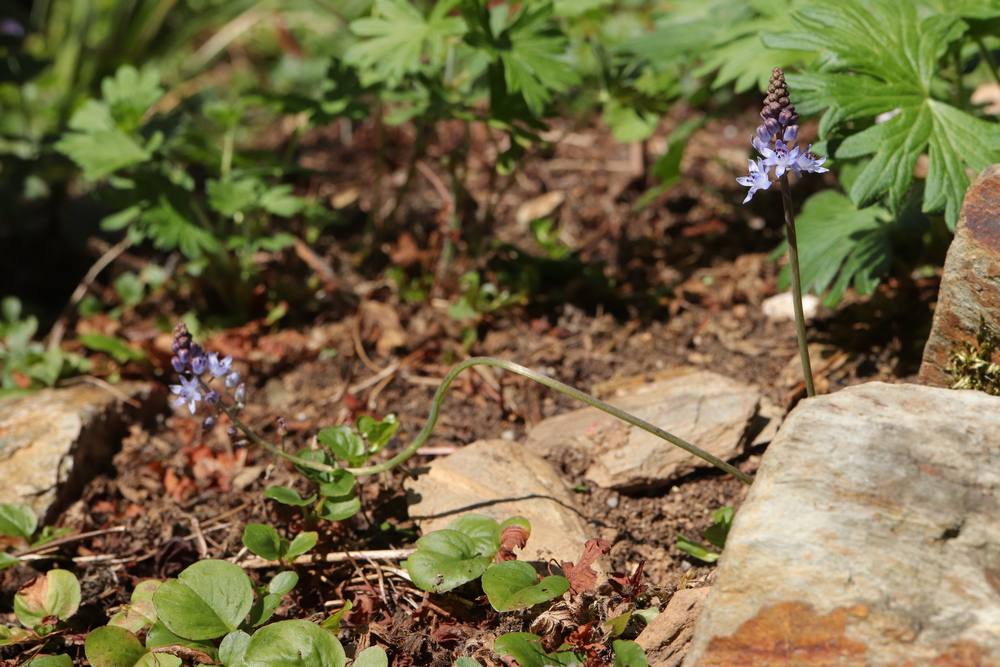
Avon Bulbs seduced me with Scilla autumnalis, less with the qualities of the plant than the fact that it is allegedly a native plant of these parts. I can’t say I’ve ever seen it anywhere, though now that I’ve seen it in my own garden that is less surprising. It’ll be stunning when I have big drifts of it.
The modest amount of rain we’ve had almost refilled my water storage so I’ve been watering some of the late flowering stuff quite generously in hopes of getting a bit more back from this summer’s efforts than I’ve had so far. My enthusiasm for watering ran out some while ago, it’s become a real chore. A burst of late Dahlias would be good for the soul. The Propagator’s SoS crowd are an optimistic lot, always looking for the bright side, should you feel in need of such a thing. I’ll chip in with this mothy clip.

 garden ruminations
I like the way your have captured the Humming Bird Hawk Moth, it just looks amazing.
LikeLike
Right place at the right time, with the right equipment. Happens so rarely.
LikeLike
What a great video of the hummingbird hawk moth! The belladonna and ginger lilies look great. I like the Scilla too.
LikeLike
I need to see if my video editor allows zooming in, it would be good to get closer.
LikeLiked by 1 person
Is that ginger lily very large? I remember the humming bird hawk moths being quite big and that plant dwarfs it. As you say, planting anything is a challenge in the dry soil. I was trying to put a thin stake in the ground but found that almost impossible.
LikeLike
The ginger lily is pretty large, though HBHM is said to be 40-45mm wingspan and doesn’t look it because the wings are going so fast. I use a long 17mm masonry drill bit on my cordless drill to make holes for my Dahlia canes.
LikeLike
I use an old golf club of Bill’s which has lost its head, plus a mallet to hammer it into the ground making the necessary hole. Unfortunately, not as successful as your drill bit. I may have one large enough in the garage….I will report back at some stage. Thank you.
LikeLiked by 1 person
Glossy privet was used only as a shorn hedge here more than half a century ago. It is quite unpopular now that it is naturalized in some situations. When not shorn as a hedge, it is prolific with seed. Anyway, I had no idea that there is a cultivar of it. I suspect that those that were grown as hedges were a cultivar, but only because they were grown from cuttings of the same plants, for uniformity.
LikeLike
I don’t think I’ve ever seen it here as a hedge, it’s usually Ligustrum ovalifolium and very occasionally L. vulgare. Neither is anywhere as popular as it used to be. Time was there were whole housing estates with nothing else.
LikeLiked by 1 person
Glossy privet is not exactly the best for refined hedges anyway. Wax privet is prettier, but less cooperative. The others are likely better behaved. I really do not know why glossy privet became as popular as it had been.
LikeLike
I had a notion that Camellia ‘Scentuous’ would make a really nice hedge but never managed to build the numbers up enough to try it.
LikeLiked by 1 person
Camellias of all sorts used to be more commonly shorn as large hedges. Many grow slowly enough that they might need to be shorn only every other year. If one side gets shorn each year, then the other side can bloom. I mean that each side takes turns blooming and getting shorn. Of course, that is too much work for modern so-called ‘gardeners’.
LikeLike
The priority here seems to be to get a six foot dense hedge in the shortest possible time, so people choose Leyland cypress or laurel. They seem to think when it reaches six foot it will stop growing, or at least slow down.
LikeLiked by 1 person
Oh my! Even I know that Leyland cypress is a problem! Gads! Only one specimen remains at work as a full sized tree. I would like to cut it down, but it is not quite dead yet. It is just slowly bleeding to death.
LikeLike
Hedges aside, it seems likely there will only ever be one generation of Leyland cypress trees. They are fast disappearing from the landscape here and will not be missed.
LikeLiked by 1 person
Who are their parents? Are they a hybrid of Cupressus macrocarpa and Chamaecyparis nootkatensis? Cupressus macrocarpa grows wild here, and is an awesome and picturesque tree. It gets very old and gnarly on the coast.
LikeLike
That’s the parentage, I have the whole story of their origins in a book downstairs and that’s where it’s staying. I’ve seen Monterey Cypress at Monterey, it grows a little differently there than here but quite a spectacle on the cliffs.
LikeLiked by 1 person
Yes, it is a very unique tree. I can remember a few specimens in Montara that were almost as wide as the tiny front gardens that they were in. I sort of knew that it is one of the parents of the Leyland cypress, but did not remember what the other parent was.
LikeLike
As I recall, the trees out there had much less well defined trunks than they have here; they seemed to be all branches going up and out at quite a wide angle.
LikeLiked by 1 person
Yes, although they are very variable. Some are very low and broad, while others are taller and lankier. Since they are imported there, they may lack such variation. All the trees there may be the descendants of only a few ancestor trees, and those ancestor trees may have been similar to each other. In Montara, where the homes closer to the beach are built on narrow city lots, I can remember a Monterey cypress that grew in one backyard, but leaned its bare trunk over and through the backyard next door, so that the foliar canopy was within the backyard of a third home! The idiot resident of the middle home cut the trunk at both property lines, leaving a stump in the backyard to the west, and a dead canopy in the backyard to the east.
LikeLike
I looked up Monterey Cypress in Alan Mitchell’s Trees of Britain and the entry is very interesting. Here is part of it:
“The two trees which dominate coastal landscapes in Devon, Cornwall and many parts of the far west, are not the native species that they would seem to be but are emphatically exotic. They are two of the select group of ‘Monterey trees’ which on their return migration from Mexico after the Ice Ages went by an extreme western route along the coast and were trapped on the Monterey peninsula by the erosion of the coast to the north. An inland diversion had become too dry and hot for them, and as the climate they were aiming to follow moved north some 700 miles to the Puget and Vancouver Island areas, they had to brave it around Monterey. They do not like it there and the native stands of Monterey Pine and Monterey Cypress are stunted and small, while both trees grow with startling vigour anywhere around the Irish Sea, and in fifty years are bigger, and much more shapely than any native trees twice their age.
The Monterey Cypress is the more extreme case. It has two tiny native stands: one of a few hundred acres on low conglomerate cliffs at Point Lobos, the other across Carmel Bay by Cypress Point with Crocker’s Grove and extending for some miles south in private gardens. A few young trees spreading the colony to the carpark at Point Lobos are the most bizarre shapes. Their crowns are about six snaky, rope-like stems closely wreathed in dense foliage, rising and twisting out. The old trees are wind-battered, contorted 30ft bushes with pale grey bark on thick, twisting trunks. Sixty miles north, in San Francisco, planted trees are like our Cedar of Lebanon with upright branches spreading layers of flat-topped crown. Another 600 miles north, on Vancouver Island, the trees are narrowly conic with spire tops. That is the shape grown in eastern England, where young trees rise rapidly as strictly erect-branched narrow columns with conic tops. In Ireland and western Britain generally they send out long branches somewhat raised and are soon immense, broad, branchy trees, some with a single stem persisting high in the crown.
The introduction of this tree was unusual. An envelope of cones was found on a desk at Kew in 1838, with no explanation. The seeds sown yielded many plants and although Douglas had seen Monterey Cypress in 1832 and it had been described by D. Don, the cones and plants could not be positively assigned to that species. They were named Cupressus lambertiana after the conifer specialist at Kew. Many plants must have been sent out under that name, mainly to Devon and Cornwall, for old trees on many estates there were long labelled or recorded under it. The first documented introduction was in 1846 from Theodor Hartweg. In 1851 William Lobb sent more”
He mentions a number of outstanding specimens such as “Before it was blown down in 1990, the biggest yet found was near Bideford, Devon, and 132/32ft. (Height and girth) An immense size for less than 150 years growth, but extremely rough with numerous branches rising strongly from low on the trunk”
LikeLiked by 1 person
What the heck?! British arborists and horticulturists think that they are such experts on . . . everything. Although amusing, it is not accurate. Both Monterey pine and Monterey cypress are quite happy here, and grow quite large. Their contorted form is merely how they respond to the climate and rugged coastline. If they stay low and stout, it is only because they do not need to grow very tall. Actually, they are likely happier here than they are in the Pacific Northwest, where they dislike snow. Their density, which effectively deflects wind, collects snow, which gets very heavy.
LikeLike
It’s what comes of thinking that size is everything. If it gets bigger, or the same size quicker, it must be happier/better suited. You’d think the overgrowth of alien species around the world would have buried that notion. And be careful what you say about British horticulturists, on a bad day that would include me. Needless to say, from our perspective it’s the rest of the world, America in particular, that thinks they know everything.
LikeLiked by 1 person
Well, we do know more about the native Monterey cypress and Monterey pine. Although most Monterey cypress do not live for much more than a century and a half, some here are a few centuries old, and a few were here before the species was imported to Europe.
LikeLiked by 1 person
I saw my first Hummingbird hawk moth a couple of days ago but it was very difficult to get a photo. I enjoyed your video of it though. Do you see them often?
LikeLike
Not often, two or three times a year perhaps. I got lucky with the video. I stood there for 15 minutes or so afterwards, hoping it would come back.
LikeLiked by 1 person
Those white butterflies! They are everywhere, yet somehow I do not have much caterpillar damage. I am hoping that means my garden habitat is in balance and many of those green hungry caterpillars are food for something else.
LikeLike
Not growing cabbages in the garden I don’t usually get much damage and they’ve even left nasturtiums alone. Not too much damage on my allotment either so I don’t know where all the butterflies did their caterpillaring.
LikeLike
I see a lot of birds swooping into the garden, I hope they are getting the protein from the cabbage white cats – how healthy and delicious it must be for a bird after it has feasted on organically produced kale, broccoli, etc! Do they eat your nasties? I have never had that happen (yet).
LikeLike
Our allotment site is surrounded by fields and there have been plenty of swallows flying around for the summer months. There are a few other insectivorous birds about as well, so they must be feeding on something and it’s likely there’s more food for them on the crops than in the fields. I’ve never actually caught them in the act though. In the garden we mainly get seed eaters, finches of various types, with a few more carnivorous species in winter, scratching about in leaf litter.
LikeLiked by 1 person
Nice! I have lot of seed eaters too. Lately goldfinches have been eating dill seed and whatnot. Cardinals too, making a colorful scene. The hummers have been at flower and feeder even during a rainstorm earlier today.
LikeLike
Goldfinches are our commonest bird in the winter but head for open country in summer. I’ve seen big flocks up on the moors a few times. Are our goldfinches (Carduelis carduelis) and your goldfinches the same though; seems unlikely. It’d be such a treat to have hummers, we saw them in Canada many years ago but that was the only time.
LikeLiked by 1 person
Oh – yours is very pretty! Our is Spinus tristis, The males a flash of yellow, the females a more subdued olive. In winter both are more dull colored. I suppose the better to blend in once everything turns white. I do love the hummers. I just had a little one buzz me while I was out picking beans for supper.
LikeLike
Ours is one of our most colourful birds. Thirty years ago we rarely saw them anywhere and never in the garden. Now they are by far our commonest bird in the garden. I’m not sure about other parts of the country.
LikeLike
Well, surely a lovely bird! Our goldfinch is a flash of yellow. The other day I had two cardinals and a goldfinch in the garden, red, yellow, and the tan of the female cardinal. They were trying out my new pole for the hummingbird feeder as it makes a nice vantage point so they can see if the neighbor cat is lurking about.
LikeLiked by 1 person
It must be much drier in your part of Cornwall, we’ve had quite a few showers here and some damp days, though some areas of my garden are pretty dry. Love the video, I have only once seen one of those moths, they are quite impressive.
LikeLike
We’ve had a bit of rain but the ground is still very very dry and a lot of plants are hanging.
LikeLiked by 1 person
Great video of Tara and friend. I saw that little scilla in the catalogue (which I haven’t ordered anything from, yet) and was tempted myself. Not much rain in the forecast, and the water bill came today which was a little shocking and I got one of those looks. Still we have some in the butts and I will have to eek it out. Gorgeous amaryllis.
LikeLike
Not looking forward to the water bill. If I pay for and install extensive water storage do I have to pay the water bill too. Asking for a friend.
LikeLike
In my world, of course not. 😁
LikeLiked by 1 person
Great video!! I’ve had lupins and dwarf iris bloom in recent weeks, and now a day lily has sent up a fully bud-laden flowera stalk… unusual sights for unusual times.
LikeLike
To be expected I guess.
LikeLike
I don’t know if it was you or Gill who sent me Scilla seeds but I sowed them successfully. On the other hand, I haven’t had any flowers yet, maybe next year.
I also have one of my hedychiums showing its first flower buds: it’s the ‘Assam Orange’ variety and it’s the first here, the other 2 I have maybe later? I’m super happy because it’s the first year that they bloom.
LikeLike
Not the Scilla from this week, that’s for sure. I have ‘Assam Orange’ but the flowers are small and distorted, which it hasn’t done before.
LikeLiked by 1 person
As thé hedychium flower is a first to me I’ll post it next week and you’ll see to compare. Mine looks straight but short.
LikeLike
Is yours scented, by day or in the evening? Very occasionally mine has been, usually it isn’t.
LikeLiked by 1 person
I just sniffed it yesterday . But I have to put the nose to it to get the smell. It smells very good though. Rather in the late afternoon
LikeLiked by 1 person
Lovely video, glad you got enough rain to refill your water butts, I was madly collecting water in pots and buckets, although this week I did obtain a 1000l tank, it just needs fixing up to the greenhouse runoff.
LikeLike
Getting the water in and back out can be a rain dance in itself.
LikeLiked by 1 person