A week ago we were on day four of a severe weather warning for high temperatures. We were also, and still are, experiencing a very dry summer. The world is getting warmer and the rate it is doing so is accelerating.
I already have a fairly complicated water harvesting setup but my stored water ran out leaving me using metered tap water. My thoughts turned to ways of increasing my storage.
If space wasn’t an issue I would install a galvanised steel tank with EPDM liner. Suppliers will tell you they are the most cost effective solution for large volumes of water and so they probably are. Historically our area gets 1250-1500mm of rainfall pa and I can collect water from about 100m² of roof. That equates to 125,000-150,000 litres of water pa. It would be great if the 100m² was a single roof with space available alongside to install a tank of perhaps 10,000 or 20,000 litres capacity. I would surely never run out of water again. Sadly, I am drawing water together from a number of roof areas and moving it about by various means.
Looking at one tank supplier, they offer a 9ft (2.76m) diameter tank in various heights. At 1.52m high it has a capacity of 9,120 litres and costs £1901.74. An anti algae cover brings that up to £2261.72, a steel roof to £3359.74. That’s a range of roughly 22-37p per litre stored.
The 3.84m high version holds 23,050 litres and costs £3208.54, £3568.52 or £4666.54 for the same options. That’s around 14-20p per litre stored.
An 18ft (5.53m) diameter tank, 2.28m high, holds 54,760 litres and for the same options costs £3708.26, £4471.46 or £6828.26, equating to 7-12.5p per litre stored.
The tank would need a concrete pad to stand on, adding to the cost. Being assembled on site, access is not the issue it becomes with a large plastic tank.
The same company offer polythene tanks in various sizes but even the 2,500 litre version is 1400mm wide; too wide to get into our back garden without a crane or taking the fence down. It weighs 55kg, could it be lifted over the gate? At £816.95 it equates to 33p per litre stored. They offer a 720 litre tank which is 700mm diameter but it costs £615.94, a cost per litre of 85.5p.
Another alternative would be reconditioned IBC’s. The same company offer them in black and including delivery, three would cost £502.20. At 1000L capacity, that works out at 16.74p per litre stored. Still too big to go through the gate but could be dismantled and manhandled. For a given volume of storage they take up more space.
I found and was intrigued by the idea of a PVC collapsible water butt. At £150 for 1000L capacity it is an inexpensive option and it could be put away when it was empty. The blurb said collapse and store in winter but that is when it would be filled, to use in summer.
Hmmm. Options, lots of ’em. And questions, where will it go? How will it look? What other costs are involved? Is it enough or will I need to add to it in a short while?
I’d be interested to hear if you have thoughts or experience in this area; there must be many angles I haven’t considered. While I was writing this piece, it was raining outside. Heavy for a while, then a long tail of drizzle. My rain gauge recorded it as 8.2mm, so another 730 litres has been captured and will be put to good use.

 garden ruminations
Not much to add. But it was interesting to read your thoughts. I have an assortment of water butts, all inherited from the previous owner. I also inherited a 500 litre storage tank that I have ‘hidden’ with a slatted covering. I pump down the garden to this wb with a rather feeble hozelock pump. Your pump looks much sturdier. Yes being on a water meter does make you think!
LikeLike
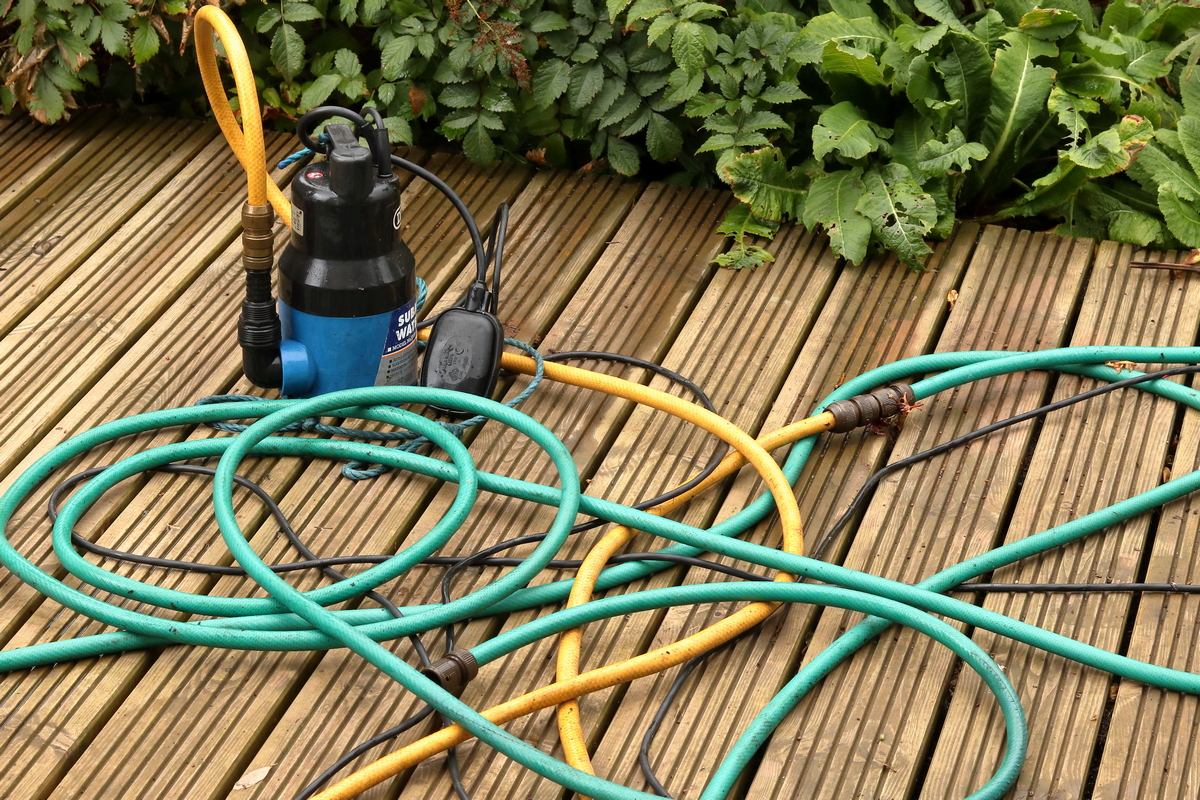
The pump in the picture is but a toy compared to the one in my big tank, but is adequate for what I need it for. I think I’ve settled on a couple of IBC’s that I can conceal in a corner somewhere.
LikeLiked by 1 person
Space to place the water tank seems the greatest challenge; they are very large. I suppose, ideally, they might be installed, underground?, when a house was being built, an integral part of the design.
LikeLike
Our building regs seem to be designed to keep what is integral to the design of houses to a minimum. I mean, who would need decent insulation, solar panels, car charger point and so on?
LikeLiked by 1 person
Welcome to our World.
So many of us ‘want’ to collect rain water, and there is a bit to collect during the rainy season. A primary problem though is that all the rain happens within a very limited season. We lack rain for more than half of the year. Rain stops in spring, and does not resume until autumn. There is none to replenish collection tanks in between. So, we would need HUGE tanks to collect as much water as possible during the rainy season, but then all that water would be depleted before rain resumes. The tanks, which are empty for most of the time, occupy significant space within confined suburban gardens. Some of us use small tanks, and just accept that they provide water for only a short time after the rain stops.
LikeLike
Even here, the size of tank you need to cover every need is bigger and more costly than most people judge worthwhile.
LikeLiked by 1 person
The math is different (different roof area, different garden space, different rainfall in regard to both volume and frequency) but I get it.
LikeLiked by 1 person