If you are squeamish, don’t read on. This will not be pleasant.
I tell myself that Cornwall is a bad area for slugs, that mild winters mean they are active all winter, breeding all year round. Our often wet summers mean we don’t get prolonged dry spells to reduce their numbers. I tell myself that anyone gardening in a worse place for slugs would simply give up. I know they are pest number one for most of us.
I have Dahlias in a number of places in the garden and the best of them are now about two feet tall. The worst of them are barely two inches tall and consist of chewed off leafless stems. I have one prominent bed with Dahlias planted in the middle of it. It is still largely bare ground, which is pretty disappointing half way through June. The difference is entirely down to slugs. According to one website they consume up to 40 times their own weight in a day. I’m not sure I believe that but they certainly do a huge amount of damage.
Generally when plants are relentlessly targeted by slugs, I roll over and give up the fight pretty readily. I am very reluctant to use even the supposedly wildlife friendly slug pellets as I know we have hedgehogs around and want to do all I can to encourage them. I’m not sure that giving up on most slug vulnerable plants, then doggedly carrying on growing one of the most susceptible makes sense, but it’s the course I’m set upon and I’m not ready to give up yet.
My main control method is simple. I venture out when there’s just about enough light left to see by, around 9.30 at present, and go round the garden checking on all the plants that get attacked, dispatching the slimy assassins by cutting them in half with secateurs. Over the last three evenings I have killed over 500, almost all the brown version of black slugs, quite big things, around 2 inches long. On one foot high Dahlia there were 36 of them.
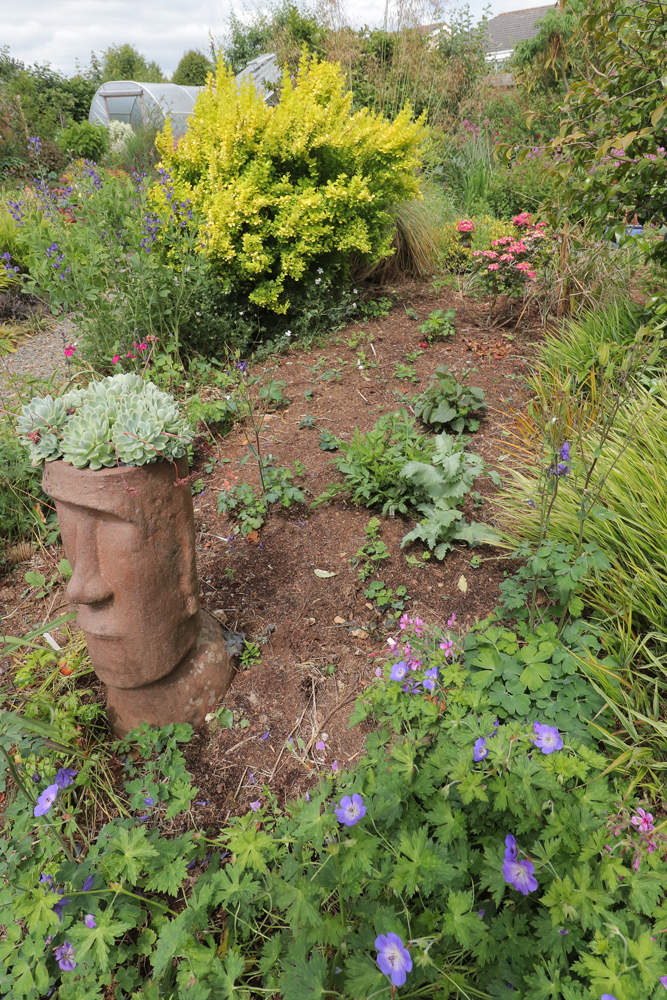
The difference between the area where the Dahlias are growing well and the rest is that there is nowhere for them to hide during the day. Mostly they hide under nearby plants, within 3 or 4 feet of the thing they’re targeting in most cases, and they are most fond of Primulas and Foxgloves in my garden, they being the things with large, low, spreading leaf canopies.

My supplementary control method then is to go round during the day, checking for slugs in their most likely hiding places and killing them. As well as providing them with cover, it provides me with likely places to look.
When Dahlias are first emerging, a single slug can remove all the above ground growth in a single night. If it keeps coming back, the plant simply never grows away. Once the plant is a few inches tall, it can usually grow faster than the slugs can eat it.
Does my method work? I think it does, but I think what I fail to do is to go in as soon as the first Dahlias show with a full on assault. That’s the time to be meticulous and seek them out in their bunkers. Instead I tend to grumble and not do much, building up slowly to being thorough. It needs to be the other way about, thorough to begin with, then relax a bit as the plants grow away.
It may be that if there is too much nearby cover, it just isn’t possible to grow Dahlias well. Perhaps in those areas I grow something else or lift the Dahlias, start them in pots under cover and plant them out when they are big enough to withstand some damage.


I introduced nematodes to our veg garden this week to fight slugs that have devastated our leafy greens. Has anyone here tried slug nematodes and have they worked for you if you have?
LikeLike
I’ve not used them myself. They seem expensive and with veg it’s hard to see how they can be cost effective.
LikeLiked by 1 person
Your dedication to the gruesome task should be recognised in the honours system! But you abuse secateurs. I simply grow my thumbnail long – proud of the end of the digit – then shape it to a sort of point (also good for them little red beetle things). Just pick up a slug and quickly pierce its skin and drop it ready to be cleaned up by the nightly hog patrols. Just remember to clean your hand with salt before washing it. I’m thinking of using sugar. If sugar rots teeth, imagine the pain when you’ve got around 20,000 teeth.
Or just get things in perspective. Given the reproduction rate, you need to kill about 2,000 slugs a night in your garden to make any real difference.
LikeLiked by 1 person
Killing 100 odd a night makes a real difference to how well I sleep. To secateurs abuse I plead guilty and I dare not tell you which secateurs I use. Why would you pick up a slug to pierce its skin when they could be impaled with ones rapier without even bending down? Can I have a peerage please.
LikeLiked by 1 person
I lift my dahlias and don’t have an issue with slugs as they are too big by the time they go out. Delphiniums however never reappear after their first year.
LikeLiked by 1 person
I think that’s what I’m going to have to do with some of them, irritating when they will survive in the ground perfectly well. Delphiniums I wouldn’t even try to grow.
LikeLiked by 1 person
Yuck, cutting up those big ones with secateurs can’t be much fun. You need a strong stomach. We just get the little ones here and as you say they cause havoc in the greenhouse. But snails are a real problem. Still they make a satisfying crunch when you step on them.
LikeLiked by 1 person
119 was this evenings total. You probably didn’t need to know that.
LikeLike
Leopard slug (Limax maximus)
“Popular with gardeners due to aggressive behaviour to other slug species. Feeds mostly on fungi, dead plant and animal material”. Feb 2020 The Garden
I put a picture of this beauty on my SOS post 25 Jan 2020. What is your opinion? I also think there are different slug shifts..different one come for the second and third sittings, then one just before dawn.
LikeLiked by 1 person
I don’t think I’ve ever seen a leopard slug. The things I have in large numbers, mostly one under every pot, the ones that there were two of in my slug picture, are never big enough, though they do have a similar, if paler patterning. If they were all leopard slugs I wouldn’t have a problem with all the other ones. The pictures on various websites I’ve looked at are so variable I’m not sure I’d know one if I saw it. You may be right about slug shifts, I’m off to hunt the evening shift now, but I haven’t managed to drag myself out of bed before dawn yet.
LikeLike
Jim, nothing to do with slugs, but I was wondering if as a nurseryman you are good at identifying unusual things on plants – although the thing I am going to ask you about is in a garden in Queensland so I don’t know how much knowledge you have about that location 🙂
My friend on the Gold Coast has discovered these weird stringy things in her garden: https://retiredfromgypsylife.wordpress.com/2020/06/17/20-20-photo-challenge-macro/
Any thoughts?
Thanks, Jude
LikeLiked by 1 person
Now that is really intriguing. I have absolutely no idea what it is and my attempts to find out have got me nowhere. I don’t think they’re eggs, the two in the larger image look quite similar and have the sort of symmetry about them that looks somewhat like an insect or cocoon maybe. Being Australia arachnids can’t be ruled out. Do let me know if they turn into something more recognisable, or even just turn into something else.
LikeLiked by 1 person
Will do!
LikeLike
https://retiredfromgypsylife.wordpress.com/2020/06/19/the-thing-update/
LikeLike
The plot thickens; they may be whitefly but not as we know them.
LikeLike
I was wondering if they are lacewing?
LikeLike
There is probably a website in Australia that would identify it from the pictures, it’s pretty distinctive. You could Tweet @flygirlNHM who is the fly expert at the Natural History Museum. She’d know who to retweet to get an ID if she didn’t know herself.
LikeLiked by 1 person
Thanks Jim. I’ll pass the info on to Pauline.
LikeLiked by 1 person
Jim, sounds like those slugs should be scared of you! I know how quickly they can munch dahlias. Here they’ve demolished my ligularias in our long, wet spring. I try to collect them and feed them to the chickens. I respect your hesitancy to use Sluggo (or other pellets). That said, I do use the pellets to save my dahlias from slugs and earwigs. I probably spend over $50 on the pellets each spring, but to me it’s worth it for my favorite dahlias.
LikeLiked by 1 person
Ligularias are something I gave up on a long time ago. Even when they survived they looked so ragged as to be ugly not ornamental. I do use some pellets, but very sparingly. Actually I think they’re probably so old they don’t work anyway.
LikeLike
I don’t suppose there is such a thing as a slug fence that you could put around your dahlia plants, is there?
LikeLiked by 1 person
Not that I know of, and they’d probably climb over it. High voltage possibly.
LikeLiked by 1 person
Yuck! I hate the things. When I had a garden in Doncaster nearly 20 years ago now, I do not remember having any problems with slugs at all. The soil was very sandy and well draining. Here in the south-west I am learning to grow plants that are virtually slug resistant and for this year and last I used slug nematodes. Most of the slugs I find are the very small ones and usually hiding under pots. And the only time I have grown Dahlias (last year) I found they were attacked more by earwigs which ruined the flowers. I must admit I don’t go out on slug patrol. But I do cut them in half when I find any.
LikeLiked by 1 person
There are some slug prone things I just don’t like to give up on, or I’d go the route of growing resistant plants. It does narrow the field quite a lot.
LikeLike
Have you tried beer traps, Jim? I bury a small take away container in the ground and fill it with beer and the slugs and snails are attracted to it and either drown or die of alcoholic poisoning. You don’t have to use the good beer either, low alcohol will do it, and it doesn’t matter if rain falls into it, it still does the trick.
I realised from your post that there was a benefit to our atrocious summer- there have been very few snails in our garden since then, though I’m sure they’ll build up again
LikeLiked by 1 person
I have tried beer traps but though they worked, there seemed to be a lot that ignored them so overall it wasn’t very effective. Emptying them out after several days turned even my strong stomach too.
LikeLike
I too think that cutting slugs in half is best and the corpses act like bait for the next foray. I don’t love it though especially the big ones! So far this year the dry weather has kept them at bay to a great extent. Extreme vigilance is the only way, sadly.
LikeLiked by 1 person
The dry weather supressed them quite a bit but the flood gates were opened when the rain came. They’re trying to make up for lost time.
LikeLike
Banana slugs are scary to those who have not seen one before. They really do resemble bananas. They are bright banana yellow, and about as big as a small banana. FORTUNATELY, they consume only decaying plant material, so, besides being scary, are relatively harmless in the garden. The Banana Slug is the mascot of the University of California at Santa Cruz, UCSC.
LikeLiked by 1 person
I just looked at Google images. Some things are just wrong!
LikeLiked by 2 people
but now you know where Chicken McNuggets come from.
LikeLike
I hadn’t counted that among the reasons I’m a vegetarian, but I will now.
LikeLiked by 1 person
Yum!
Actually, there are a few urban legends concerning banana slugs. Some believe that licking the underside of a banana slug provides more than 100% of the recommended daily allowance of vitamin C. (I think that myth was started just to see how many people would actually do it.) Children at camp here earn a ‘banana slug badge’ for kissing a banana slug. (I do not know how that works is a group of children find only one banana slug.) While camping, it is supposedly good luck to wake up with a banana slug. However, a banana slug on a window might be construed as a bad omen. Some say they taste like chicken. Others say they taste like port. I think they taste like lobster.
LikeLiked by 1 person