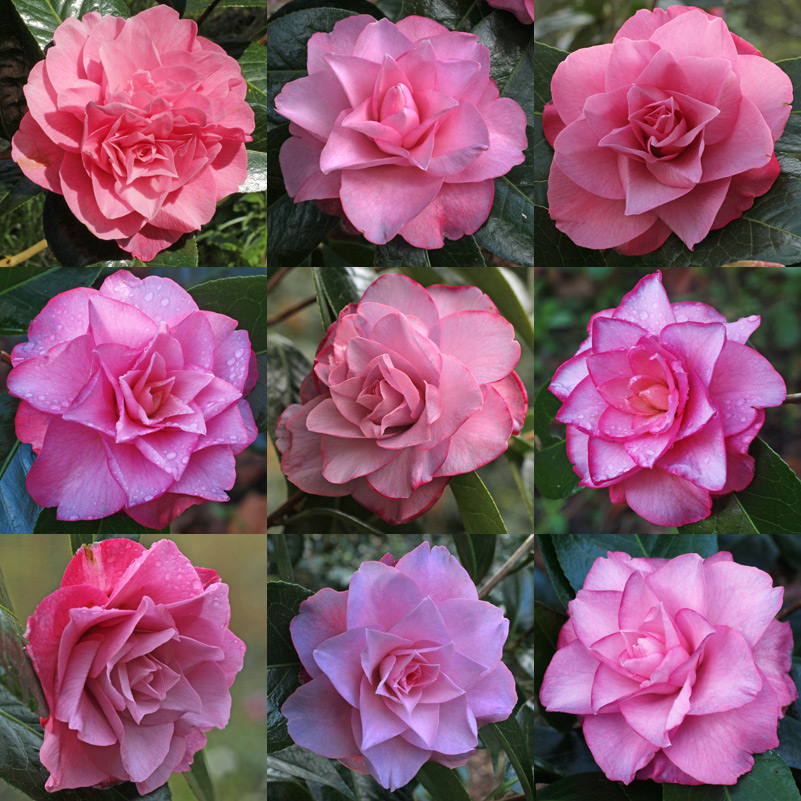
Camellia japonica ‘Joe Nuccio’. The most usual colour seems to be a slightly purplish pink, but the variants shown are not uncommon. I suspect light frost damage accounts for most of it.
ruminate vb. to chew (the cud)
Camellia japonica ‘Joe Nuccio’. The most usual colour seems to be a slightly purplish pink, but the variants shown are not uncommon. I suspect light frost damage accounts for most of it.
 garden ruminations
A bit of a chameleon this one – which flower would you say is true to type ? do they get frost at Nuccios ? Some years ours could be mistaken for Joan Trehane – because the recurved petals and the interesting colour doesn’t develop. Yours has canopy shade but ours is in the open. When I first saw both the recurved petals and the rather special graduated tint I was blown away by the beauty of it. Those Nuccios know how hybridise !
LikeLike
The description in Nuccio’s catalogue reads: “Medium formal. Medium orchid pink. Tips of petals incurved and toned deeper pink.” On that basis none is exactly true to type. There’s a picture in the SCCS Nomenclature that shows it clear pink with much darker incurved edges but no sign of lilac. I saw it at Wisley in 2016 and it had the barest suggestion of purplish about it. The Jury williamsii hybrid ‘Dreamboat’ behaves similarly as regards the petals rolling in, it rarely does it in Cornwall. These varieties that change dramatically from one climate to another, or one season to another are an elephant trap for the unwary when it comes to identifying them. I don’t much like flowers with inrolled petals, they look like something’s wrong with them. The colouring though, I find irresistible; it’s quite unlike any other camellia I’ve ever seen.
The concept of “type” flower, akin to a “type specimen” in a herbarium, is a bit suspect. I see the ICS are putting “type images” in their online database and I’m not sure it’s really helpful.
LikeLike