Another month has passed so another allotment post is due. I’ve been looking at some veg growing stuff on YouTube and there is a wealth of advice about what to do and how to do it, not all of which I’d agree with. What I am aiming to do is to look backwards over the past month and share my successes and failures. If it helps a decision you make this autumn about which seeds to buy for next year or some such then that’s good, but I am sharing my experience, not offering advice.
August, except for the last few days, was very dry. Seeds that I sowed in July and August have struggled to make headway in spite of being watered occasionally. Eight weeks on from sowing beetroot, carrots, chard, spring onions, lettuce and perpetual spinach, with the lettuce failing to come up, I can say that I am reasonably confident of getting usable crops of spinach, chard and carrots, may get usable beetroot and won’t get usable spring onions. For me, in south-east Cornwall, the beginning of July seems to be the absolute latest I could direct sow anything much and get a usable crop. That’s a bit early for sowing a second crop where I have had peas or potatoes in the early part of the year, but OK after an overwintered crop like kale or leeks, which would be gone by May. Modular sowing in May or June, such as the row of cabbage ‘January King Marabel’ that I sowed 15th May and planted at the beginning of July, would be the only viable way to get two crops in one season from the same piece of ground.
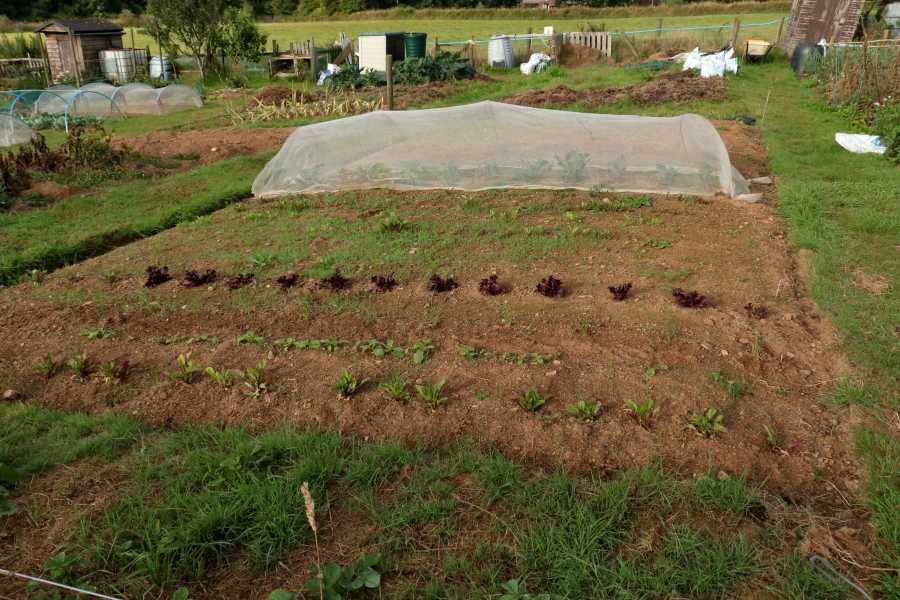

The cabbages are growing very well now. I initially didn’t cover them, was punished by pigeons and put enviromesh over them supported by wire hoops. That stopped the pigeons but wasn’t pinned down well enough to stop cabbage white butterflies or diamond back moth. The caterpillars of the moth burrow into the very heart of the plant and are impossible to get at. I had a long chat with a neighbouring plot-holder who has tried every combination of mesh and supports going, to see which he thought was best. The cabbages are now covered with a small holed mesh (5 x 7mm) suspended on plastic water pipe hoops with their ends in aluminium tubes. I had the mesh in my shed, the pipe at home, and was given the aluminium by another allotmenteer; it cost me nothing but time.
I have concluded that late planting of brassicas can avoid the worst of cabbage root fly but that without protection against caterpillars I’m going nowhere. I have also planted spring cabbages in my tunnel, under the same 5 x 7mm mesh, and have a few more to plant outside alongside the ‘January King’.
I sowed runner beans in late July, they started to come up on the 27th so were sown around the 20th. To my surprise they have shoots up to three feet long and are beginning to flower. They have no support so will sprawl around the ground and since I only planted them as a green manure crop I am unbothered by that, but it does make me think that I could have sown them with supports and probably got a crop of beans late in the season. We eat a lot of salads in summer and few cooked veg, so they would be of more use in September, perhaps even October, than in midsummer. I am keen to see what sort of crop this lot produce.

I have continued to dig ‘Kestrel’ potatoes as required, which hasn’t been a lot, and have now started on my maincrop, ‘Java’. The blight resistance of ‘Java’ seemed to break down quite suddenly several weeks after it had infected all the other potatoes on the allotment site, so I removed the tops, dried them for a few days, shredded them and spread them in my garden where there is nothing susceptible to blight. I have lifted a few plants and seem to have a decent crop with plenty of baking sized spuds to store for winter use. I now have to decide whether to leave the rest in the ground or lift them. They will be slug prone left in the ground so I’ll probably lift them.

I left my Hurst Greenshaft peas in so that pods I’d left on them would ripen and I could collect seed. That done they are gone and a green manure mix of Phacelia and Buckwheat was sown mid August. My onions were harvested soon after and the same green manure mix sown on 25th August. I don’t like to leave the ground bare; the green manures will take up available nutrients and prevent their loss to winter rain as well as protecting the soil surface from rain damage. I also think that the soil biome needs sustaining by the exudates they get from plant roots and repay it with improved soil structure and fertility. Nature doesn’t do bare ground in the UK. Other bare areas have been sown with a mix of Phacelia, buckwheat, Italian ryegrass and fenugreek.
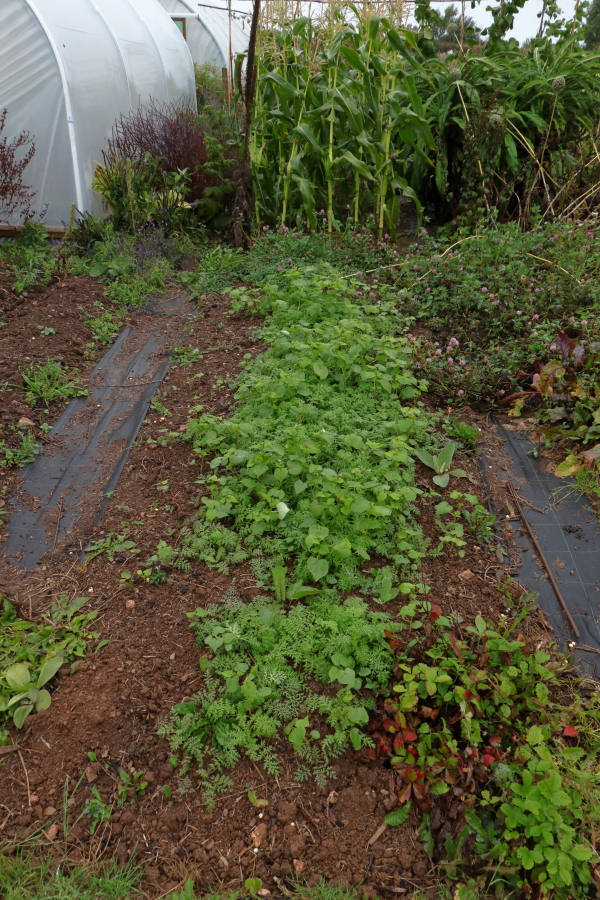
In my tunnel I have sown diakon radish, mizuna and carrots, all of which are up and growing away. They will be added to and will keep us in salad leaves through the winter. I have picked a lot of tomato ‘Akron’, which had a mighty crop, but will not be growing it again. I planted them directly into the soil, which has in the past, before the tunnel went up, been used for potatoes and much else. About half of them clearly became virus infected and while they still cropped well, the fruits had greenback badly and were almost inedible. The uninfected plants cropped twice as much, to the point I doubled up on their supporting strings, but still had greenback to a degree. In most cases I was able to eat two thirds to three quarters of each tomato.
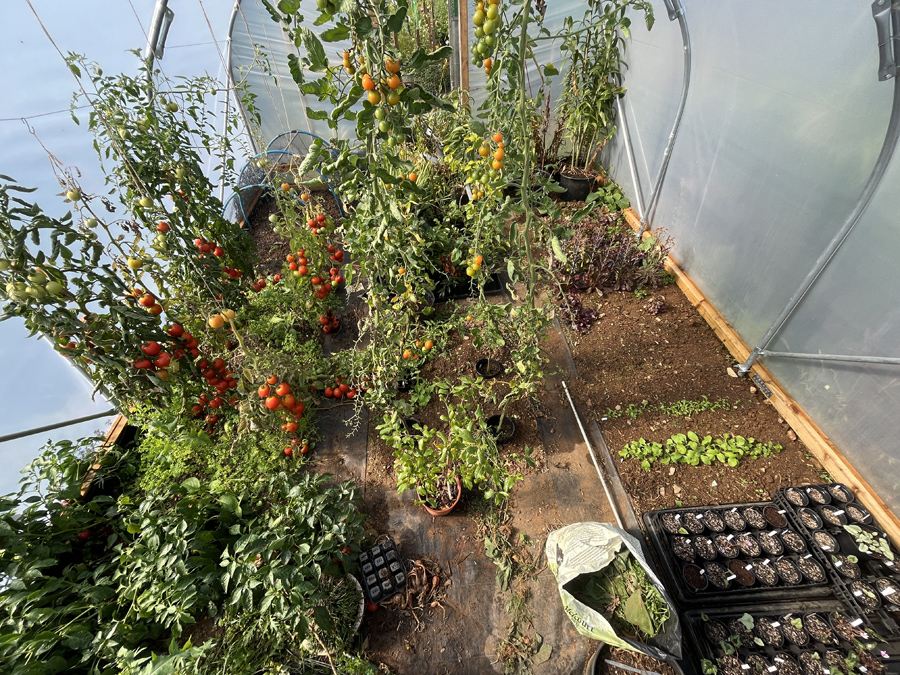
The Sungold tomatoes were grown in 3 litre deep pots sunk three quarters their height into the ground. They remained healthy but always looked hungry, perhaps because they had very little space for surface feeding roots. Next season I will grow them in bigger pots, still sunk into the ground, and will feed them more. I also plan taking two stems up from each plant, in hopes of getting twice the crop for the same amount of expensive F1 seed. I’ll let you know how that works out!
I grew sweet peppers in the tunnel too, a variety called ‘Red Ace’. They have cropped well but with thin skinned fruits. I should have given them more space and I should have supported them; they’re lying on top of each other and voles have had a go at some fruits.
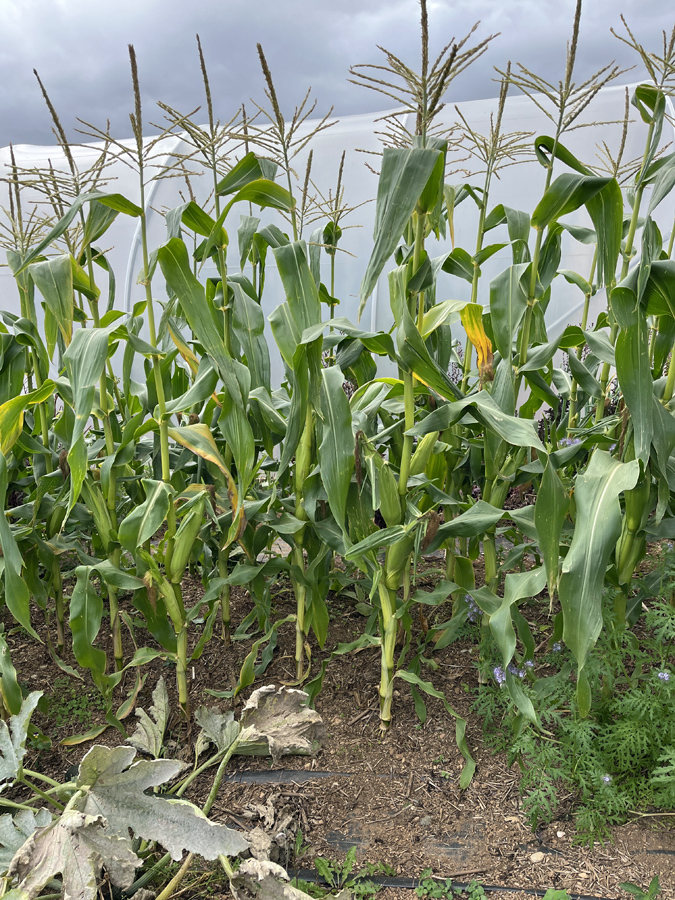
Sweet Corn has been good this year, I had an exceptionally good seed germination and ended up with probably rather more plants than I needed. I then planted them perhaps a little too close and I suspect I may get only one cob from most of them instead of the more usual two. They seem to have been slow to fill out properly, probably due to lack of water, which is no longer an issue. We’ve been eating them for about a week and feel a tad overwhelmed. We should probably freeze some but they’re so good when really fresh.
It will all start to slow down now, with very little more planting or sowing likely until spring but I will still carry on doing a monthly post even if it’s only to say nothing has happened. Until the end of September then, over and out.

 garden ruminations
I’ve grown some quite good brassicas this year, but it is v. hard keeping up with the defences. Not only the pigeons, butterflies, but then flea beetle, which seems to find its way through the smallest grade of mesh. I’m admiring all your hard work, and good to see the July sown area coming on well, especially given the summer we’ve had
LikeLike