Oh dear, doesn’t time fly. My last post on ferns was in May 2022, more than three years ago. Since then I have lost a few and added a few, plus I have three years more experience of all the rest.
In this post I will continue the roundup of the varieties I have and give a brief mention of those I have lost.
Dryopteris filix-mas. Common Male Fern.
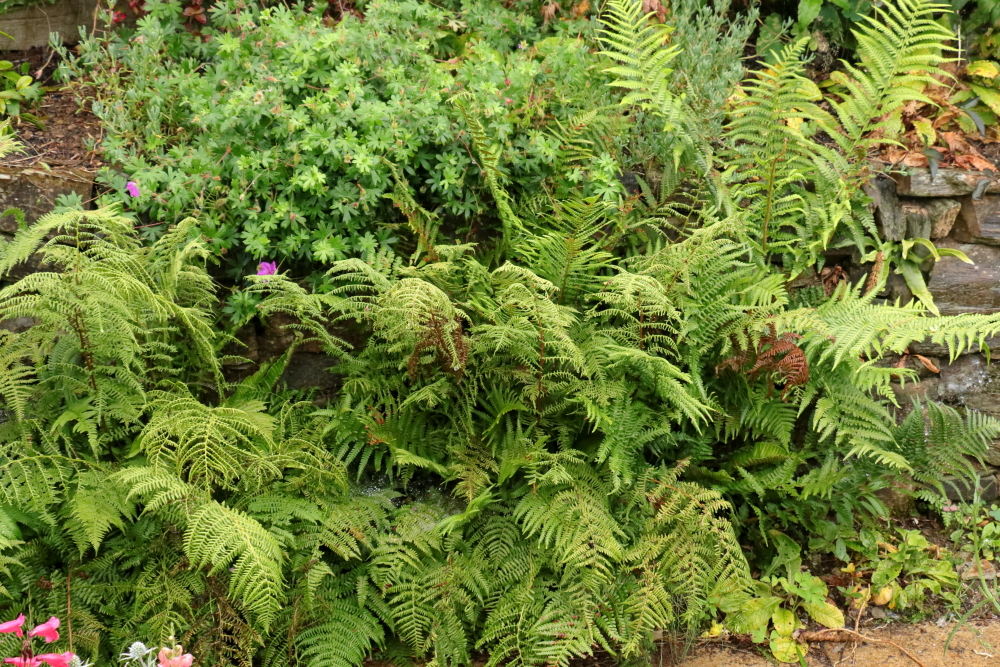
It would be nonsense to think of our native ferns as ordinary or even dull while spending good money on other species from further afield that to most people are barely distinguishable from them. The common male fern makes a large, wide spreading shuttlecock of fronds and to most people would be the ubiquitous and quintessential fern. I haven’t planted it, I didn’t need to; it arrived and made itself at home without my help. I have a couple of plants growing in a dry-stone wall in part shade and another growing in the ground in full shade. The UK has a number of native male ferns and as handsome as the common one is, it is, from an ornamental point of view, eclipsed by Dryopteris affinis, the golden or scaly male fern, which has much more conspicuous golden scales and lighter, slightly yellow, fronds.

Common male fern is sharing a stretch of wall with another native, one of the species of buckler ferns. I am still trying to unravel which species it is, with Dryopteris dilitata, carthusiana and aemula all in the frame. Whatever it is, it is scruffy and does not merit keeping.
Dryopteris lepidopoda. Sunset Fern.
My plant of this fern is still very small but it is already showing something of its most notable characteristic, colourful emerging fronds that gradually turn green. It should be evergreen and get 60-75cm tall.


Dryopteris kuratae. Autumn Fern. Wood Fern.
This would be a classic example of an exotic fern that nine out of ten people would take to be our native male fern. The two most obvious things that distinguish it are that the emerging fronds are covered in black scales and it is evergreen. I planted it very close to the trunk of an apple tree and while its growth has been slow, it looks to be in rude health, suggesting it is pretty tough and tolerant of less than perfect conditions..

Dryopteris wallichiana ‘Jurassic Gold’.
Sometimes a plant gets shoved into an awkward corner mainly because it seems likely to be able to cope with the shortcomings of the location. Then when it surpasses expectations, both thriving and looking good, you regret not having put it somewhere more prominent, where its qualities would be more on display. This is tucked in behind a post supporting trellis and the boundary fence, almost completely hidden from view and it deserves much better. I took a picture of it on 17th April when it had produced fronds almost to its full height of around 1m but not yet fully unfurled them. Had they not grown so upright then, they might now be pushing through the barrier in front of them and be more visible. Now, three months later, the fronds are fully expanded and almost all of the earlier rich gold colour has faded to green.


Araiostegia pulchra HWJ1007.
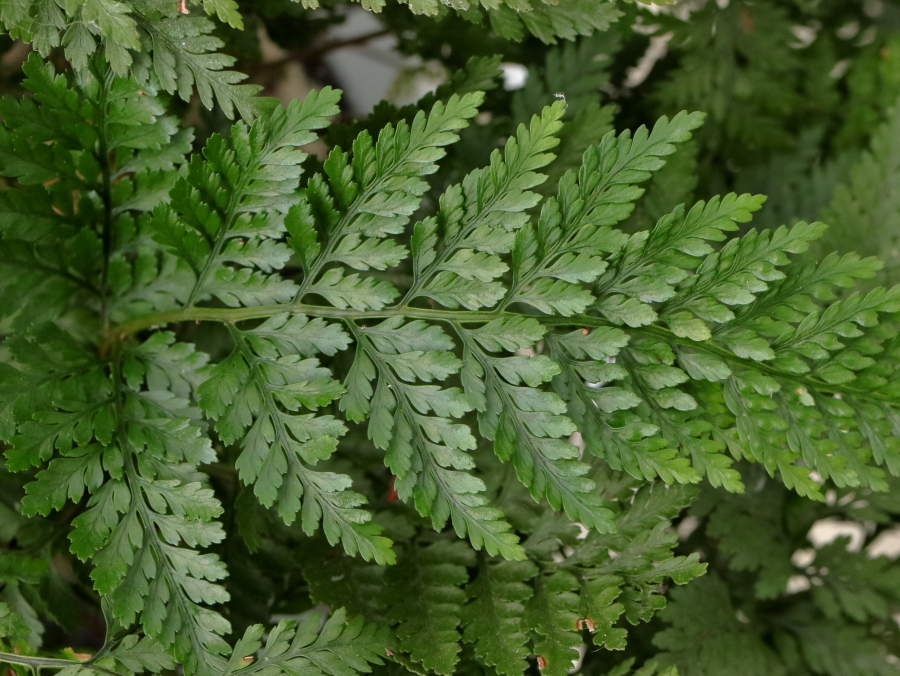
This came from Crug Farm plants a good few years ago, from whom I also bought Araiostegia parvipinnata. Crug still list this one but not A. parvipinnata. I can see no real difference between them so they may have turned out to be the same species. Looking them up on Plants of the World online, Araiostegia is shown as a synonym of the genus Davallodes and most of the species listed are shown as synonyms either of Davallodes or Davallia species. Thus there is a Davallodes pulchra, for which Araiostegia athamantica, A.pulchra and A. pseudocystopteris are synonyms; and there is a Davallia perdurans, for which Araiostegia faberiana, A. parva, A. parvipinnula and A. perdurans are synonyms. Since the two forms of Araiostegia that I have look almost identical it seems unlikely they are different species, far less in different genera. Looking online it seems that Davallia perdurans is likely the currently accepted name for probably both the plants I am growing. Suffice it to say that this plant is growing in a 10L pot, its rhizomes spilling over the sides and its fronds four or five times pinnate. I would have expected it to be easily propagated from section of rhizome but that hasn’t proved the case for me.

Humata griffithiana var. tyermanii.
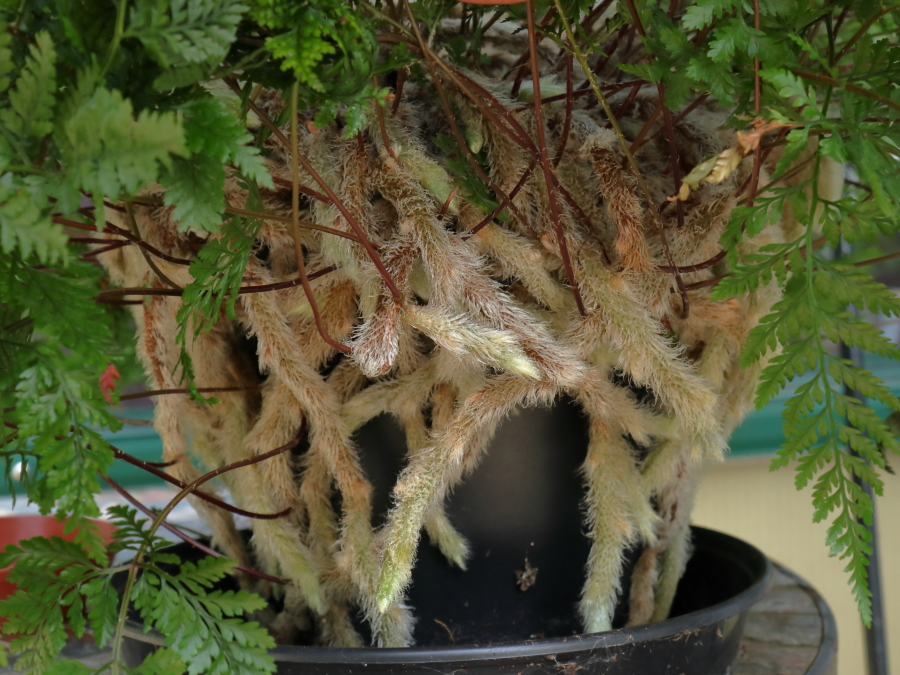
I bought this from the house plant section of a local garden centre, mainly on the strength of having been told about it, or rather Mr Tyerman, having connections to a place where a friend of mine works. I can no longer remember the connection, I must ask again and record it. Plants of the World online reduce H. griffithiana to being a synonym of Davallia griffithiana and Mr Tyerman doesn’t get a mention. However, Wikipedia refers to a cladogram produced in 2016 by the Pteridophyte Phylogeny Group, which contains Davallia tyermannii and Davallia griffithiana as adjacent species. It’s all way above my pay grade, that’s for sure. Perhaps I need to join the British Pteridological Society.
What is also sure is that it is a very beautiful fern of the squirrel’s or rabbit’s foot variety and my plant has all but hidden the pot it is growing in with rhizomes spilling over the rim. Repotting it into a bigger pot is both urgently needed and all but impossible.

Microsorum diversifolium.
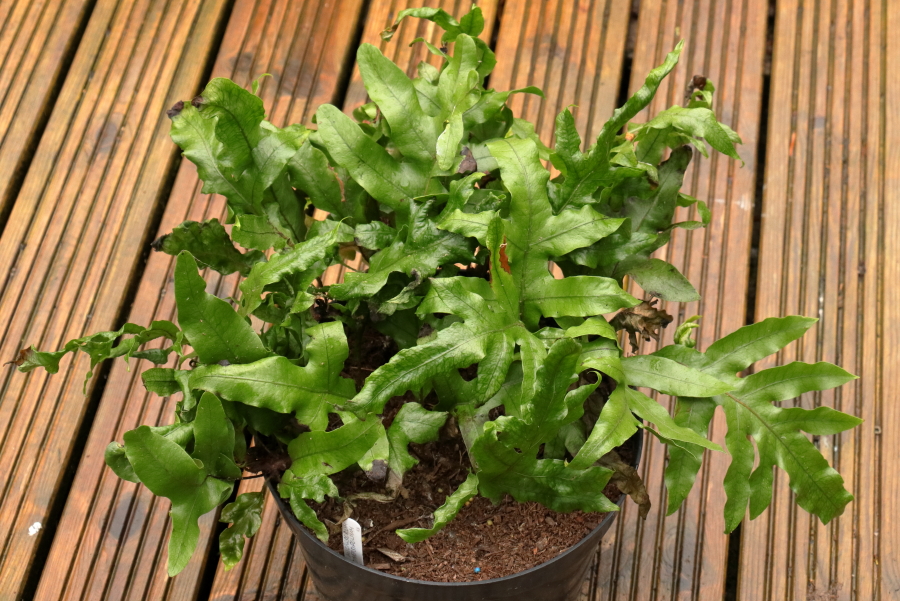
This poor thing has had to endure ill treatment and neglect, relegated to the lower shelf of the greenhouse staging where it gets probably more shade than it wants and less water than it needs. It has survived, even grown reasonably but I think it could be a lot better. POWO are calling it Lecanopteris pustulata subsp. pustulata. I’m guessing it has pustules somewhere. Online more generally it gets the common name Kangaroo Fern and is described as an easy houseplant. I’d better clean it up, water and feed it.
Athyrium ‘Godzilla’.
I believe this was part of a small order I made to an Irish nursery before Brexit choked off that supply line. As I recall I planted out a small plant, then dug it back up when it was obviously not thriving and put back in a pot for a couple of years in the hope that if planted out as a larger plant its chances would be better. It is back in the ground, has been for a couple of seasons and is at least holding its own. I think it is in too much shade and probably gets dryer at the roots than it should because of competition from other plants. It won’t be easy to increase the light level where it is so I shall look around for somewhere it can be moved to.
It’s a Plant Delights introduction from 2009 and is assumed to be a hybrid of the Japanese painted fern, Athyrium nip onicum, with Athyrium asplenioides, leading to it being exceptionally large and vigorous, but sterile.
My picture was taken in fading light with my phone and does not do it justice. I will try to get a better picture and replace this one at some point.

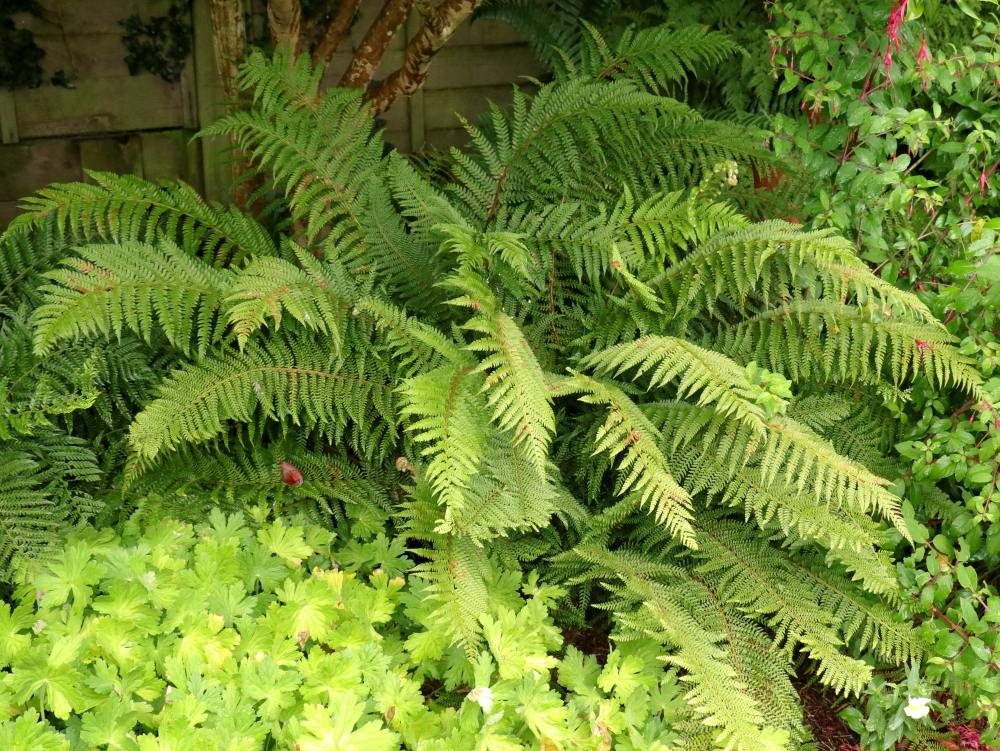
Polystichum setiferum ‘Herrenhausen (?)
I have a number of varieties of the soft shield fern and this one has long been without a label; a pity since it is a very fine plant. I think ‘Herrenhausen’ is most likely what it is but I have looked at plants in nurseries bearing the name and while some look identical to my plant, others do not. This is a large, wide spreading plant, 70cm high x 1.2m wide, with neat fronds. It has never produced the bulbils that many varieties of this species do. Like the majority of my ferns, I cut away all the old fronds in early spring just as the new fronds start to unfurl.
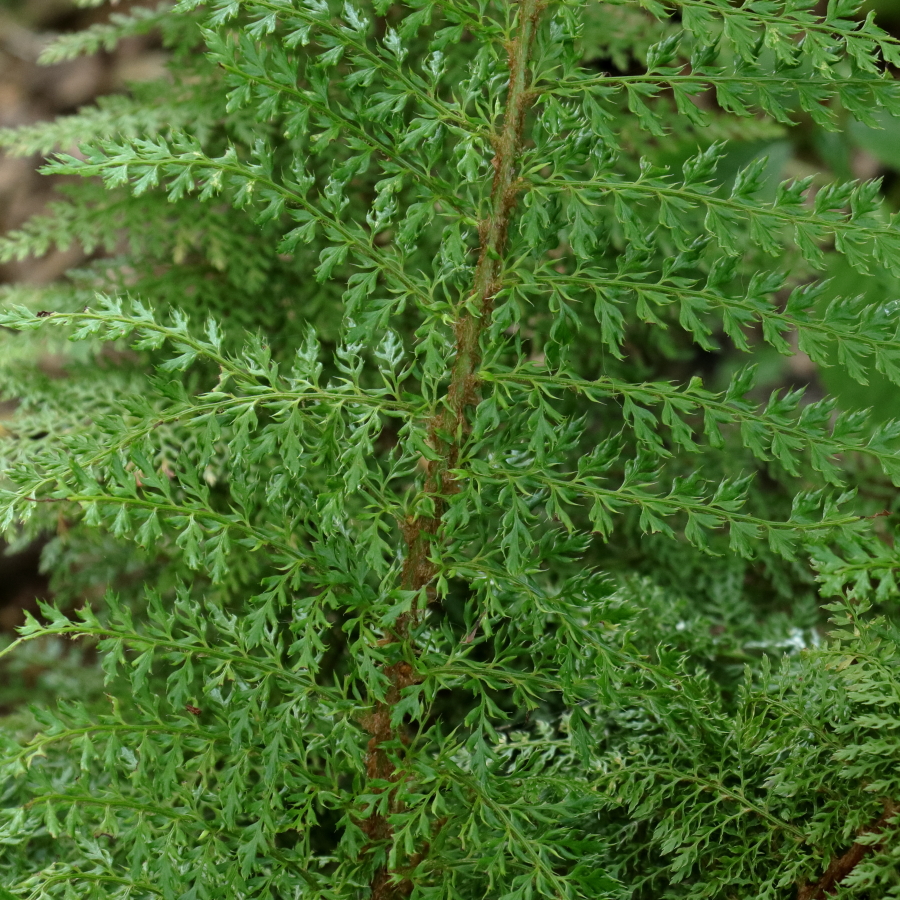
Polystichum setiferum ‘Mrs Goffey’.
Very different from the cultivar above is this form of soft shield fern. I have had this for a couple of seasons and it seems to have settled in well and is making good growth. I am hoping it will produce bulbils from which I can increase its numbers, not least because it has the most delicate appearance and I would be happier if I had a back-up plant or two. Steffen and Olsen refer in their book to the Plumosomultilobum Group and the Plumosodivisilobum Group of P. setiferum but list very few named varieties. I assume this variety belongs to one group or the other but have no idea which.

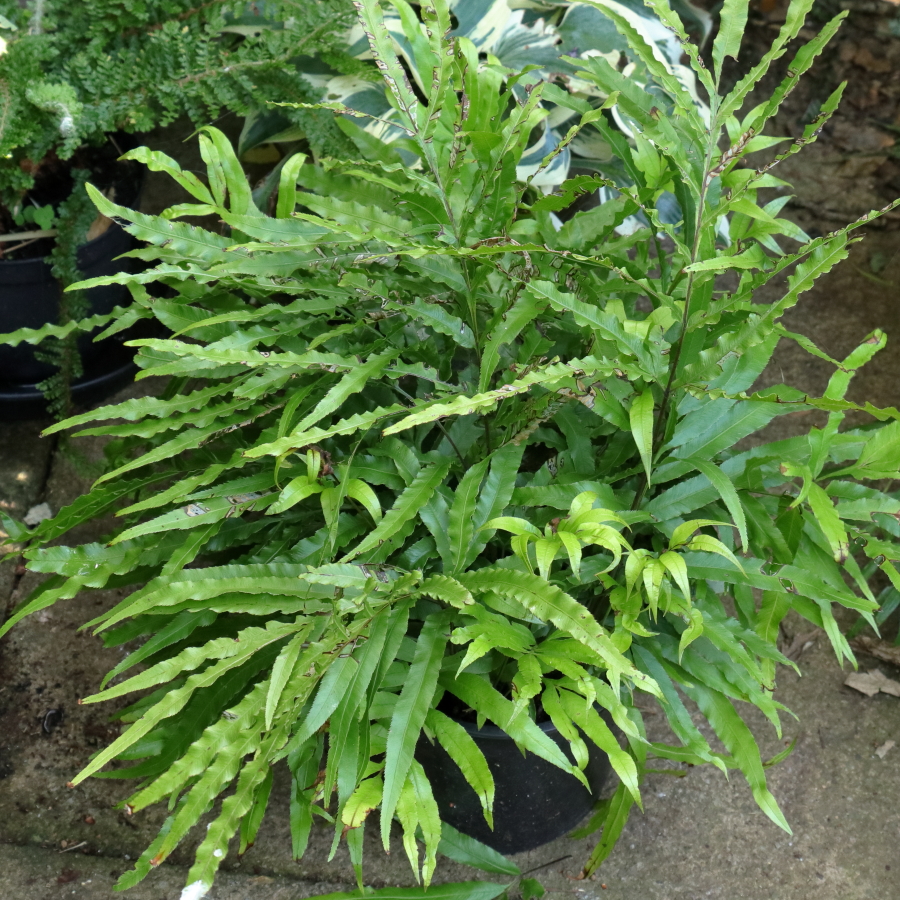
Pteris umbrosa. Jungle brake fern.
In spite of coming from Australia this fern seems to be hardy in this part of the UK. However, while it might be able to survive our winters in the garden, when it dies away completely, it’s a different story when it starts to emerge again in spring. Unlike almost every fern I grow, this appears to be a magnet for molluscs and since I don’t use slug pellets, I have had the greatest difficulty getting it back to a size in spring where it will withstand a little browsing. Even in a pot it is clear that it is an attractive food source for something. I’m pretty sure it would grow much better in the ground but unfortunately the places in the garden that suit ferns, the cooler, damper places, suit slugs at least as well. I need somewhere that is open and clear of cover for slugs in winter but then gets shade in the summer and I’m still looking. In a group of plants where so many forms are so similar, it stands out as being distinctive, so I am keen to find somewhere which meets its requirements.
Looking at the list of varieties that I have lost over the last few years I am pleased to see it only amounts to six. There may be one or two more that I killed so quickly they never got added to the list. Here is the roll call:
Adiantum hispidulum
Adiantum raddianum ‘Ultragracillimum’
Cryptogramma crispa
Dryopteris crassirhizoma
Pteris cretica albolineata
Pteris quadriaurita
I have to admit that there are a few still about that are clinging to life by a thread; it might be a kindness to do the necessary and add then to the list of casualties. I think on the whole though that it says quite a lot about how resilient and undemanding most ferns are. I don’t lavish an unusual amount of care on them, just leave them to get on with it. Probably the most important thing is to avoid adding too many male fern lookalikes, there are just so many of them that differ in the tiniest ways, and seek out the distinctive ones, in shape and colour. Do that and they will provide many months of interest in parts of the garden where the options are comparatively limited.

 garden ruminations