I can’t quite believe that my Vitopod propagator arrived as recently as 2020, it seems to have been around much longer. That might be a testimony to how many turnovers of cuttings have come through it since then, it’s certainly a lot.
I used to have a mist system, suspended over a sand bed with a heating cable buried in it. It was messy and unreliable, then some species of fly; I never saw an adult; infested the sand with its larvae, which attacked the roots of the cuttings.
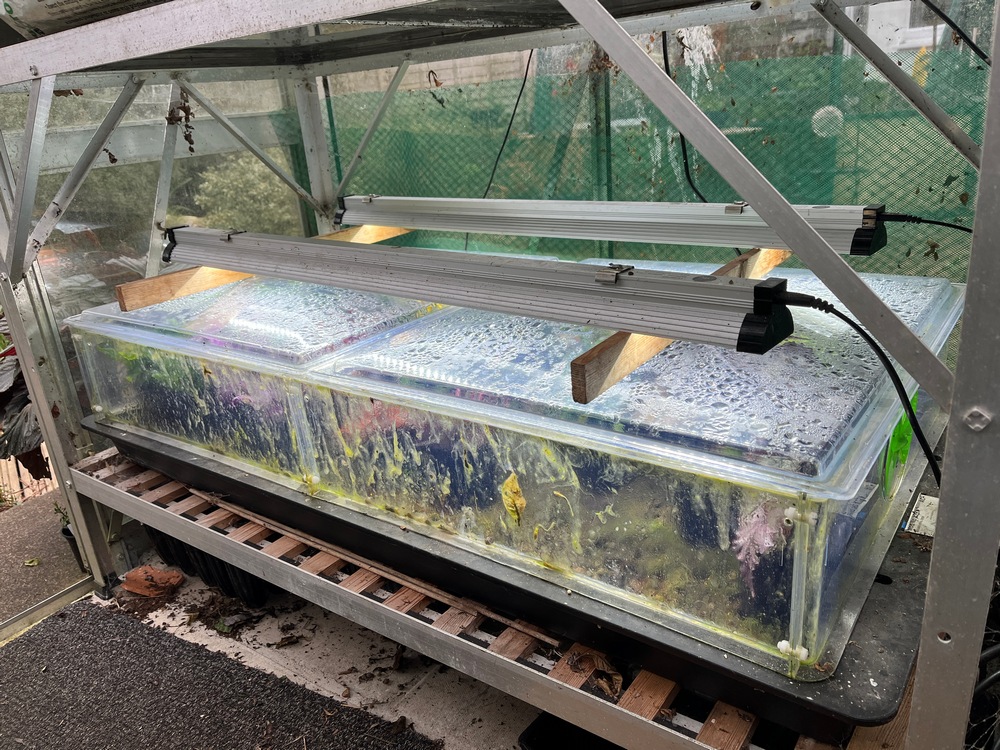
It had to go and did, replaced by a Vitopod propagator, bought for me as a birthday present. It’s the larger size, 111cm x 58cm overall, giving a working space of 102cm x 52.5cm. The bottom tray has a 100w heating element in it and there is a thermostat provided, with a sensor that is lying on the surface of a 1.5cm layer of clay granules in the tray. I currently have it set at 17°C.
Above the propagator I have two grow lights, 87cm long and rated at 36w each. Natural light in the greenhouse is tricky because even a short burst of summer sunshine hitting a small area of the propagator will send the temperature inside rocketing. I have it screened from sunshine but open on the north and east sides, so it does get some natural light. The house blocks morning sun.
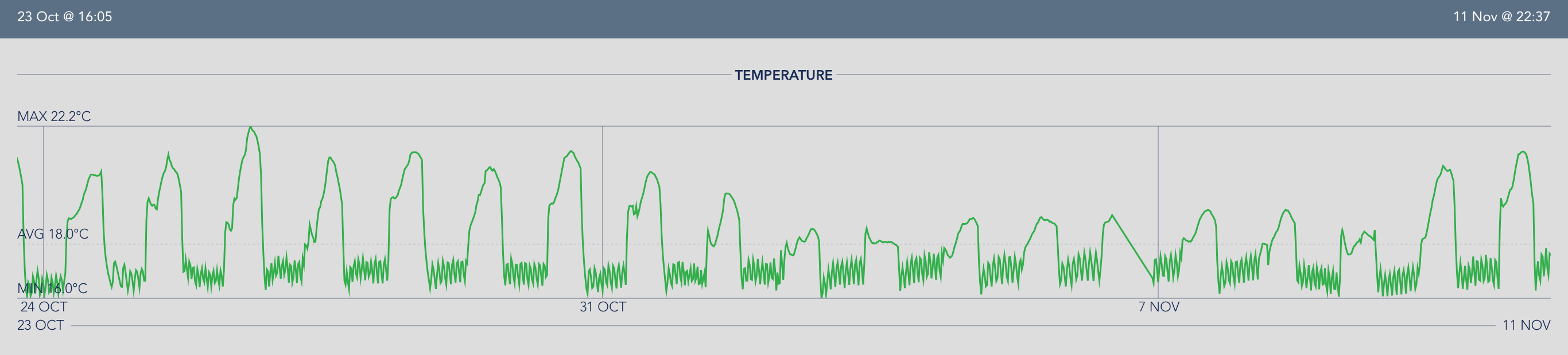
I put a data recorder in the propagator for a couple of weeks at the end of October and beginning of November which shows that the heater was operating for about 13 hours each night but not coming on during the day. When it was operational it would switch on, push the temperature up to the set temperature, switch off and go back down more slowly than it went up until the thermostat turned it on again. Thus when operational, it was on for about 50% of the time, meaning it was consuming electricity for about 7.5 hours a day. During the day, the grow lights provided enough heat to keep the propagator above the 17°C set temperature. With sunshine, the greenhouse itself heated up, taking the propagator temperature up with it.
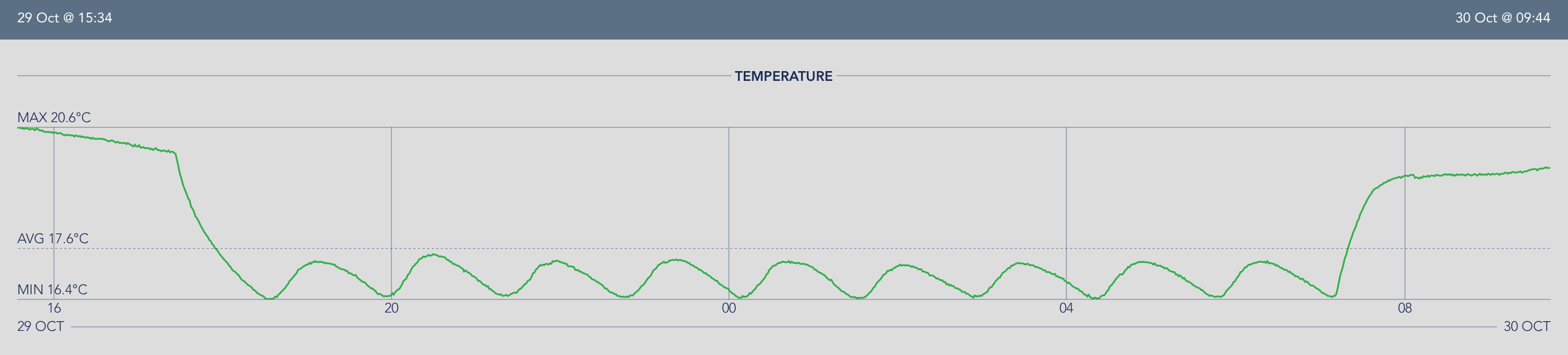
With shorter days and lower temperatures the power consumption has no doubt increased but probably to no more than around ten hours a day, one kWh in total.
The lights are set to come on at 7am and turn off at 5.30pm, 10.5 hours. Less than 0.8kWh per day, much of which will be covered by our solar panels.
I’m currently paying 23.03p/kWh for electricity so if I am consuming 1.5kWh a day then my propagation setup is costing me 34.5p/day. I would say that’s about as high as it gets; in summer the heater will never come on and the lighting will be completely covered by the solar panels.
I could save money by shortening the hours that the lights are on or turning down the thermostat, but set as it is, the plants within are still just about in growth. I think that my success rate would drop quite steeply if things were dialled back any more. The real challenge is to keep it full over the winter, the season when the highest costs are incurred for the lowest productivity.
I covered the bottom of the tray with expanded clay granules which I keep moist. The heated base evaporates the water, keeping the humidity within the propagator very high. Over the period in the graphs above it averaged 99% and never dropped below 90%. By contrast, with the data monitor on the greenhouse shelf, the last month has seen the relative humidity average 91.9% with max and min of 98.9 and 67.6.
Most of what has gone into the propagator is stem cuttings, the bulk of them tender perennials such as Salvia, Penstemon, Impatiens, Diascia, Coleus, Aloysia, Fuchsia, Plectranthus, Euryops, Coprosma and Begonia. Tip cuttings of Hydrangeas are very easy. Bulbils, rhizome sections, leaves and seeds of Begonias have all succeeded. The tiny plantlets that grow along the edges of Polystichum setiferum ‘Ray Smith’ have done well. I haven’t tried many Camellias in it, those I have tried have failed.
Most things have been rooted in the same compost we use for potting, Sylvagrow, but without added fertiliser. We have used a bag of Westland seed and cutting compost for a few things but I am not a fan of it. For leaf cuttings I have used pure perlite successfully, although it doesn’t provide good support for the cuttings. I have had success with Begonia leaf cuttings by simply laying them onto the clay granules on the propagator floor.
Usually we are propagating small numbers of things, so most go into clean 9cm plastic pots, 4-8 cuttings per pot, depending on size. I hardly ever use rooting compounds, when I do it’s Clonex Rooting Gel containing IBA.
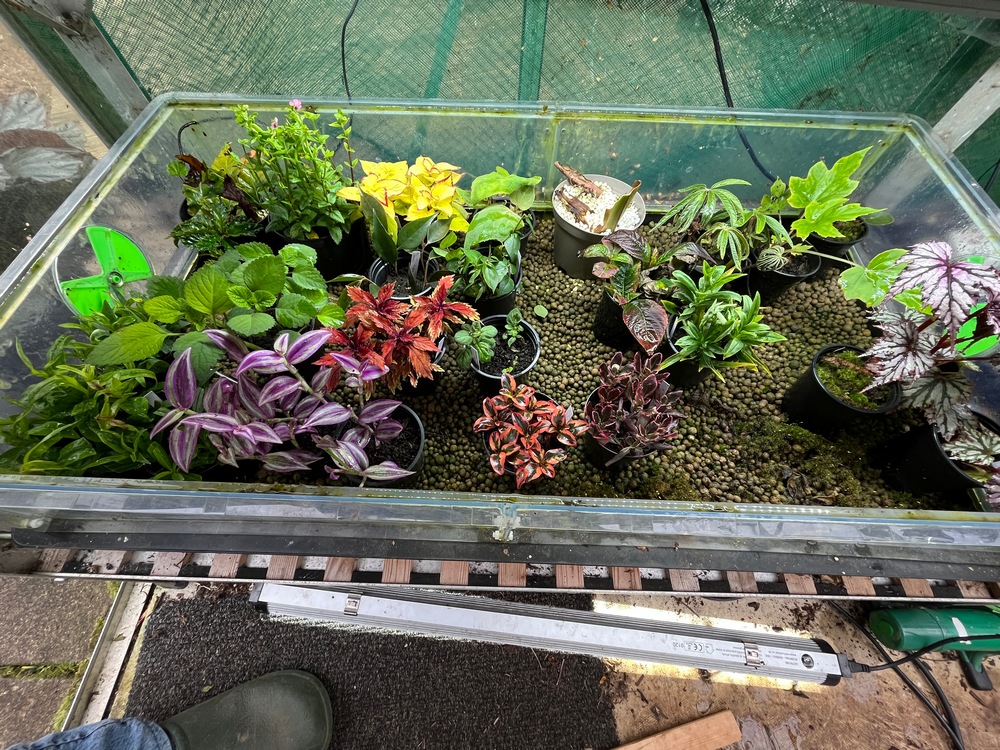
The clay granules get algae and moss growing on them, as well as roots and a small amount of leaked compost so it needs cleaning from time to time. I have only once emptied the whole thing out and sterilised the gravel. It should probably be done annually. The sides and lids of the propagator get slimed up with algae and cleaned occasionally.
Most of the time it’s full or nearly full, with a very rapid turnaround time of 3-4 weeks on the easiest subjects. There have been failures but not very many, so if I were rating it I’d probably give it a five. The things that annoy me about it, like the algae and the need to shade it constantly from direct sun, are not the fault of the propagator.

 garden ruminations
This is a very interesting post and very complete, thank you… The first thing that surprised me is the price of a kWh that you indicate at 23p and here we have an average of 0.025€ ( 0.017 by night and 0.032 the day) which is very close.
I expected higher costs in the UK (because here we have nuclear power with supposed lowers prices)
Nevertheless very interesting because I see that you often take stem cuttings in pots, placed on clay granules. Indeed some seedlings at 17°C would be difficult to start and very expensive if you raised the temperature.
Do you leave the vents open at the risk of letting in cold or do you leave them closed and in this case the humidity remains inside and therefore risks rotting? What is your choice?
LikeLiked by 1 person
I keep the vents closed and oddly enough don’t have much of a problem with things rotting. We don’t put things like Pelargoniums in there, which I would expect to go mouldy. I’m looking at your electricity figures and thinking you must have meant 0.25€ not 0.025€.
LikeLiked by 1 person
Oh yes 😅 0.25€ … otherwise I would have set the greenhouse thermostat at 20°c
LikeLike
That’s an impressive set-up you have there, and it’s good to have all the data to know how it’s all working. The plants look very happy, too.
Beth @ PlantPostings.com
LikeLiked by 1 person
I imagine this would be so useful for tender perennials, making sure you have some for the next year. Thank you for sharing your propagator!
LikeLiked by 1 person
Oh, that could become a bad habit real fast! I already grow more than we can use within our landscapes. I try to limit what I grow to what I ‘can’ grow without propagation infrastructure. I plug cuttings of a few species that I do not expect to survive. If they do not survive, I do not need to find homes for them. If they do survive, we, and perhaps the neighborhood, get too many.
LikeLiked by 1 person