There are people with large gardens who never water anything and there are people with small gardens stuffed with water hungry plants in pots stood in full sun, who never seem to do anything but watering. On a sunny summer’s day we’re in the second camp, or at least feel like we are.
It would be possible, if expensive, to automate the process and reduce the workload involved in lugging cans of water around the garden. Overhead irrigation would be cost effective to install but wasteful and expensive to use. A drip system would be complex, expensive, inflexible and prone to going wrong, but less wasteful to run. Even so, it would use much the same amount of water as targeted watering by hand. And that is a lot of water. I haven’t ever kept count but I bet I apply around 20 cans of water or more on a summer’s day. That’s 140 litres. I have around 6000L of water storage, so it’s going to run out on day 42. Even if I was only using three cans a day, a 210L water butt is gone in just over a week.
Last year my 6000L ran out quite late in the summer. I had stopped watering most things in the ground by then but was still watering glasshouses and plants in containers around the garden, some of which were by then outgrowing their pots and requiring generous daily drenchings. Almost all our pots are stood in drip trays to avoid water wastage but even so, for a few weeks we were watering with metered water from the tap. You get a bit obsessed with being self sufficient and it felt like a fail.
This year the greater part of my stored water has not been drawn on at all. The more rain you get, the less you need. More rain means plants transpire less and are watered by the rain. I’m wondering whether I should empty more stored water and replace it with fresh over the winter.
We could save ourselves time and effort by watering with a hose rather than watering can. We could be considerably more generous with watering rather than slightly stressing the plants between waterings. We’d get lusher growth and would be locked in to watering more. We could water far more plants in the ground, which are always at the bottom of the pecking order when lugging cans of water about. We could water the same plants more generously. In short, if I had 10,000L stored instead of 6,000L, it probably wouldn’t last very much longer. It’s also probably true that if we weren’t constrained by the thought of running out of water, we’d grow even more things that needed irrigation.
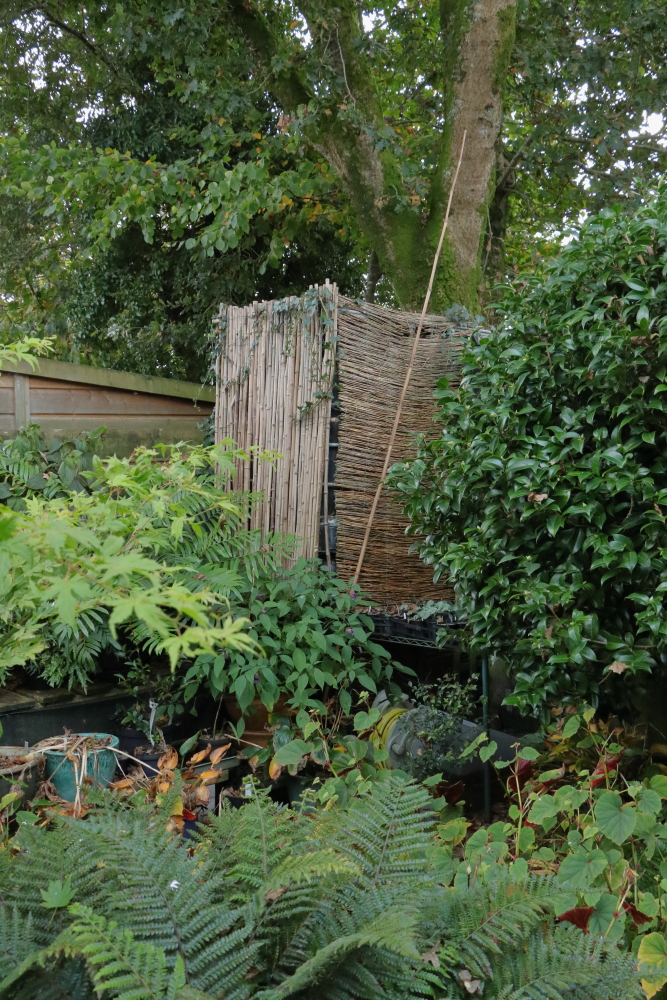
The last time I upped our storage capacity I did my homework on what was available and what it would cost per cubic metre stored. I don’t remember the details but I ended up purchasing two IBC’s (intermediate bulk containers) which I stacked one on top of the other in a corner of the garden then camouflaged with a bamboo screen. The aesthetics mattered as much as the value for money. That they are square means they take up less space for a given volume of storage. I bought black IBC’s so that algae wouldn’t become a problem. They hold 1000L each and when empty are easily manhandled by two people, though getting them over our side gate was fun.
I’ve long had a black polythene tank which I believe was originally used for transporting orange juice. It has a volume of 1500L but no outlet other than the opening at the top. I could have cut a hole into it but chose instead to leave it intact and pump the water out. The big plus was that it cost me next to nothing, though they sell online for a fair whack. It’s what I regard as my main storage; it contains a submersible pump with which I can pump at higher than mains pressure and I have a tap operating via a syphon so I can fill my cans from it easily. I usually keep it topped up from my other storage and then either pump from it or fill cans from it to do my watering.
The last semi-bulk storage that I have is a row of six 210L water butts linked with 20mm LDPE pipe. They should give me 1260L storage but are on a slight slope so only the lowest fills to the top. They are against a fence and have a wooden shelf running along the top of them with plants in plastic trays on it. The front is covered in with a willow screen.
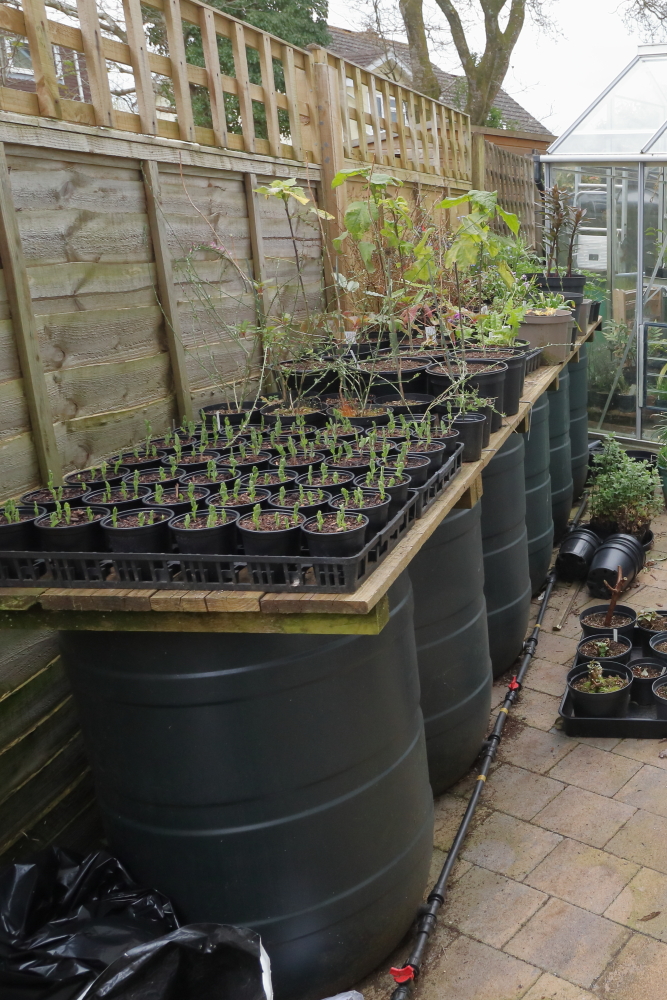
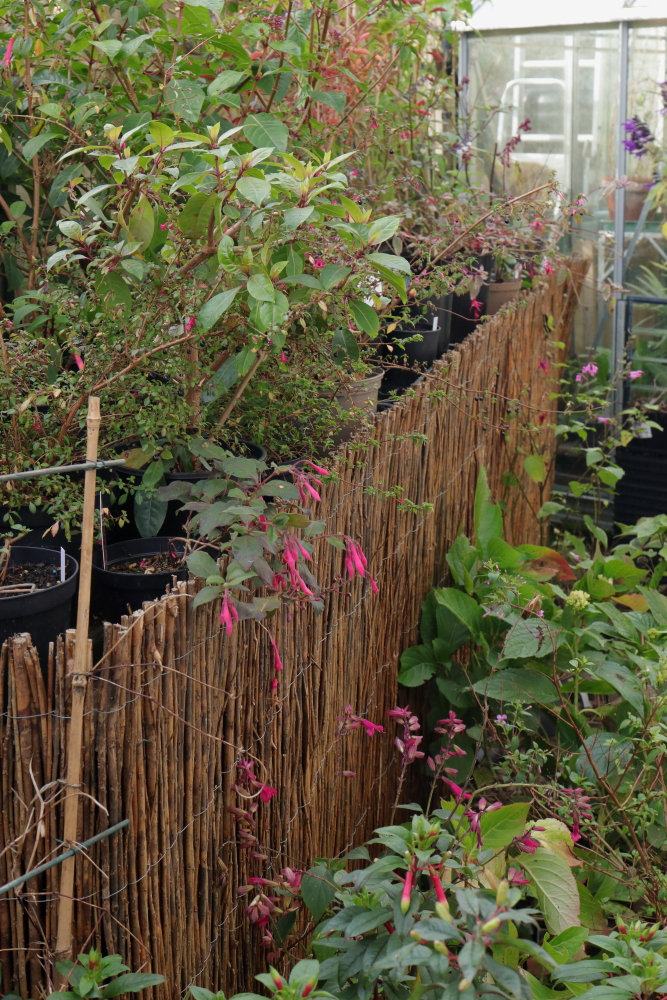
I doubt that any of our garden visitors notice the row of water butts or the IBC’s. Neither are easily visible though they are hiding in plain sight. The orange juice tank will get noticed but is tucked in behind one of the glasshouse in a corner that doesn’t lend itself to much else.
On top of that are the four 100L water butts that collect water from the house roof and the four 200L water butts that collect it from Sue’s glasshouse roof. There is another water butt that gets the water from the other two smaller glasshouses before feeding it into the row of six butts. Call it 6160L in total. It’s probably about as much as we really need; it would be a wiser course to reduce the amount of stuff that needs watering, rather than increase the amount of water. Having said which, who knows where climate change is going to take us.
The other two main options for larger scale water storage are plastic tanks, available in a huge range of sizes up to at least 30,000L, and galvanised steel tanks. It comes down to the volume you want to store, the space you have available for the tank, possibly access to get the tank in, especially large plastic tanks, and what you are prepared to pay. You will need the right base and you will need to be able to get water in and out of it, but none of it seems to me to be beyond a competent and careful DIY’er, though I imagine most people would get someone in to install a large capacity pump and control system.

 garden ruminations
One thought on “Water stuff: part 2, storage.”