I don’t know how many Begonias I now have, I have a list of them but haven’t updated it in a while. I will admit to more than a slight tendency to being obsessive but I really try very hard to restrict new purchases to things that are distinctly different from anything I have already and that look like they would thrive in the garden, either all year round or bedded out seasonally.
I will also admit to a failing memory, so I offer apologies in advance if I repeat things I’ve said in previous posts.
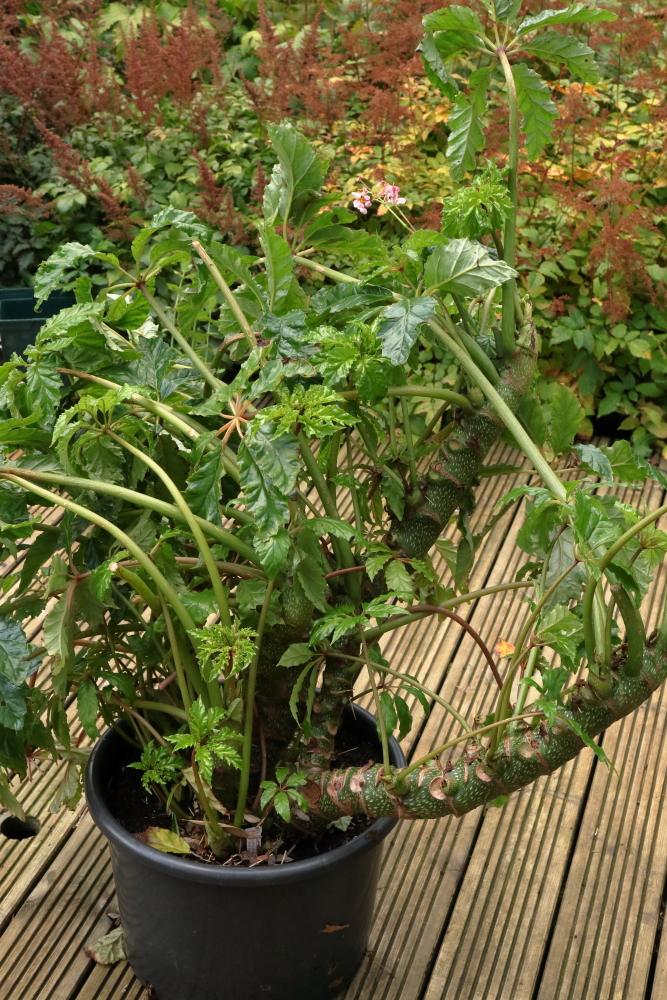
Begonia carolineifolia is a species that is in Dibley’s list but which I bought, not directly from them but in a local garden centre, with their name on the side of the pot. It was small and expensive but so unlike any Begonia I’d ever seen that I had to have it. I’ve since seen several pictures of it and none were anything like as big and lush as my plant has become. I have it in a 20L pot and the tallest of its stems is 2 feet. That same stem is seven inches in circumference at its mid point. ‘Thick stemmed’ is a begonia type recognised, if not precisely defined, by the American Begonia Society and this species is a great example.
The leaves are palmately compound, with 6-8 leaflets which on my plant are up to 9 inches long on a petiole up to 18 inches long. It has produced an occasional flower spike, with small pink flowers.
I cut up a leaf and put the pieces into a pot of perlite, there are a couple of new shoots coming up and masses of roots out of the bottom, so propagation seems to be easy enough. A shoot broke off which I intend to cut into pieces which I will probably simply push into the clay granule base material in my propagator.
It spent last winter indoors in a cool room. It lost all its big leaves but never went entirely dormant so as the old leaves fell off, new leaves were being produced on new growth. In early summer I stood it outdoors in a sheltered and shady position, where it was very happy until October and the first of the winter gales, which left it looking a little beaten up.
At the moment it is a greenhouse and that is likely to be where it spends this winter; it’s getting rather large to bring indoors again and now that I know I can propagate it, I’m prepared to take a slight risk with overwintering it.
Begonia ‘Spacestars Maia’ was a relatively new purchase in my last post in July and I had reservations about it fitting in, visually, in an informal garden setting. I needn’t have worried, its colouring has toned down enough to allay my concerns while still remaining distinctive and eye catching. I’d go so far as to say that it has been one of this season’s star performers. I will lift it and over-winter it in a pot in the greenhouse, kept frost free but with insufficient heat to keep it growing. I haven’t propagated it so I hope it will survive.

Begonia U614 was the second “hardy” begonia I obtained, after Begonia grandis. It was given to me as Begonia sikkimensis but is now regarded as unidentified. I still have a plant of my original form growing in the garden and it is probably as flowery now as it will be this season, which is quite a lot less flowery than at this time last year. It’s worth having for its deeply divided, silvery foliage, irrespective of flowers.
I wrote a blog about it and four seedlings of it that I have raised, at which point I had just planted out U614-3 in the garden. Right now, the two silvery seedlings which I had designated U614-1 and U614-4, are looking pretty ragged with very few leaves left on them. The two green seedlings, one in the ground and one in a pot, are looking much happier. U614-3 is flowering quite well. Earlier in the year I was rating U614-4 as the best of them but that would not be the case now.

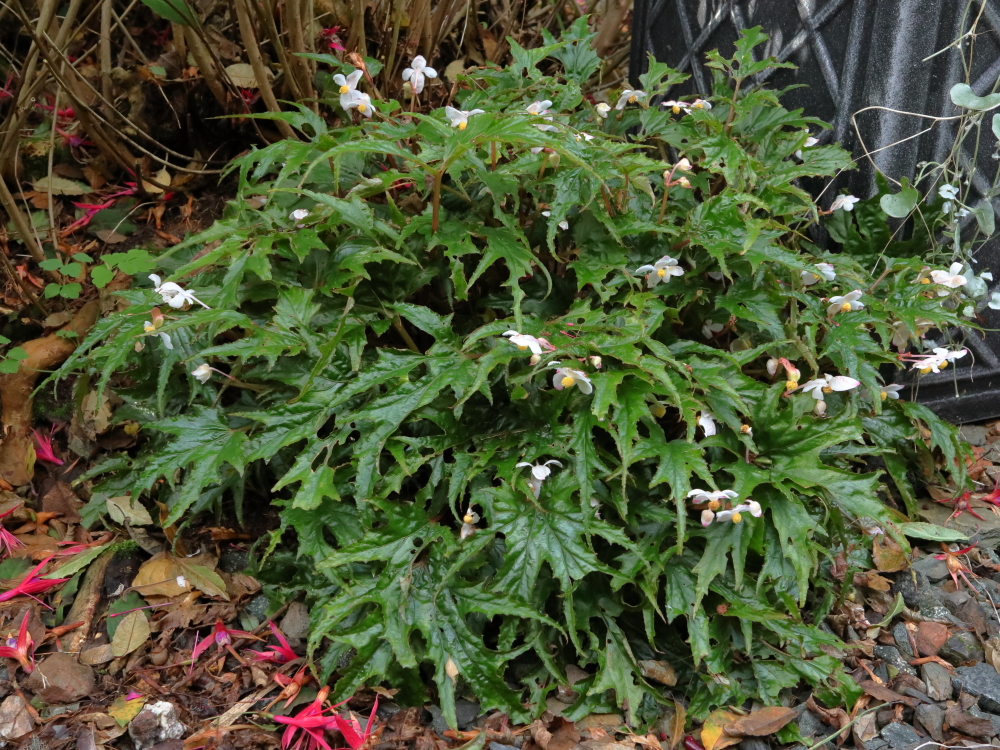
Begonia palmata ‘Tie Dye’ was planted to replace Begonia sinensis ‘Red Undies’ which had not emerged by June. It turned out that it was simply still dormant so I potted the corms and planted ‘Tie Dye’ where it had been. Begonia sinensis is a close relative of B. grandis and like that species produces bulbils in the leaf and stem axils as it collapses in the autumn. They were so tiny I simply wrote them off as highly unlikely to come to anything. A few weeks after planting ‘Tie Dye’ tiny plants of ‘Red Undies’ started to appear. I carefully lifted a dozen and potted them up in a cell tray to see how they fared. Very well, it turned out, making surprisingly good little plants considering how tiny the bulbils will have been and how late they started into growth. Hopefully they will survive the winter to come as well as they survived last years. I assume that this year they will carry over as tiny corms, perhaps with a few bulbils of their own to add to the stock. More have since appeared around ‘Tie Dye’, I could easily get another dozen, and probably will. They get a bit of mildew under cover but seem clean outdoors.
I bought a different form of Begonia palmata at the Royal Cornwall Show this year; so different from ‘Tie Dye’ as to make it all but impossible to believe they are forms of the same species. It’s still in a pot in the greenhouse where it will stay until next spring.

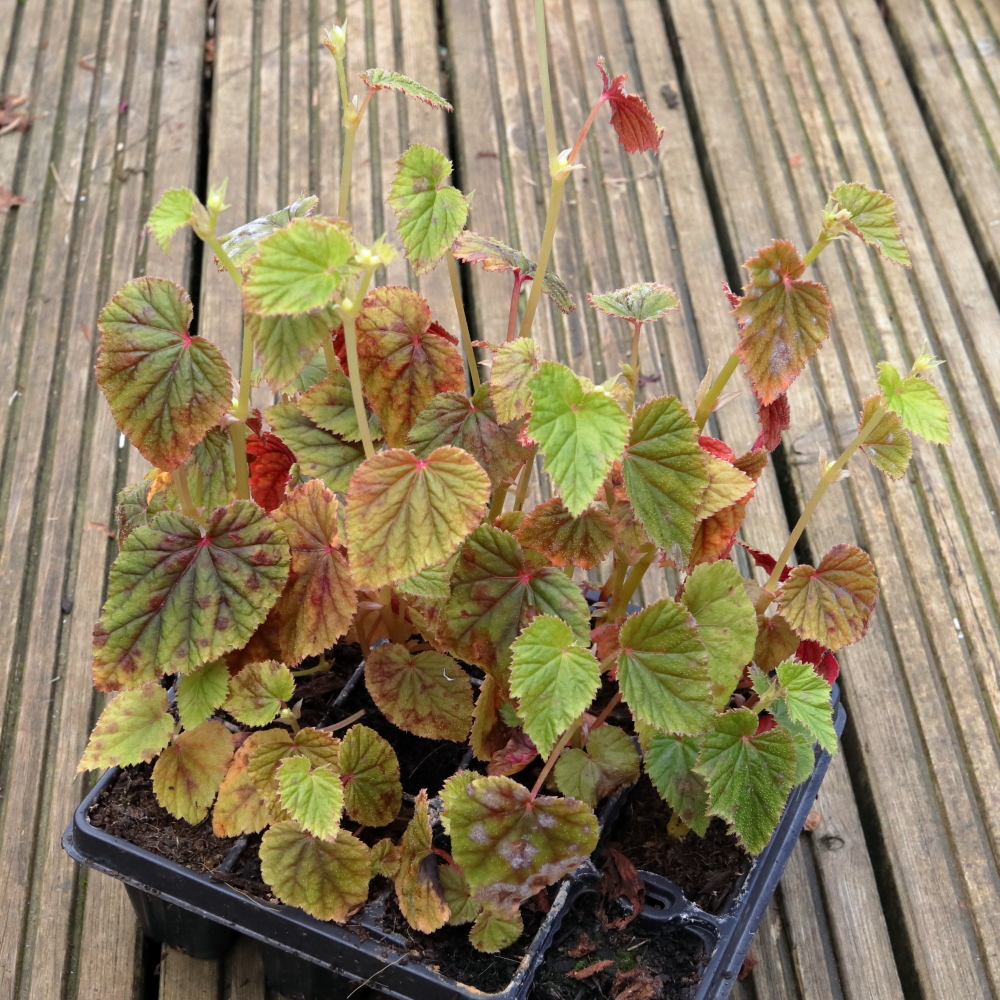
Begonia ‘Torsa’ produces bulbils in huge numbers leading to the potential for exponential growth in numbers. Seeing the price people are asking for one or two year old plants makes it almost impossible to throw the bulbils away, but this year I shall literally have thousands. The plants in this picture were planted as part of a grouping of bold foliage plants, did rather poorly last year even with regular watering and this year have thrived with nothing more than has come from the sky. The tallest are over 30 inches in height. Flowering has been poor this year compared to previous years.
One irritating characteristic they have is to arrange their leaves like upright funnels, meaning they catch and collect everything that comes down from above. No doubt it effectively directs rainfall down the petioles and stems to the plants roots, but every leaf and spent flower that falls from the Ligustrum above it, as well as its own flowers, is caught at the base of the leaf and if not promptly removed, causes the leaf to rot. I have tried, and failed, to keep on top of it but its tedious and time consuming and there’s always something more appealing to do.

I still have quite a bit of flower on bedding type tuberous begonias and some of the grandis forms. Some, like ‘Torsa’, will provide some autumn tints before they collapse, some would be evergreen in a milder climate and will have good looking foliage until the weather damages it or I am forced to cover them with a protective blanket of leaves. I can’t complain about plants that take their display into November though, so for me, for now, the obsession continues.

 garden ruminations
I hadn’t realised there were so many different ones – I think I would become obsessed with them too. I like the leaf colours on Red Undies.
LikeLiked by 1 person
Over 2000 species and probably even more cultivars.
LikeLiked by 1 person
I’ve never thought of growing them but I’m starting to think I should make room for at least one.
LikeLiked by 1 person
It started as one with me.
LikeLiked by 1 person
Fantastic., still wrapping my head around red undies!
LikeLiked by 1 person
better to wrap your head round red undies than red undies round your head. I don’t know what he was thinking when he named it that.
LikeLiked by 1 person
Beautiful Begonias! I’m a huge fan, and I grow them as annuals here sometimes in the summer. You have quite a collection!
Beth @ PlantPostings.com
LikeLiked by 1 person
haha at some of those names. Spacestars Maia has gorgeous foliage!
LikeLiked by 1 person
tee hee, . . . ‘Tie Dye’ ‘Red Undies’. Perhaps I should not be so embarrassed by ‘Santa Cruz’.
LikeLiked by 1 person
You have the advantage, if that’s what it is, of knowing Santa Cruz, but it sounds just fine to me. ‘Red Undies’… not so much.
LikeLiked by 1 person
Well, my neighborhood is that part of Los Gatos that extends a bit into Santa Cruz County, so is not within Santa Clara County. (I am a native of Santa Clara County, so am not exactly keen on living anywhere else.) What makes it sort of worse is that the town of Santa Cruz is famously weird and liberal, so outsiders believe that everyone within Santa Cruz County is also. I prefer to not get political, but it amazes me that everyone in America makes fun of the extreme liberalism of California, but so many want it for the rest of America, as if it works so well here. Although, I also understand that even those who do not want it do not want the alternative even more.
LikeLike