I’ve written blogs before about water collection and storage, but not for a long time. A couple of things have come along recently to prompt me to revisit it as a subject.
One was an article in The Garden, about water butts. What particularly caught my attention was the observation that an average roof could yield 24000 litres of water, which would fill 120 water butts, but no mention of any form of water storage on a scale larger than water butts.
The other was the discovery that Bosch make a battery powered submersible water pump.
Ours is a modern house of simple design, with a roof sloping to back and front. There are gutters at back and front, each with a single downpipe. Then we built an extension which is set back from the line of the house at back and front and has its own length of gutter and downpipes. Four downpipes in total, so four collection points for rainwater. The total roof area is 73.1m2. I reckon our local rainfall to be between 1250 and 1500mm per annum so there is the potential for a minimum of 91,000 litres of water to be collected over a year.
Four “standard” 200L water butts would give me the capacity to collect less than 1% of that amount although obviously if I’m using the water, I’m increasing that proportion. Even so, most of it will come in the cooler, wetter half of the year when I’m using very little. For me, with four greenhouses and a lot of plants around the garden in containers, larger scale water storage and the means to transfer water from the collection point to that storage, was a must. I also prefer the slimmer, less obtrusive 100L water butts, so potentially I could be looking at 910 fillings and emptyings in a year.
The impression I get though is that at a retail level, as reflected in what is available at a typical garden centre or covered in a typical magazine article, water butts and rainwater diverters on downpipes, are about as complicated as it gets. From there on, you enter a grey area between what is marketed for amateurs and what is available to professionals. It gets into plumbing and pumps and tanks and I’m not surprised that most people don’t want to go there.
I’m going to take you there, in stages and only so far. Let’s start with collection.
Buy a water butt and it may well come with a diverter for a standard downpipe. It may not, or you may want one that is the colour of your downpipe and choose to get it separately. They’re readily available online and probably also in bigger garden centres. They’re also simple enough to fit though it entails cutting the downpipe, which may have implications for its attachment to the wall and/or the gutter. It has to be set at the right level too, relative to the water butt.
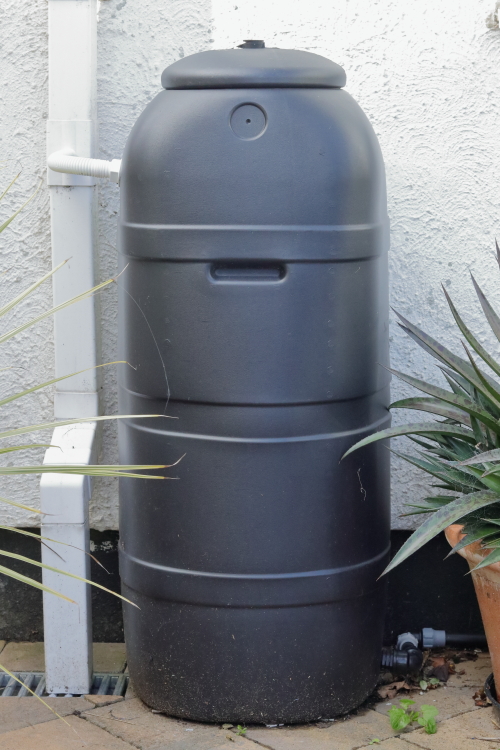
At the front of our house we have two downpipes serving two sections of roof, one twice the size of the other. I put diverters into both downpipes then linked two butts with a pipe fitted to the tap outlets on each. The two tanks fill equally, though more comes from one section of the roof than the other. I empty both butts with a pump in one of them, meaning I only need access to one and also that they can sit on the ground as I do not need to put a watering can under a tap. The diverters needed to be set at precisely the same level, but I was working from a hard level surface so that wasn’t too difficult.
The butts are connected with 20mm black LDPE (low density polyethylene) pipe. Both pipe and fittings were purchased from easy-irrigation.co.uk but are widely available online. They offer two types of fittings, barbed fittings and Tavlit Nutlock fittings; I use the latter. Barbed fittings are OK for the distribution end of a water system where the water is only on occasionally, under very little pressure and where a few leaks don’t matter. The Nutlock fittings require the pipe to be pushed onto a barbed piece which the outer nut clamps to the fitting. The pipe might need to be softened a little in hot water to get it onto the barb but it creates a very secure joint.
Plastic water butts usually have a 3/4 inch female threaded connection at the base which the tap is intended to be screwed into. A fitting which is 3/4 male thread to 20mm Nutlock will allow pipe to be connected instead. I would apply three or four turns of PTFE tape onto all the threaded joints.
At the back of the house I have a water butt on one downpipe with a pipe leading to a second water butt about ten feet away. This is simply because the second butt is easily accessible while the one by the downpipe is not. The second butt could be any distance away so long as it’s at the same level.
On Sue’s greenhouse I have a similar setup, except that the gutters lead straight into one water butt without the need for a diverter. Here I have installed four 200L water butts, all connected via the tap outlets at the bottom. As one fills, they all fill. She waters by dipping a watering can into the butt by the glasshouse door. All the pipework is underground. The butts at the ends of the linking pipe have 20mm to 3/4″ male connectors, the middle two have a tee, 20mm to 20mm with a 3/4″ male branch which is screwed into the water butt. There is no limit to how many butts could be connected in this way, or to how far apart they are, so long as they are at the same level. One could be inside the glasshouse, another outside, for example.




 garden ruminations
A question, could I connect one tank from the tap to the top of another so that water could be taken from the tap of the second one. Would the pressure from the first tank fill the second one?
LikeLike
An interesting and informative article it is a pity new builds do not have under ground water storage built in it would help prevent some of the flooding and sewage problems.
LikeLike
Great set-up! I do collect rain water, the little we get. I know I could be doing a better job of it.
LikeLiked by 1 person
Outsiders must wonder why rain water collection is not more popular in the chaparral and desert climates here. It is precisely because of the chaparral and desert climates. Although we could certainly use such water, it all arrives within a limited season, with no more to replenish supply until the next rainy season. Garden spaces within urban gardens are too small to accommodate both gardening and tanks that are large enough to store enough water to sustain gardening through the dry season. The Pacific Northwest gets the same dry season that we get, but with occasional rain throughout. The occasional rainstorms replenish rain water storage.
LikeLiked by 2 people
I manage to collect rain water too.but not a professional as yours..plants just do better on rain water even though there is probably something in it that shouldn’t be there..Some things we just can’t control yet.
LikeLiked by 1 person
I don’t need this information, but it was interesting to read it. You are very, very clever.
LikeLiked by 2 people