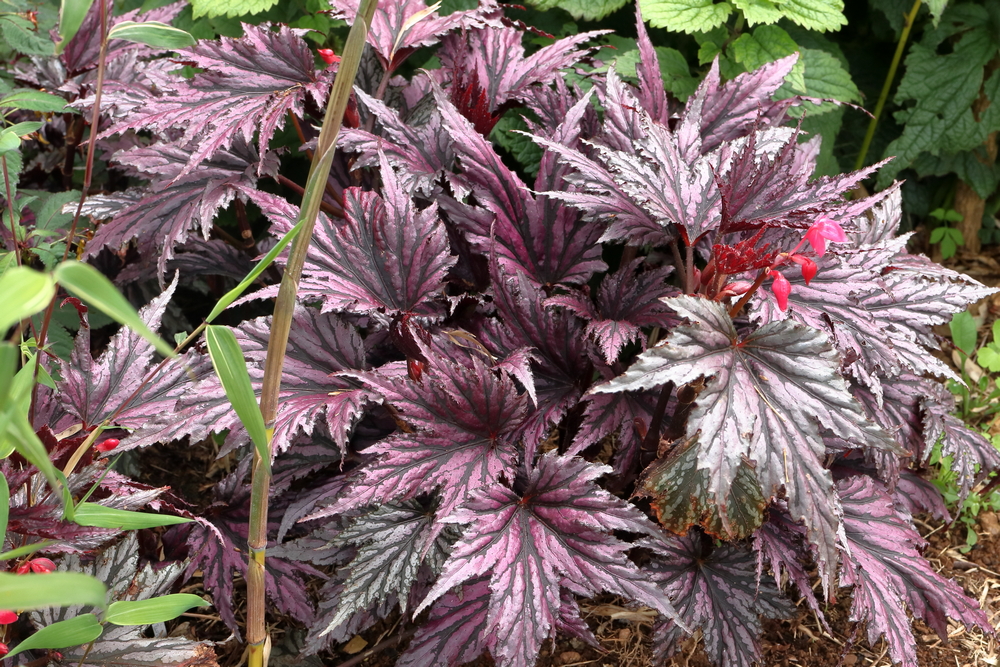
This is undoubtedly a contender for best performing plant in my garden this year. I put it into a “Six on Saturday” post on 11th June, noting that it was shaping up well, and now, on 6th November, it is still looking good, if a little windswept by the very gusty winds we’ve been getting of late.
The RHS would have us accept its name as Begonia GARDEN ANGEL BLUSH (‘Tnbeggab’) (Garden Angel Series), which seems to make a nonsense of the good work Linnaeus did to rationalise plant names around a binomial system, as well as risking bringing the current rules of nomenclature into disrepute.
Begonia ‘Garden Angel Blush’ is one of a series of three, raised by Terra Nova Nurseries in America. A great deal more information about it is available on their website entry for it. The other two varieties are ‘Garden Angel Silver’ and ‘Garden Angel Plum’, both available in the UK. I have recently purchased ‘Garden Angel Silver’, which looks fairly similar to ‘Garden Angel Blush’.
Terra Nova describe it as hardy to USDA zone 7, which for someone like myself, gardening in the UK, could be very misleading. Zone 7 is described as having lowest average winter temperatures of 0°F – 10°F, -17.8°C – 12.2°C. I haven’t tested it in very low temperatures but it didn’t seem to much enjoy being left out in a comparatively mild Cornish winter and I have found it performs much better if brought in for winter. In an article accompanying the Terra Nova web page it is advised that a minimum temperature of 55°F (12.8°C) is needed for active growth and that at temperatures below 38°F (3.3°C) cold injury may result. I frankly don’t believe it will take very low temperatures so while it might grow well in summer in zone 7, it is, from my experience, going to need to be kept a few degrees above freezing to survive winter in reasonable condition.
The plants in the series derive from B. ‘Benitochiba’ and B. ‘Garden Angel Blush’ certainly bears more than a passing resemblance to that cultivar. B. ‘Benitochiba’ is probably a cross between B. ‘Filigree’ and B. hemsleyana.

I have my plant (actually a group of three) growing under Phyllostachys aureosulcata ‘Spectabilis), a tall, generally clump forming bamboo. I have removed the lower branches on the bamboo so the Begonia is in shade but still gets plenty of light. I chopped out a generous sized hole when I planted it so it is not competing with the roots of the bamboo, though it will be if I let the roots grow back. The bamboo keeps a lot of rainfall off the Begonia and ensures that the soil is never very moist either. Terra Nova advise against overhead watering because of possible fungal leaf problems and it seems I may have planted it in ideal conditions to help this; certainly, I have experienced no disease issues. There are a few slug or snail holes in the leaves, not enough to spoil the plant.
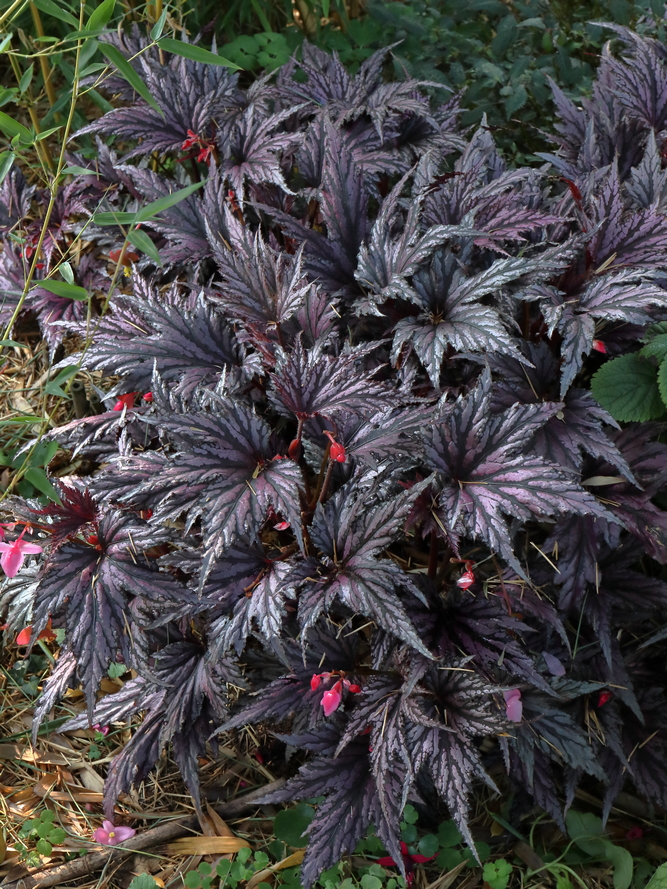
This is a plant that with high enough temperatures would remain evergreen. Left in the ground the top growth will get gradually beaten down by winter weather, rendering it effectively deciduous. New growth tends to start late as the plant needs the ground to have warmed up a fair bit before growth resumes. Lifting the plant, overwintering it under cover and bringing it back into growth a lot earlier than would happen in the ground, makes for a much longer period when it is looking good and increasing in size. My intention this winter is to lift the two smaller plants and bring them under cover, then to protect the main plant by piling dry leaves around and over it.
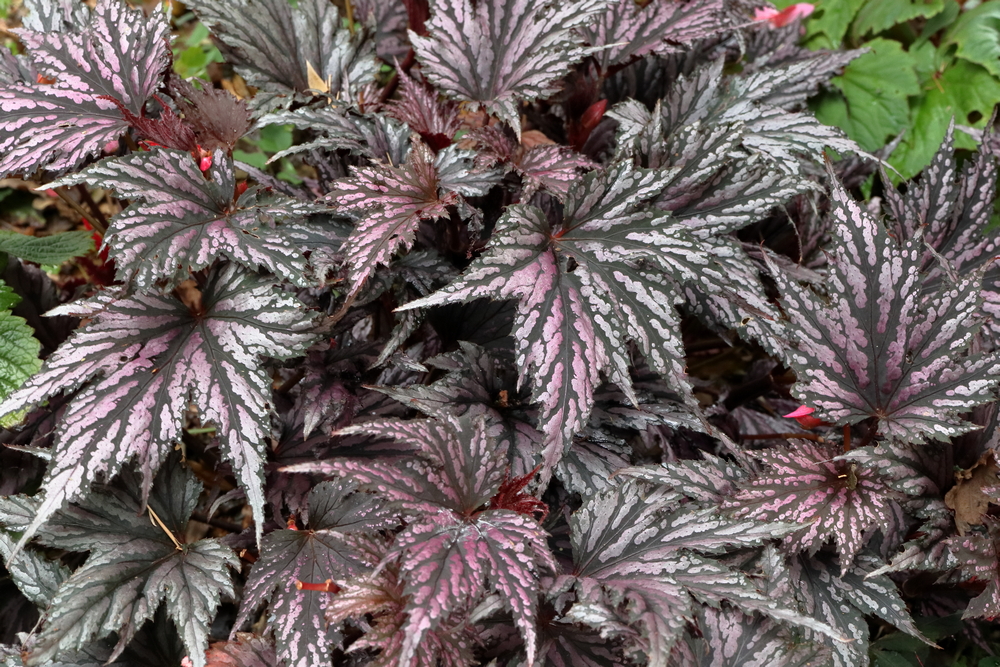
The new leaves are the brightest, any overwintered leaves soon look dull compared to new growth. The silvery variegation has a reflective quality about it that is hard to capture in a picture. It seems to mean that the apparent colour changes a lot in different light conditions and I think it means that there is a degree of iridescence so that the leaves change colour subtly as the viewpoint changes. Every picture I’ve taken has fallen short of capturing the true effect.
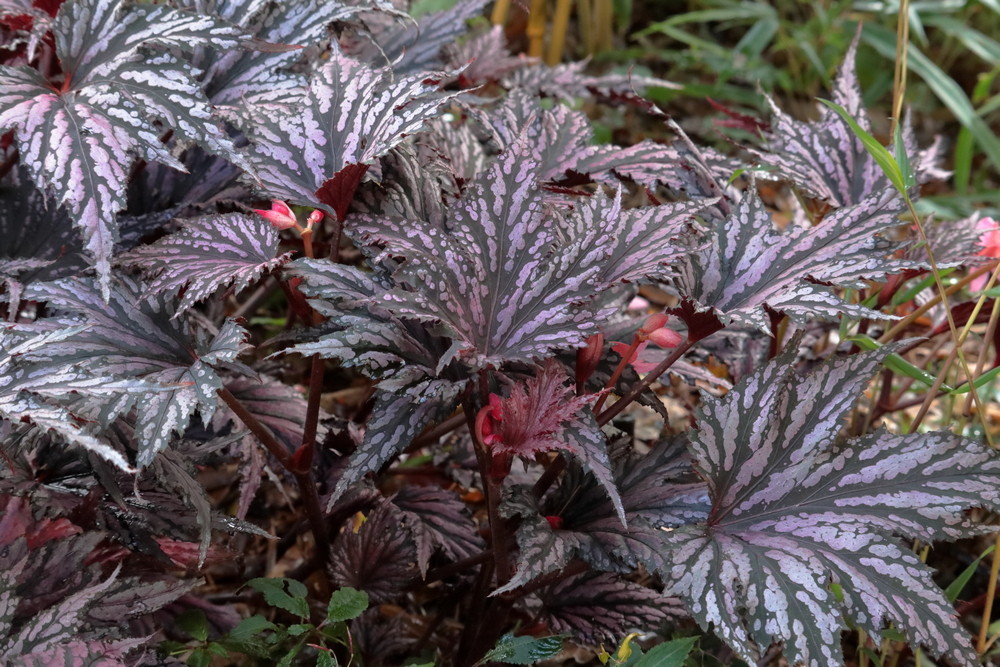
In my predominantly green shady area, it couldn’t be said to blend in quietly. Rather, it makes a strong visual statement which I concede might not be to everyone’s taste. It provides contrast in colour and leaf shape, making the area more interesting, and because it is with foliage, does so over a very long period. It is flowering, but I am getting only small numbers of pink flowers which don’t add much to the overall effect. Like other purple leaved plants, I believe its real value lies in how it contrasts with and sets off, other plants. It is not my intention to propagate it like mad and mass plant it; I suspect that en masse it would look rather dark and dull. In a bigger garden a larger planting of it would needed to keep in scale with its surroundings.


 garden ruminations
My plants retained foliage all winter. Tried to keep green house at 4C but it did dip ocassionally to 0C.
LikeLiked by 1 person
It’s a variety that will survive outdoors with protection here, but then struggles to get going again in the following year. I’ve had better results overwintering it under glass, as you, just frost free.
LikeLike
What fabulous foliage, such wonderful colours. Here’s my six https://n20gardener.com/2022/11/12/six-on-saturday-7/ with bergenias back in flower !
LikeLiked by 1 person
oops posted on the wrong page!
LikeLiked by 1 person
It’s even better in the flesh, I have yet to take a picture that really captures its shimmer.
LikeLike
That is gorgeous in every way possible!
LikeLiked by 1 person
It’s a beauty!
LikeLiked by 1 person
NOMENCLATURE! GADS! What is the point anymore?!
LikeLiked by 1 person
I love the stunning foliage, Jim…
LikeLiked by 1 person
I love it ! Good choice under the bamboos
LikeLiked by 1 person
A super foliage plant Jim.
LikeLiked by 2 people