The only conspicuous casualty in my garden this summer was Berberis ‘Golden Torch’. In spring and early summer it had grown very well, quickly covering up the wire ties I had used to try to achieve a tidier column and create a smaller scale echo of the big fastigiate Yew.
In July a few dead twigs started to appear, scattered across the bush. I removed them, wanting to keep up appearances as we were still opening the garden, but by mid August it was becoming clear I was fighting a losing battle. By September it had lost most of its leaves and it wasn’t clear whether the twigs were dead or alive.

At the beginning of this week I dug it up. I figured that even if it survived it would probably go the same way next year and in any case it was getting too big for the spot where it was. I expected more of a struggle to remove it than turned out to be the case. I cut all the way round with a spade and found that there were only one or two straight down roots still holding on.
Close examination of the root system revealed two serious problems. Firstly, there were several black thread-like strands running through the root system, the unmistakable rhizomorphs of Armillaria, aka Honey Fungus. FIne strands of white fungal mycelium were probably more of the same. Secondly, the central part of the root system was still locked into the shape, not of the 3L plant pot from which I had planted it out, but the 9cm square liner pot that it would have been growing in before it was potted into the 3L pot.
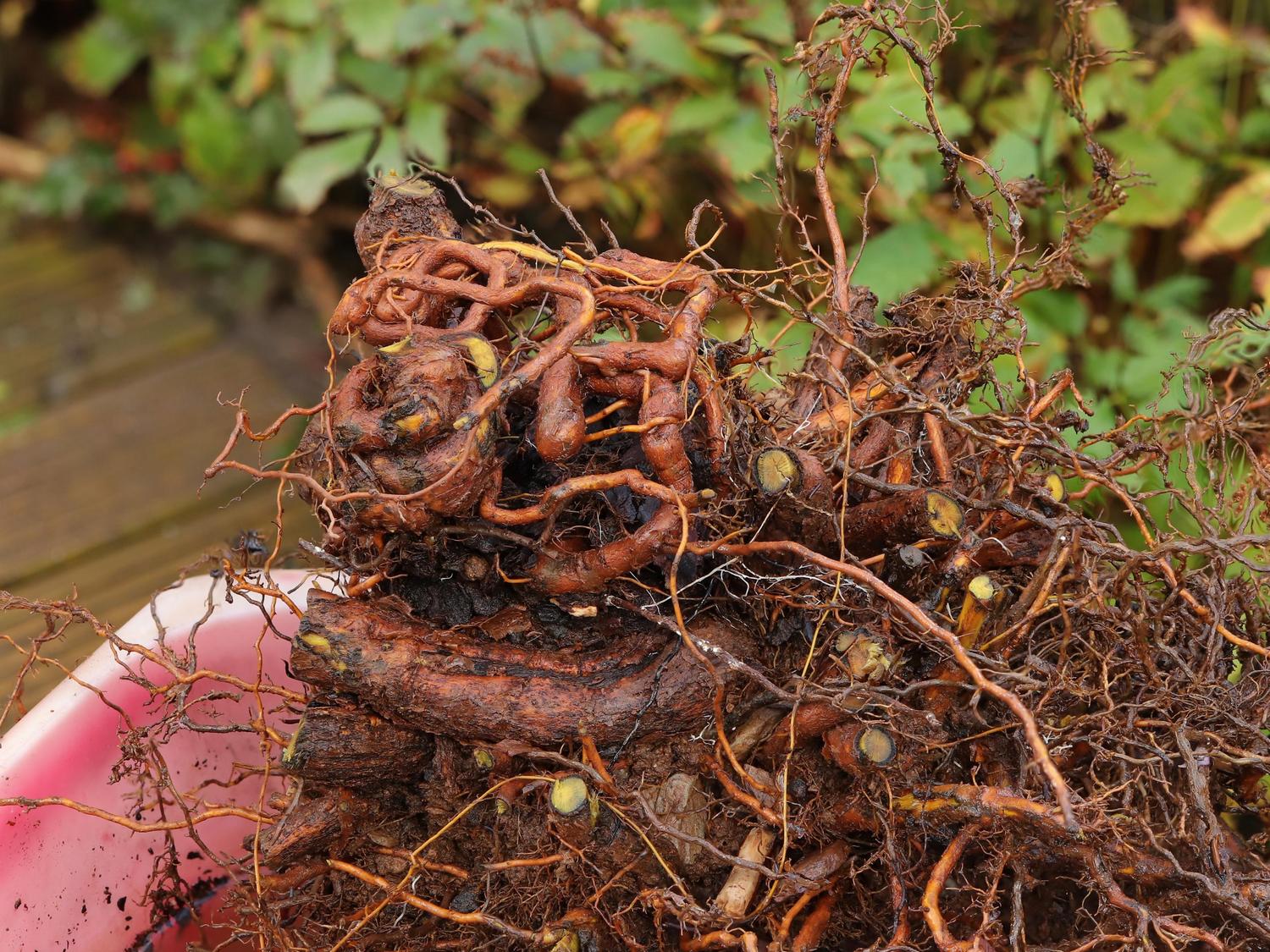
Sadly, I cannot say that I am surprised. Even more sadly, I probably deserve a good part of the blame, it having been a product of the nursery where I worked as production manager. We were growing a good proportion of the stock we sold, which usually meant that we were buying in liners, usually young plants growing in 9cm pots, from specialist producers and potting them up in 2 or 3L pots to grow on for a season before they went out for sale. Quite often the liners were pretty pot bound and on the scale we were working it was not realistic to consider doing anything about it before potting them up.
In the case of the Berberis, the roots in the liner pot had mostly wound around the pot with a couple coming through the holes in the bottom. When potted up most of the new root growth was from the level of the top of the liner pot, with one or two growing down from the base of the rootball. What didn’t happen was for laterals to develop from the mat of roots running round inside the pot. The root tips had been forced back to the surface or out of the bottom and it was there that further growth continued. Over the years since, the pot constrained roots have thickened greatly but they have not straightened out or produced lateral roots.
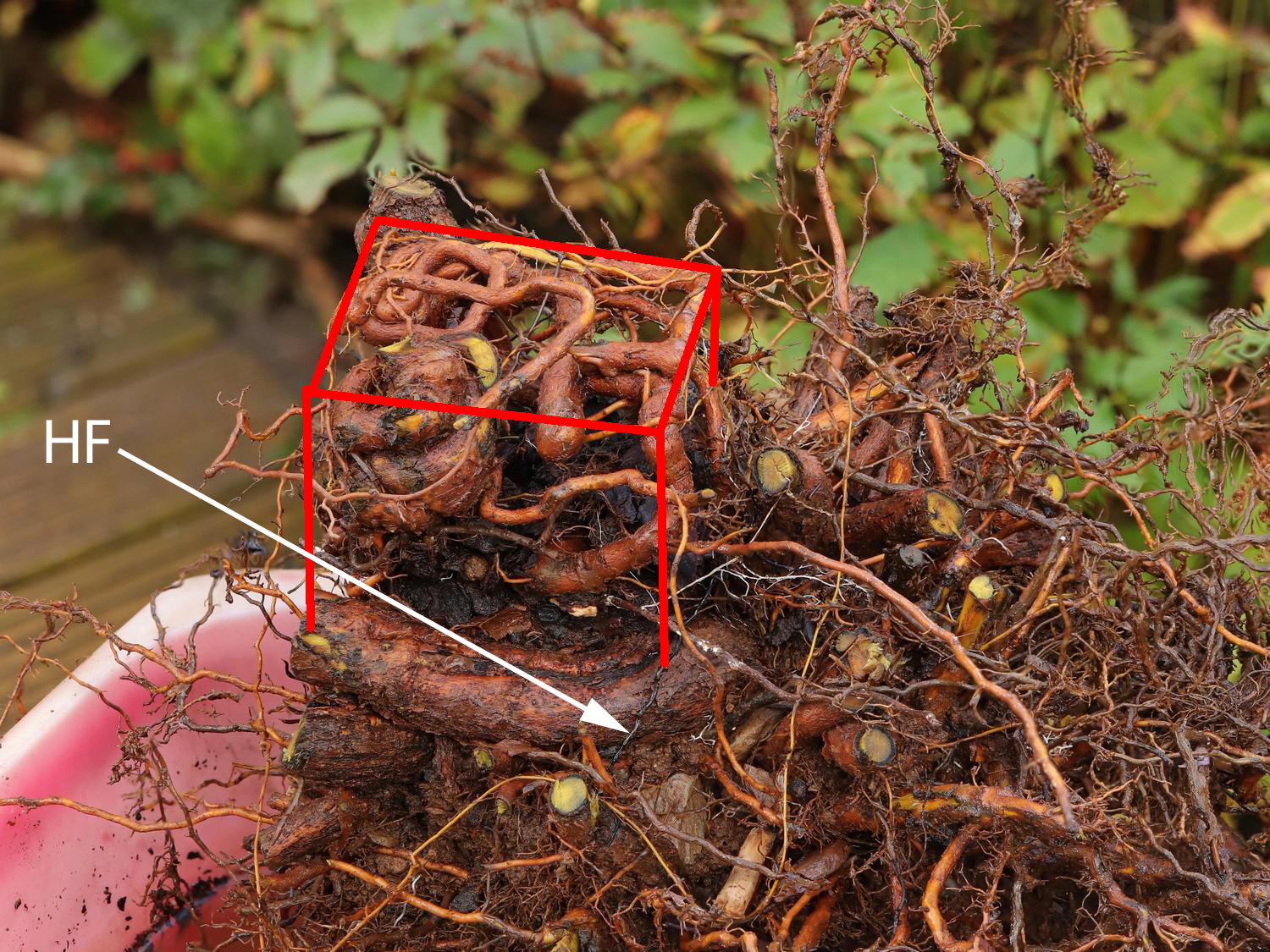
Digressing a little, when a woody plant grows from a seed, it will almost always emerge root first from the seed and the root will go straight down strongly and rapidly without producing anything much of lateral roots to begin with. The young plant is securing a good anchorage and getting its root down where the moisture supply is much more likely to be reliable. That first root will likely go down a metre or more in its first season. When it is down several cm. lateral roots will start to develop, radiating out from the main root and mainly only a cm. or two below the surface. When the plant is a few metres tall and starting to be pushed about by wind, it has a strong but flexible straight stem running directly down into a strong root, anchored near the soil surface by roots radiating out in all directions. From whichever direction the wind is blowing, the plant is restrained by roots pulling in the exactly opposing direction.
In a pot, the initial tap root quickly hits the bottom of the pot and the laterals hit the sides. I think when the plant gets into the ground, it knows it has to get roots going down for anchorage and water; most of the plants I’ve dug up have had some roots going straight down. The tap root when it hits the bottom of the pot will often go through a drainage hole and then get cut off when the plant is moved, it grows again from the cut, much as a pruned shoot does.
The lateral roots hit the side of the pot, conclude they’ve hit an obstruction they need to go around and take off sideways, or down, or up. They may go round and round or they may reach either the pot surface or come out the drainage holes where they will get air pruned or physically pruned. Planted out or potted on again, it is from those pruned tips that growth will resume. What is lacking is the pattern of radiating roots running straight out from the top of the root system just below soil level. When the wind blows, there is a high likelihood the plant will blow over.
With a tough subject like Berberis that isn’t going to get huge, it probably doesn’t matter if the root system is a mess. With trees and shrubs like Camellias which get to a good size with a tree-like habit, it is often disastrous. The slower growing shrubs like Camellias are especially at risk because they often haven’t grown enough in one season to get potted on immediately. After two seasons in the same pot the root problems can be quite acute. When you plant such subjects out from a pot, you have an opportunity to do something about it. The girdling roots will not be thick like they are in the pictures of the berberis, but there will very often be a layer of thin roots forming a surface layer to the rootball. If you plant it like that, the roots will continue to grow from wherever their tips are, behind which may be a root that has gone twice around the pot already. the root tip will head off into the surrounding soil, producing laterals as it goes. Behind it, instead of a straight connection to the bottom of the stem, there are root coils, providing the stem with plenty of slack when it tries to fall over in a gale.
Before you pot it on or plant it out, shave off that outer skin of roots. Don’t disturb the rootball itself, hopefully within it the roots are radiating out as they should. What you are aiming to do is to cut them off them off at the point where they reached the pot wall, with a nice clean cut just as you’d make if you were pruning above ground. I use an old carving knife that will still take a good edge, plus secateurs for anything getting a bit thicker. The roots will then respond exactly as shoots do above ground, by growing strongly from just behind the cut. I believe this works much better than trying to disentangle the roots and spread them out. You haven’t disturbed the rootball and you haven’t removed very much root, so the effect on the plant’s ability to take up water should be minor. Sometimes you have to be cruel to be kind.
The other problem, honey fungus, is not so easily dealt with, but strong healthy plants are almost certainly better able to resist it than weak plants with poor root systems.

 garden ruminations
Thanks Jim, I shall look out for pot bound roots when I buy plants.
LikeLike
I wouldn’t reject a plant solely because some of its roots were circling round inside the pot, that’s too simplistic. If they’re still thin and easily cut off, there shouldn’t be a problem. I have seen “advice” not to buy plants with the roots coming out the bottom of the pot, which is more a reflection of poor presentation of the plant in the sales area than an indication of a serious problem with the plant. There still may be a serious problem with the plant but you won’t see it without removing the pot.
LikeLiked by 1 person
I found similar situations in the houseplants I’ve bought. When I’ve re-potted them, it was clear why some were struggling, even though the outer roots looked normal at first. I even found plastic wrapping on an inner root ball! Shocking. With repotting and tending to the roots, they started thriving. It is interesting to hear of your experience with this as a nurseryman. Glad you wrote about it. -lisa
LikeLike
The emphasis in nursery production is on efficiency and getting a presentable plant in front of the customer as quickly and cheaply as possible. For some plants the true price is paid further down the line. When you leave these sorts of businesses behind you get to reflect on what you were doing in a more balanced way.
LikeLiked by 1 person
What an odd problem for Berberis. I would expect such a root bound specimen to simply replace the disfigured roots and continue on as if nothing happened. It looks as if it did so for a while.
LikeLike
I don’t think the constricted roots had much to do with its demise, though they may have left it more vulnerable to drought. Honey fungus was probably the main problem.
LikeLiked by 1 person
Thank you for this excellent post Jim. The tips about potting on too are invaluable.
LikeLiked by 1 person