Four hot days and a thunderstorm, the new normal for an English summer perhaps, except that in these fast changing times, the very idea of normal has largely gone out of the window. What lies ahead is varying degrees of abnormal. In any event, Sunday was a sizzler and Monday the thunder rumbled around for hours but provided us with not a drop of rain! Bodmin Moor and north Devon hogged the lot. Monday racked up a grand total of 10.5mm and Thursday added another 1.5mm, a massive 12mm for the week. Knowing the area from which I collect rainwater, that added fractionally over 1000 litres to my storage. I am grudgingly grateful, if only because there are always people in a worse state than we are.
By Friday, things were wilting again and I was back out with the watering can. From Tuesday next week we are under a hosepipe ban. I am looking at ways to increase my water storage; all seem to cost far more than I’d hope to save.
The brief respite did at least mean there were a few more things going on when I went round with my camera. Here are my six choices.
One.
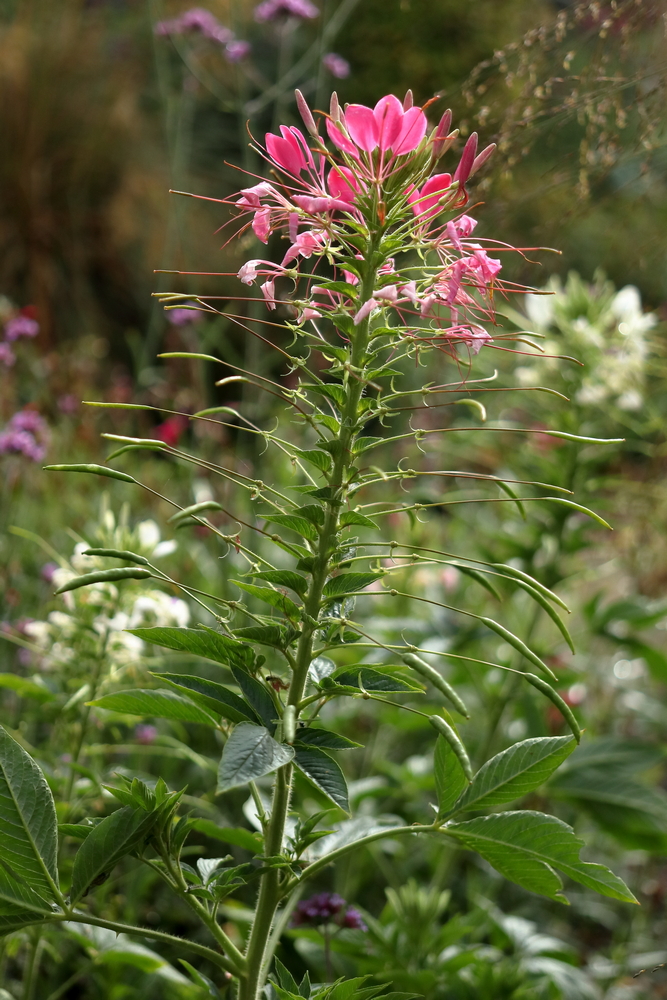
A couple of weeks ago I was showing off Abutilon seedlings grown from Fred’s seed, now it’s a pink Cleome. They didn’t wilt when the ground went dry but they stopped growing, except for one right beside the gravel path, under which its roots were presumably finding some moisture. In the heat the flowers were withering almost as they opened so it’s only now that I’m seeing them anywhere close to their potential. At least it looks like I will get seed so that I can have another go next year. I like Cleome as fillers, like Cosmos, they seem to fit in effortlessly. Thanks Fred!

Two.
Yucca gloriosa ‘Variegata’. Last weekend I noticed this was putting up a flower spike; then I saw it was two, no three. It’s now up to seven. At least I have one plant that looks future proof. They are going up at about three inches a day. Getting a picture without a clutter filled background is now my aim. Telephoto lens from way back when the car is not there but the wall is still in shade. Easy.


Three.
The wonderfully weird Muehlenbeckia astonii. Vanishingly rare in its native New Zealand, I feel a certain weight of responsibility to keep this plant going and to promote its qualities far and wide at every opportunity. Sadly, those qualities seem to have a limited appeal, if the level of enthusiasm shown it by our garden visitors this year is anything to go by. Greenish white flowers about 3mm wide, the petals of which swell and turn translucent, with a single black seed at the centre. Infertile sadly, in the absence of a mate. I’ve failed with cuttings too.


Four.
It’s not strictly the year we discovered Lophospermum, I know of at least one person who was growing it last year if not earlier. It is the first year we’ve grown it. Lophospermum ‘Wine Red’ I believe; I shoved the label down beside the plant when I potted it and now can’t find it. Aka Maurandya, Asarina and probably a few other things as well. Perennial but not very hardy, we will attempt to get it through the winter. I’m sure the label said 60cm, which is clearly nonsense.


Five.
Fuchsia ‘Marlies de Keijzer’ is a silver leaved encliandra section Fuchsia that has been around a good deal longer than the widely available and similar ‘Silver Lining’. It is a Dutch raised hybrid registered in 1999, whereas ‘Silver Lining’ was collected in the wilds of Costa Rica in 2004. Neither is reliably hardy and we lost ‘Silver Lining’ last winter, left in the ground, though possibly not to cold. ‘Marlies de Keijzer’ is rather more compact, with smaller flowers and silvery leaves. In a year when most of our Fuchsias, in pots or in the ground, have had a terrible time, it stands out as one of only four or five that are healthy and performing as they should.


Six.
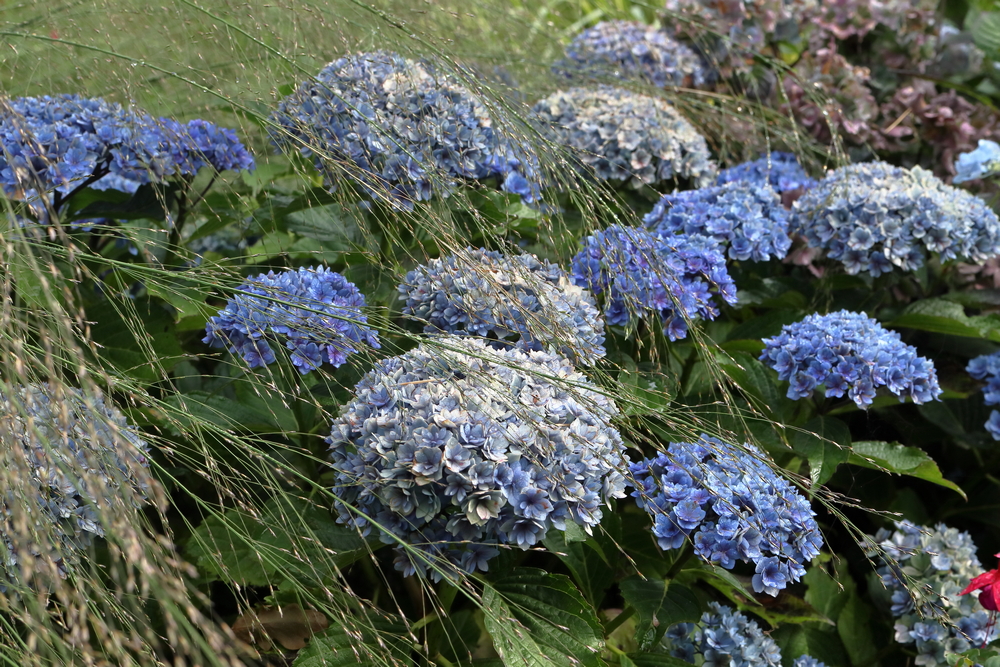
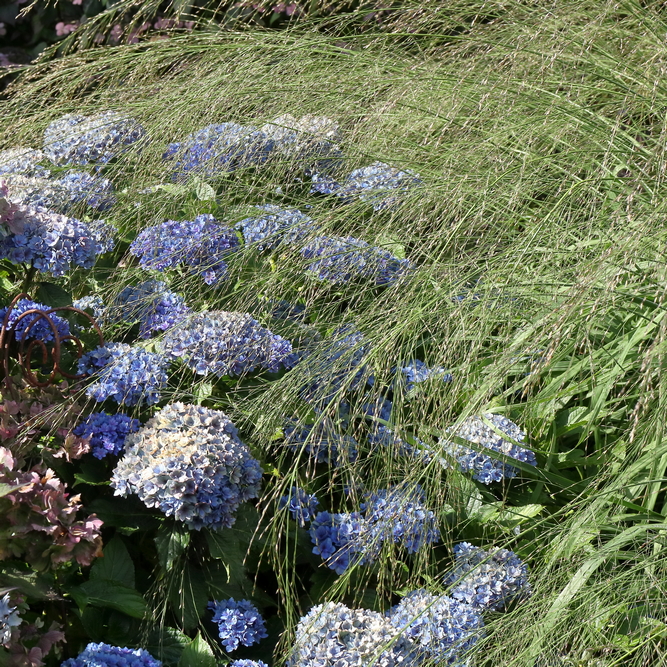
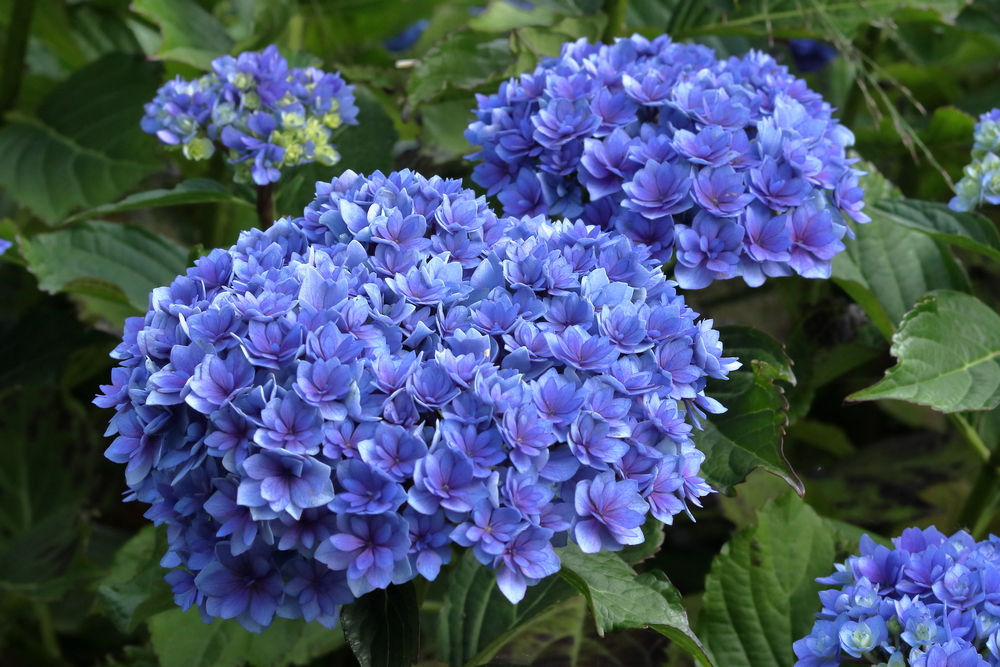
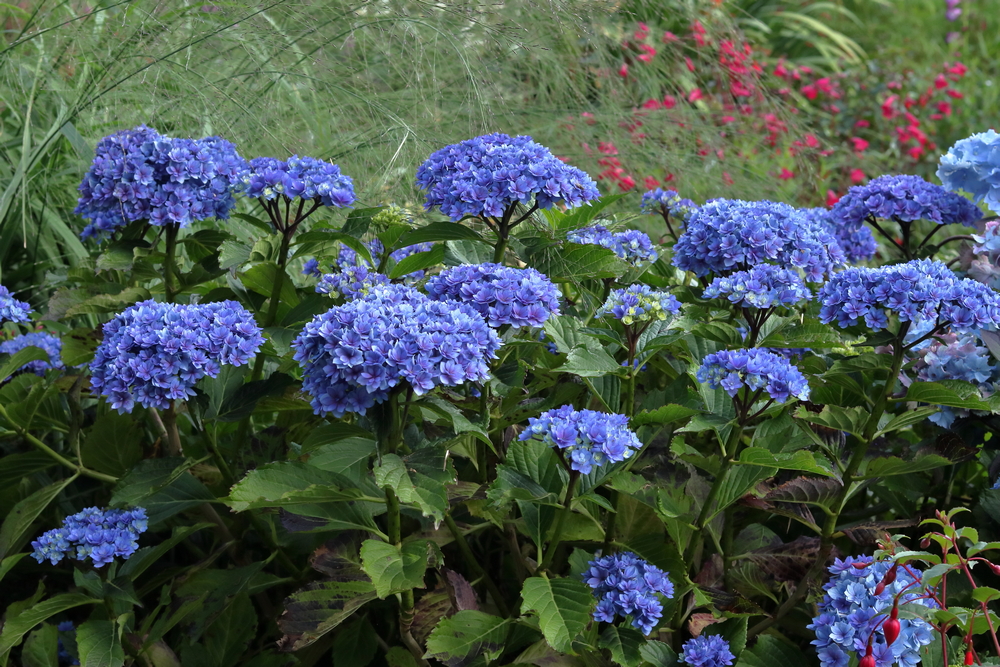
I nearly put Hydrangea ‘You and Me Together’ in a six at the end of July. It was looking great, but so were a couple of other hydrangeas, so it missed out. The sun has done it no favours and it is now rather faded, so I dug out a couple of the older pictures to add to the current ones. It is one of the You and Me series bred by Irie in Japan and released in 2004, a snippet of information gleaned from an article on the Hydrangea Derby website, they being a National Collection holder. https://hydrangeaderby.co.uk/a-brief-history-of-the-macrophylla-cultivars/
Molinia ‘Transparent’ is providing the waterfall effect.
If there was ever any doubt about August being the seasonal turning point where it all starts heading back down, last week’s hot weather dispelled the doubt. Gardening becomes an exercise in keeping the show limping along. I can identify with that at a personal level, although in that sense I’m in November at least.
I’ve a pile of rubbish to put through my shredder, dead heading, apple tree pruning and endless watering to do. Procrastination is the thief of time, and all that jazz. The Prop’s links are where they always are, here.

 garden ruminations
A lot of plants new to me, as usual. The effects you have created in the picture of the blue hydrangea and the grass are lovely.
LikeLike
The grass is arching over more than usual because it’s so dry, another case of design by accident.
LikeLiked by 1 person
Yucca floral spikes taste like asparagus. Yours are already too mature and too tough though. We ate a few of them while we were starving students, but only because Yucca whipplei grows wild there. We would not have done it if only a few were available, . . . unless of course, we got really hungry. They are not easy to collect, since they are down inside all that wickedly sharp foliage. Once they bloom, the flowers are also edible, but really are too pretty in the garden to eat.
LikeLike
I’m trying to imagine the earliest humans in America, working their way down from Alaska, having crossed from Siberia, perhaps only just post ice age, everything unfamiliar, coming across Yucca and thinking it might be edible. More similar to 20th century students than bears thinking about perhaps.
LikeLiked by 1 person
We always knew that it was edible. Otherwise, I would not have messed with it. I sort of wonder about artichoke though. I still am not convinced that it ‘is’ edible.
LikeLike
We talking globe artichoke or Jerusalem artichoke? I’d agree with you whichever it is. Arty choke, says it all.
LikeLiked by 1 person
Globe artichoke. It was the primary vegetable crop (that was not a cut flower crop) near Montara, where my Pa lived prior to the Earthquake. Castroville, which is supposedly the Artichoke Capital of the World, is less than forty miles from here. So, artichokes are common locally. Nonetheless, their allure escapes me.
LikeLike
How on earth did the Artichoke Capital of the World pass me by? As claims to fame go it perhaps misses the top ten?
LikeLiked by 1 person
Well, perhaps you should also be aware that Montara is the Fog Capital of the World.
LikeLiked by 1 person
Love the muehlenbeckia – probably wouldn’t like our winters here, though who knows what the future will bring!
LikeLiked by 1 person
Such a lovely little Fuchsia. I grew Asarina and Maurandya from seed last year and by the autumn they had all made little tubers. I dried them off and overwintered them in the loft with the Dahlias and, with the exception of one have all made good sized plants this year.
LikeLike
That is good information on Asarina/Maurandya. Probably means additions to next year’s seed purchasing though.
LikeLike
It has been a tricky year for Fuchsias to be sure. I like the effect the grass gives against ‘You and Me’
LikeLike
I was seeing waterfall into pool with the grass and hydrangea, so my imagination hasn’t completely gone.
LikeLike
I think that you are doing a grand job of keeping plants from around the world alive. I was putting out all my pots and buckets to collect water this week.
LikeLike
I have one roof section still uncollected but still have 89m², alongside which a few drip trays or buckets wouldn’t add much. I get very frustrated that so much good clean water goes down the drain in winter but large scale storage gets tricky.
LikeLike
It has been tough going with the weather.
LikeLike
So hard to know which way it’s heading other than more extreme and less predictable. A wide range of plants seems the best strategy for future proofing. Some will survive.
LikeLiked by 1 person
I was amused at the way you wrote about the weather. Love your sense of humour!
LikeLike
Don’t for a moment think that I don’t take climate breakdown seriously, but despair won’t help.
LikeLike
You are right. Despair doesn’t help.
LikeLiked by 1 person
I am loving that hydrangea and the molinia really adds to the joy. A fuchsia I’ve never heard of, which is not necessarily a surprise, what a little darling! And I’d forgotten about cleome and lophospermum, both great plants. I know what you mean about August, I’m itching to prepare for next year, extend borders and do the shuffle, but I will have to wait. *drums fingers*
LikeLike
It’s not healthy with over four months to go to have gotten really rather fed up with this year and be wishing the next would get here quicker. And I’m ten years older than you.
LikeLike
I was thinking more about the horti year which I always think starts in October. Slightly better? 😊
LikeLiked by 1 person
Welcome for cleomes seeds! I can see that you did well too .
Regarding Lophospermum, is it easy to grow? rather shade?
LikeLike
Seems very easy, mine’s in part shade.
LikeLiked by 1 person